
Over one third of american investors are now adding residential real estate to their portfolios for greater resilience and growth opportunities. As global markets shift, more individuals see residential property as a steady path toward wealth that can withstand economic ups and downs. This article breaks down what residential real estate means in an investment portfolio and reveals why understanding these properties can give novice investors a real advantage.
Table of Contents
- Defining Residential Real Estate In Portfolios
- Key Types And Their Investment Patterns
- How Residential Real Estate Generates Returns
- Diversification Benefits And Portfolio Resilience
- Risks, Costs, And Common Pitfalls
- Comparing Residential Real Estate To Other Assets
Key Takeaways
| Point | Details |
|---|---|
| Diverse Investment Opportunities | Residential real estate offers multiple entry points, including direct ownership, REITs, and crowdfunding, catering to various investor profiles. |
| Stable Income & Appreciation | This asset class provides steady rental income and potential long-term property value appreciation, making it a reliable investment option. |
| Risk Mitigation through Diversification | Diversifying across different property types and markets can minimize risks and enhance the resilience of investment portfolios. |
| Understanding Risks and Costs | Investors should be aware of potential risks, including market downturns and management challenges, and develop a risk management strategy before investing. |
Defining Residential Real Estate in Portfolios
Residential real estate represents a fundamental component of modern investment portfolios, offering unique opportunities for wealth generation and financial stability. As an asset class, residential properties encompass single-family homes, multi-unit dwellings, apartments, and condominiums that serve both investment and living purposes. Global real estate market research indicates residential real estate constitutes a substantial portion of the investable universe, demonstrating its critical role in diversified investment strategies.
Unlike more volatile investment vehicles, residential real estate provides multiple income streams and potential value appreciation. Investors can generate revenue through rental income, long-term property value appreciation, and strategic property improvements. Strategic market analysis highlights that residential properties have consistently delivered stable returns, particularly in markets with strong demographic growth and economic fundamentals.
The residential real estate investment landscape offers diverse entry points for investors. Options range from direct property ownership and rental management to real estate investment trusts (REITs), crowdfunding platforms, and syndicated investment opportunities. Each approach carries unique risk profiles and potential returns, allowing investors to select strategies aligned with their financial goals, risk tolerance, and available capital.
Pro tip: Always conduct thorough market research and consider local economic indicators before investing in residential real estate to minimize risks and maximize potential returns.
Key Types and Their Investment Patterns
Residential real estate investments encompass diverse property types, each presenting unique investment characteristics and potential returns. Professional market analysis reveals multiple residential investment categories that sophisticated investors strategically leverage for portfolio diversification and income generation.
The primary residential real estate investment types include single-family homes, multi-unit properties, condominiums, townhouses, and specialized segments like student housing and manufactured home communities. Demographic research indicates these categories respond differently to economic cycles, with each offering distinct risk-return profiles. Single-family homes typically provide stable long-term appreciation, while multi-unit properties generate consistent rental income and potentially higher cash flow.

Investment strategies vary significantly across these property types. Single-family rentals often appeal to individual investors seeking direct property ownership, whereas institutional investors might prefer larger multi-unit complexes or real estate investment trusts (REITs) that provide broader market exposure and enhanced liquidity. Emerging specialized segments like student housing and senior living communities present alternative investment pathways with potentially unique demographic-driven growth opportunities.
Pro tip: Diversify your residential real estate portfolio across different property types and geographic markets to minimize risk and maximize potential returns.
Here’s how major residential real estate types compare for investors:
| Property Type | Main Investment Benefit | Common Investor Profile | Typical Risk Level |
|---|---|---|---|
| Single-family homes | Long-term appreciation | Individual owners | Moderate |
| Multi-unit apartments | Steady rental income | Institutional investors | Higher |
| Condominiums | Lower entry cost | Individual/first-time buyers | Moderate |
| Student housing | Demographic-driven demand | Income-seeking institutions | Variable |
| Manufactured communities | Affordable housing demand | Diversification-focused funds | Moderate to High |
How Residential Real Estate Generates Returns
Residential real estate generates returns through multiple interconnected mechanisms that provide investors with consistent income and potential capital appreciation. Comprehensive market research reveals two primary return channels: rental income and property value appreciation, which work synergistically to create robust investment opportunities.
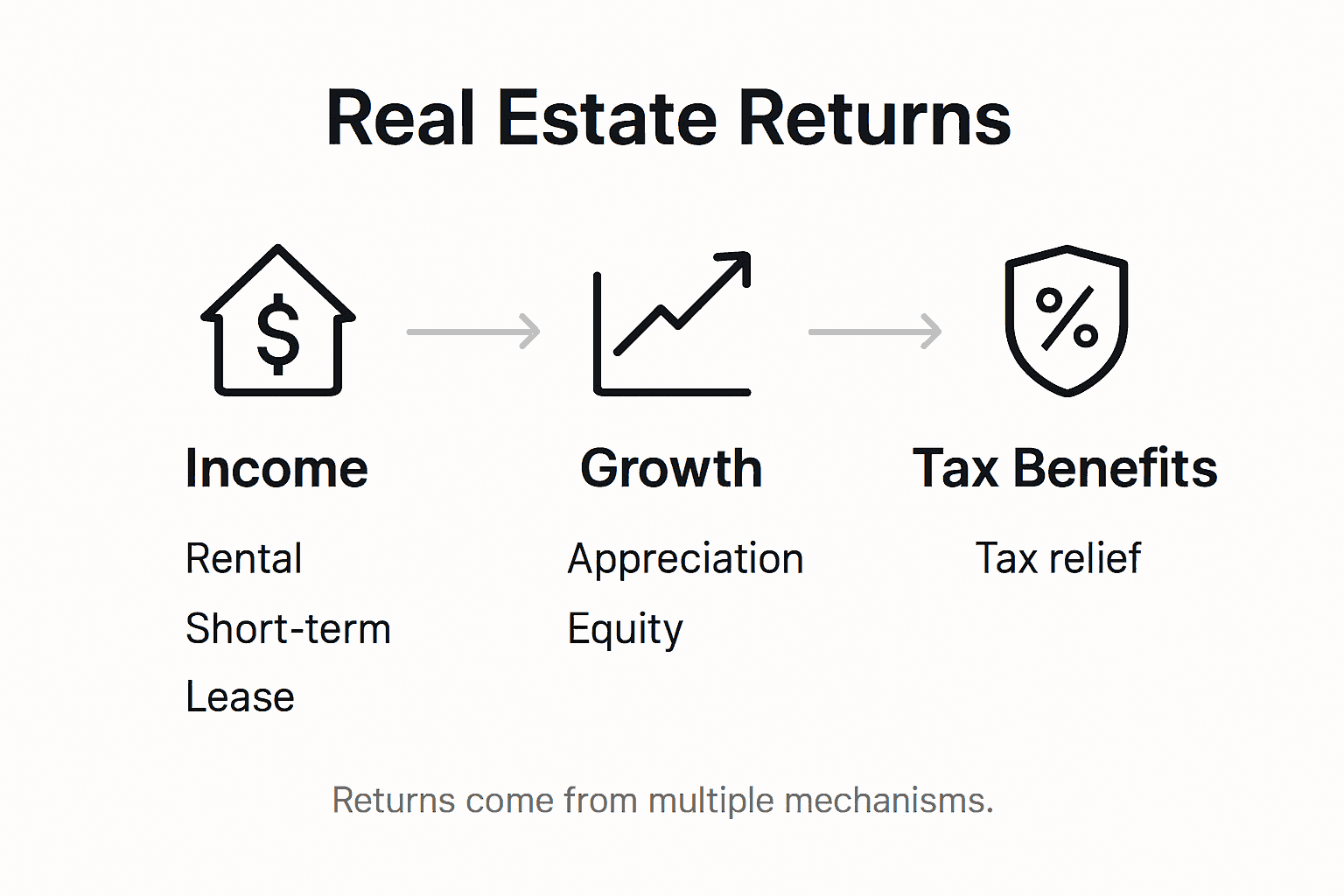
Rental income represents the most immediate and predictable return mechanism for residential real estate investments. Global investment perspectives demonstrate that long-term lease contracts provide steady cash flow, with multi-unit properties and single-family rentals offering varying income potential. Factors such as location, property condition, and local market dynamics significantly influence rental rates and occupancy levels, directly impacting an investor’s income stream.
Capital appreciation emerges as the second critical return mechanism, driven by broader economic trends, population growth, and strategic property improvements. Residential real estate typically appreciates over time as housing demand increases, urban areas expand, and infrastructure develops. Investors can enhance property values through targeted renovations, maintaining properties in desirable neighborhoods, and selecting markets with strong economic fundamentals. 2024 investment strategies suggest that understanding macroeconomic indicators can help investors anticipate and capitalize on potential appreciation opportunities.
Pro tip: Calculate potential returns by analyzing local market rental rates, property appreciation trends, and your total investment costs before committing to a residential real estate investment.
Diversification Benefits and Portfolio Resilience
Residential real estate serves as a powerful diversification tool, offering investors a unique mechanism to reduce portfolio volatility and enhance overall investment stability. Portfolio optimization research demonstrates that residential properties exhibit low correlation with traditional financial assets like stocks and bonds, creating a robust hedge against market fluctuations.
Academic research on investment strategies confirms that residential real estate can significantly improve portfolio performance by reducing overall risk and enhancing risk-adjusted returns. The low correlation with other asset classes means that when stock markets experience downturns, residential real estate investments often maintain or even increase in value, providing a stabilizing effect on investment portfolios. This characteristic becomes particularly valuable during economic uncertainties, such as the recent global pandemic, where residential real estate demonstrated remarkable resilience.
Diversification through residential real estate extends beyond simple risk mitigation. Investors can strategically allocate investments across different geographic markets, property types, and economic regions to further minimize risk. Multi-unit properties, single-family homes, and specialized residential segments like student housing or senior living communities offer varied risk-return profiles that can be combined to create a more robust and adaptive investment strategy. This approach allows investors to balance potential returns while protecting against localized economic challenges.
Pro tip: Create a diversified residential real estate portfolio by investing across different property types, geographic locations, and market segments to maximize resilience and potential returns.
Risks, Costs, and Common Pitfalls
Residential real estate investments, while attractive, come with a complex array of potential risks and challenges that require careful navigation. Comprehensive market analysis reveals multiple risk factors that can significantly impact investment performance, including market cyclicality, demand fluctuations, and financing complexities.
Investment portfolio research highlights critical financial risks that investors must understand. These include potential market downturns, unexpected maintenance expenses, regulatory changes, and the dangers of over-leveraging. Financing costs can dramatically affect returns, with interest rate shifts potentially eroding profit margins. Property management challenges such as tenant turnover, unexpected repairs, and vacancy periods represent additional financial risks that can quickly diminish investment returns.
Economic and operational pitfalls extend beyond direct financial metrics. Investors must navigate local zoning regulations, property tax implications, insurance requirements, and potential legal complications. Geographic diversification can mitigate some risks, but each market presents unique challenges such as different rental regulations, local economic conditions, and infrastructure development stages. Inexperienced investors often underestimate the complexity of property management, overlooking hidden costs like property taxes, insurance, routine maintenance, and potential extended vacancy periods.
Pro tip: Develop a comprehensive risk management strategy by maintaining a financial buffer of 3-6 months of expenses and conducting thorough due diligence on local market conditions before making any residential real estate investment.
Comparing Residential Real Estate to Other Assets
Residential real estate emerges as a uniquely compelling investment asset, distinguishing itself through characteristics that set it apart from traditional financial instruments. Global investment research reveals its remarkable ability to generate consistent income, provide capital appreciation, and serve as an effective inflation hedge, characteristics rarely found in a single investment vehicle.
Portfolio optimization studies demonstrate that residential real estate exhibits significantly lower correlation with stocks and bonds compared to other investment options. While stock markets can experience dramatic volatility and bond returns can be suppressed by interest rate changes, residential properties tend to maintain stability. This unique profile allows residential real estate to provide steady cash flow and potential appreciation, making it an essential diversification tool for sophisticated investors seeking risk-adjusted returns.
Unlike stocks, which can be subject to immediate market sentiment, or bonds, which are sensitive to interest rate fluctuations, residential real estate offers tangible value and multiple revenue streams. Investors can generate income through rental payments, benefit from property value appreciation, and leverage tax advantages not typically available with other asset classes. The physical nature of real estate also provides a sense of security, as investors own a concrete asset with intrinsic value, unlike more abstract financial instruments.
The following table highlights key differences between residential real estate and traditional assets:
| Feature | Residential Real Estate | Stocks | Bonds |
|---|---|---|---|
| Income Source | Rental payments | Dividends | Coupon interest |
| Typical Volatility | Low to moderate | High | Low |
| Inflation Hedge | Effective | Mixed results | May lag inflation |
| Liquidity | Low to moderate | High | High |
| Tangible Asset | Yes | No | No |
Pro tip: Compare the risk-adjusted returns of residential real estate with your current portfolio assets, focusing on correlation, income potential, and long-term appreciation to make informed investment decisions.
Unlock the Full Potential of Residential Real Estate Investment Today
Navigating the complexities of residential real estate requires more than just understanding rental income or property appreciation. You need reliable access to vetted investment opportunities, trusted agents, and expert guidance to manage risks and maximize returns. Bold Street AI is designed to break down these barriers by empowering investors with AI-driven deal analysis and strategic connections tailored for today’s dynamic market.

Take control of your portfolio growth with Bold Street AI. Whether you are a beginner eager to learn through the Bold Academy or an experienced investor seeking curated listings and community support, you can confidently diversify across property types and markets. Explore how our platform blends technology with practical expertise to keep you informed and connected. Visit Bold Street AI and start building your resilient residential real estate portfolio now.
Frequently Asked Questions
What are the main benefits of investing in residential real estate?
Investing in residential real estate offers multiple benefits, including steady rental income, long-term property value appreciation, and the potential for tax advantages not typically available with other asset classes.
How does residential real estate compare to stocks and bonds?
Residential real estate typically exhibits lower volatility and is an effective inflation hedge compared to stocks and bonds. While stocks can be highly volatile, real estate often provides steady cash flow and tangible value.
What types of residential properties should I consider for investment?
Key types of residential properties to consider include single-family homes, multi-unit apartments, condominiums, and specialized segments like student housing and manufactured home communities, each offering distinct risk-return profiles.
What risks should I be aware of when investing in residential real estate?
Investors should be mindful of risks such as market cyclicality, unexpected maintenance costs, regulatory changes, and financing complexities that can impact overall investment performance.