
Staring at your first property listing can feel exciting and uncertain all at once. For new residential investors in the United States, understanding the fundamentals of property investment unlocks real opportunities. With real estate recognized as the world’s largest asset class and a primary source of individual wealth, learning how equity, financing options, and market choices work together is key. This overview guides you through foundational concepts, proven strategies, and essential resources designed specifically for first-time investors ready to build confidence and clarity.
Table of Contents
- Residential Property Investment Fundamentals
- Key Types of Residential Investment Properties
- How Residential Properties Generate Returns
- Legal Principles And Ownership Rights
- Risks, Costs, And Financial Considerations
- Common Pitfalls And Mistakes To Avoid
Key Takeaways
| Point | Details |
|---|---|
| Understand Property Types | Familiarize yourself with different residential property types to align your investment strategy with your financial goals and time capabilities. |
| Manage Financing Wisely | Utilize leverage effectively by understanding your mortgage options and maintaining adequate cash reserves to handle unexpected costs. |
| Evaluate Risks | Be aware of potential risks such as market fluctuations, property expenses, and tenant management challenges to make informed investment decisions. |
| Conduct Thorough Due Diligence | Perform comprehensive market research and legal assessments before purchasing to avoid costly mistakes and ensure compliance with local regulations. |
Residential property investment fundamentals
Residential property investment starts with understanding the basics. At its core, this form of investing involves purchasing properties where people live—single-family homes, small multi-family buildings with 2-4 units, and land—with the goal of generating income or building long-term wealth. Unlike passive stock investments, real estate requires active decision-making about property selection, financing, tenant management, and maintenance. The foundation of successful investing rests on three pillars: knowing what types of properties exist, understanding how to finance them, and recognizing the risks involved. Real estate is the world’s largest asset class, frequently serving as the primary source of wealth for individuals. This scale explains why residential property has become such an accessible entry point for wealth building—it’s tangible, understandable, and within reach for many first-time investors willing to learn the fundamentals.
The mechanics of residential property investment combine both equity and debt financing. Most investors don’t pay cash for properties. Instead, they secure a mortgage using a down payment (their equity) combined with borrowed funds (debt). This approach, called leverage, allows you to control a large asset with a relatively small initial investment. For example, with a 20 percent down payment on a $300,000 home, you only need $60,000 of your own capital while the bank provides the remaining $240,000. As the property appreciates or generates rental income, you build equity—the difference between what the property is worth and what you owe. Understanding how to analyze investment properties gives you the tools to evaluate whether a deal makes sense financially. Key metrics you’ll examine include cash flow (monthly rental income minus expenses), cap rate (return on your investment), and appreciation potential (expected property value growth). Market dynamics also matter significantly. Economic trends, interest rates, local job growth, and population movement all influence property values and rental demand in your target market.
What separates successful residential investors from those who struggle is recognizing both opportunities and pitfalls. Residential private investment encompasses expenditures on new construction, remodeling, and broker commissions, reflecting the economic footprint of this asset class. Your own investment strategy determines whether you focus on cash flow from rent, property appreciation, or both. First-time investors often overlook hidden costs—property taxes can vary dramatically by location, insurance protects against liability and damage, maintenance reserves cover unexpected repairs, and vacancy periods mean months without rental income. The type of residential property you choose matters too. A single-family home offers simplicity and lower management complexity, while a duplex or triplex generates multiple rent streams from one property. Understanding these differences helps you align your investment with your financial goals, time availability, and risk tolerance.
Pro tip: Start by analyzing 10-15 properties in your target market using publicly available data before making your first purchase—this builds your intuition about what constitutes a good deal and prevents costly rookie mistakes.
Key types of residential investment properties
When you start looking at residential investment properties, you’ll quickly discover that not all real estate is created equal. Each property type has distinct characteristics, income potential, and management requirements. Understanding these differences helps you choose the right investment for your goals, available capital, and time commitment. Residential buildings encompass various types including single-family homes, multi-family units such as apartments and condos, alternative living arrangements like tiny homes and modular units, and specialized housing such as student or senior living. Each type has unique design, zoning, and market characteristics influencing its investment potential and operational considerations. Let’s break down the most common options for first-time investors.
Single-Family Homes
Single-family homes are the entry point for most residential investors. You purchase one house, rent it to one tenant, and collect one monthly payment. The appeal is straightforward: minimal management complexity, easier tenant relationships, and straightforward financing since most lenders treat these properties like primary residences. On the downside, a single-family home generates only one income stream, meaning vacancy periods completely halt cash flow. If your tenant moves out, you earn nothing until you find a replacement. These properties also require you to handle all maintenance yourself or hire contractors, which can be unpredictable and expensive. However, single-family homes tend to appreciate steadily over time and exist in nearly every market, making them flexible investments for building initial wealth.

Small Multi-Family Properties (2-4 Units)
Small multi-family properties, also called duplexes, triplexes, or fourplexes depending on unit count, offer better cash flow diversity than single-family homes. If one unit sits vacant, you still collect rent from the others. A duplex producing $2,000 per month in total rent loses only 50 percent of income if one unit empties, compared to 100 percent loss with a single-family home. Management requires more attention since you’re handling multiple leases and potentially different tenant issues. However, the additional income often justifies the extra work. These properties are easier to finance than large apartment complexes but harder than single-family homes. Lenders view 2-4 unit properties as investment properties rather than residential homes, meaning you’ll need a larger down payment (typically 20 to 25 percent) and face slightly higher interest rates.
Land and Development Opportunities
Raw land appeals to investors with different goals. You might purchase vacant residential land with plans to build, flip for development, or hold for long-term appreciation. Land requires no tenant management, maintenance, or repair costs. However, land produces zero income during holding periods, so you need sufficient cash reserves to cover property taxes and carrying costs. Appreciation potential exists, especially in growing markets, but realizing that appreciation requires finding a buyer willing to develop or purchase at your target price. This property type suits investors with longer time horizons and capital to wait for market conditions to align.
Considering Your Investment Strategy
Investors also participate in residential real estate through alternative mechanisms. Real Estate Investment Trusts specialize in residential properties including apartment communities and single-family rentals, offering diversification, liquidity, and a way to invest without direct property ownership. REITs operate large-scale income-producing assets professionally managed by teams with expertise in property operations. This approach removes the hands-on work but also limits your control and typically provides lower returns than direct ownership.
Your choice between property types depends on three factors: cash flow needs (do you want monthly income?), appreciation goals (are you building long-term wealth?), and management capacity (how much time can you dedicate?). Single-family homes work well for passive appreciation seekers willing to tolerate vacancy risk. Small multi-family properties suit investors wanting better cash flow without excessive management. Land appeals to patient investors with capital reserves and long-term horizons.
Pro tip: Start by analyzing properties in only one category within your first year—mastering single-family homes before scaling to multi-family properties prevents overwhelm and builds confidence in your decision-making process.
Here’s how the main residential investment property types differ:
| Property Type | Typical Return Source | Management Complexity | Entry Capital Requirement |
|---|---|---|---|
| Single-Family Home | Balanced (rent + growth) | Low | Moderate |
| Small Multi-Family (2-4) | Primarily rent/cash flow | Moderate | Higher |
| Land/Development | Appreciation potential | Very low | Variable (often higher) |
| REITs | Dividend income | None for investors | Low (shares available) |
How residential properties generate returns
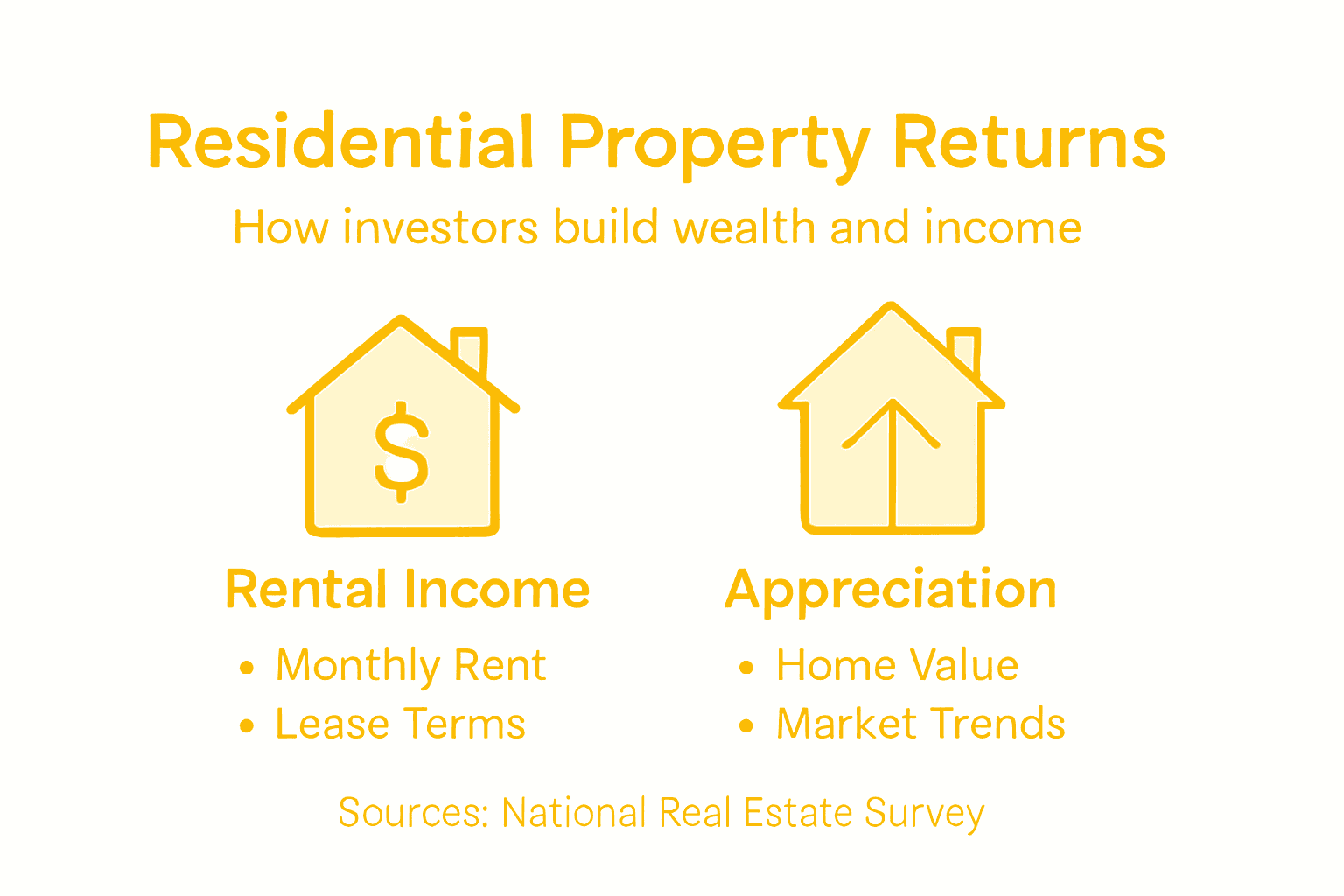
Residential property returns come from two primary sources: rental income and property appreciation. Understanding how each works helps you evaluate whether an investment makes sense and what to expect over time. Most successful investors use a combination of both strategies, though the emphasis varies based on market conditions, property type, and personal financial goals. Residential property investments generate returns primarily through rental income and property appreciation. Rental income includes payments received for the use or occupation of property, advance rent, and any other payments related to leasing arrangements. Getting these two income streams right determines whether your investment produces steady cash flow or serves as a long-term wealth builder.
Rental Income as Monthly Cash Flow
Rental income is the money tenants pay you each month to live in your property. This creates immediate, predictable returns if you manage the property well. A single-family home renting for $1,500 monthly generates $18,000 in gross annual rental income. However, gross income is not your profit. From rental income, you must subtract operating expenses: property taxes (often $100 to $400 monthly depending on location), homeowners insurance ($80 to $150 monthly), maintenance reserves (typically 1 to 2 percent of rental income annually), property management fees if you hire a manager (8 to 12 percent of rental income), and vacancy reserves for months when the unit sits empty. After these expenses, your net operating income is what actually stays in your pocket. For example, that $1,500 property might net only $600 to $900 monthly after all expenses, depending on your location and property condition. The key advantage of rental income is consistency. You receive money regularly, which can pay down your mortgage, cover expenses, or reinvest into additional properties. Many first-time investors underestimate how much expenses eat into rental income, so realistic projections matter significantly.
Capital Appreciation and Long-Term Wealth Building
Property appreciation occurs when your property’s value increases over time. House prices significantly influence residential property returns as they impact wealth accumulation and financial outcomes. If you purchase a home for $300,000 and it appreciates 3 percent annually, your property grows in value by $9,000 each year. Over 10 years, a 3 percent annual appreciation adds $90,000 to your property’s value. Over 20 years, it approaches $200,000 in gains (assuming compound growth). What makes this especially powerful is leverage. You controlled a $300,000 asset with only $60,000 of your own capital (20 percent down payment). The remaining $240,000 came from borrowed money, yet you capture 100 percent of the appreciation gains. This amplification effect distinguishes real estate from many other investments.
Appreciation depends on several factors: location, local economic growth, population trends, and supply-demand dynamics. Properties in growing markets where jobs are being created and population is increasing tend to appreciate faster. Conversely, properties in declining areas may appreciate slowly or even depreciate. This is why location selection matters so critically. You cannot predict exact appreciation rates, but historical trends in your target market provide guidance. Some investors focus primarily on appreciation and accept minimal cash flow from rental income, betting that future price increases will justify the wait. Others prioritize cash flow and view appreciation as bonus wealth building.
Combining Both Strategies
The most effective approach usually combines both income sources. You collect steady rental income to cover expenses, build equity through mortgage paydown, and potentially achieve positive cash flow. Simultaneously, you benefit from appreciation as the property value rises. After holding the property for several years, you can refinance at better terms if interest rates drop, pulling out equity while keeping the property. Or you can sell the appreciated property, pocket the gains, and reinvest elsewhere. Examples of different investment strategies show how experienced investors balance these approaches based on market cycles and personal circumstances.
Timing matters too. During strong appreciation periods, investors sometimes accept lower cash flow because appreciation gains compensate. During slow appreciation periods, strong rental income becomes more attractive. Market conditions shift, so flexibility in your strategy helps you adapt.
Pro tip: Calculate both your monthly cash flow and projected 10-year appreciation separately before purchasing any property—this prevents overestimating returns from one source and helps you identify which returns will actually matter to your specific financial goals.
Legal principles and ownership rights
When you purchase residential property, you are not just buying a physical structure. You are acquiring a collection of legal rights that define what you can do with that property. Understanding these rights protects your investment and prevents costly mistakes. In U.S. property law, ownership rights include possession, use, transfer, and exclusion. Legal principles define property rights as a “bundle of sticks,” where each stick represents a distinct right such as the right to possess, use, exclude others, and transfer ownership. These rights are governed by federal constitutional protections and state-level property laws. For first-time investors, grasping these fundamentals means understanding exactly what you own and what limitations apply to that ownership.
The Bundle of Property Rights
Property ownership breaks down into specific, separable rights. The right to possess means you have the power to occupy and control the property. You decide who enters, who stays, and who leaves. The right to use allows you to decide how the property functions. You might live in it, rent it to tenants, or keep it vacant. The right to transfer lets you sell, gift, or lease the property to others. The right to exclude means you can prevent anyone else from accessing or using your property without permission. These rights form the foundation of ownership, but they are not unlimited. Government regulations, deed restrictions, and neighbor rights create boundaries around what you can actually do.
Real property ownership encompasses rights to possess, use, enjoy, and dispose of the property. These include surface rights (the land itself and what sits on top), subsurface rights (mineral rights and what lies underground), water rights (if applicable), and air rights (the space above your property). Most residential investors focus primarily on surface rights and use rights since single-family homes and small multi-family properties are primarily valued for habitation and rental income.
Regulatory Limitations on Your Rights
Ownership is subject to significant regulatory limitations. Zoning laws restrict what uses are permitted. A property zoned for residential use cannot legally operate as a commercial business. Violating zoning could result in fines, forced closure, or having to remove non-conforming uses. Building codes establish construction standards that must be met during any renovations or modifications. These codes exist for safety and structural integrity. Local ordinances cover everything from setback requirements (how far buildings must sit from property lines) to parking requirements to rental licensing. Some jurisdictions require landlords to obtain rental licenses, register properties, and meet specific habitability standards.
Tax obligations accompany ownership. You must pay annual property taxes based on assessed value. Missing payments can result in tax liens or even foreclosure. Understanding your local tax rates and assessment practices prevents financial surprises. Additionally, some jurisdictions impose rental registration requirements, meaning you cannot legally rent a property without proper licensing and compliance.
Deed Restrictions and Homeowners Associations
Beyond government regulations, deed restrictions may limit your rights. These are covenants recorded in the property deed that bind current and future owners. A deed might prohibit certain business activities, require approval before renting out the property, or mandate architectural standards for modifications. Some residential properties fall under homeowners association governance. HOAs collect fees and enforce community standards. While HOAs can increase property values through maintenance standards, they also restrict your freedom and require compliance with their rules.
Understanding deed restrictions and HOA rules before purchasing is critical. A restrictive deed or oppressive HOA can significantly impact your investment strategy. For example, if your plan is to rent the property but the deed prohibits rentals, that investment strategy becomes impossible. Reviewing the deed and HOA documents should be part of your due diligence before making an offer.
State and Local Variations
Property law varies significantly by state and locality. Some states impose strong tenant protections that limit eviction rights and require expensive notice periods. Others favor landlords with faster eviction processes. Some states cap the amount of security deposits you can collect. Others allow unlimited deposits. Understanding your specific state and local laws prevents legal violations and protects your investment. This is where working with local real estate attorneys, agents familiar with investor needs, and experienced property managers becomes valuable. Bold Street AI connects you with investor-friendly professionals who understand these nuances in your market.
Pro tip: Before making any property purchase offer, hire a local real estate attorney to review the deed, HOA documents, and local ordinances for your specific property—spending $300 to $500 on legal review prevents thousands in future compliance costs and investment conflicts.
Risks, costs, and financial considerations
Residential property investment carries real financial risks and costs that can erode or eliminate your returns if not managed carefully. Understanding these challenges upfront helps you avoid common pitfalls and build realistic financial projections. Investing in residential property involves risk and significant costs, including exposure to market fluctuations, rising property prices, and increasing mortgage rates. High housing costs strain homeowners and renters, leading to affordability challenges that can affect both property values and rental demand. Investment returns are sensitive to economic conditions, interest rates, and local market supply and demand dynamics. Your first investment needs to account for these variables, not assume they stay constant.
Direct and Hidden Property Costs
Most investors underestimate the true cost of property ownership. Beyond the mortgage payment, several substantial expenses reduce your cash flow. Property taxes vary dramatically by location, ranging from less than 1 percent of property value annually in some states to over 2 percent in others. A $300,000 property might cost $2,000 yearly in one state and $6,000 in another. Homeowners insurance protects against fire, theft, and liability. Standard policies range from $800 to $1,500 annually for residential properties, but rates in hurricane-prone or flood-prone areas climb significantly higher. Maintenance and repairs represent ongoing costs. The general rule is to reserve 1 to 2 percent of property value annually for unexpected repairs. For a $300,000 property, that means $3,000 to $6,000 yearly set aside for roof repairs, plumbing failures, HVAC replacements, or structural issues that inevitably arise.
Rising insurance costs due to extreme weather and increased claim losses represent a substantial financial risk. Increased premiums affect affordability and investor returns. Many homeowners face higher insurance expenses, which can undermine the profitability of rental properties and put returns out of reach, especially in disaster-prone regions. If you invest in areas with significant weather risks, insurance costs can consume 15 to 25 percent of your rental income in worst-case scenarios. Vacancy losses occur when rental units sit empty between tenants. Even with good management, expect 5 to 10 percent annual vacancy rates in average markets. If your property rents for $2,000 monthly, a 7 percent vacancy rate costs you $1,680 per year. Property management fees, if you hire a manager, typically run 8 to 12 percent of collected rent. These costs add up quickly and must be factored into your pro forma financial projections.
Market and Economic Risks
Property values fluctuate with market conditions. During recessions or periods of rising unemployment, property values decline. A property purchased for $300,000 might be worth $260,000 two years later if the local economy weakens. While long-term trends favor appreciation, short-term downturns can trap you underwater (owing more than the property is worth). Interest rate risk affects both your financing and property values. If you have an adjustable-rate mortgage, rising interest rates increase your monthly payment, reducing cash flow. Rising rates also reduce buyer demand, slowing appreciation or causing depreciation. Tenant risk is real for rental properties. Bad tenants damage properties, fail to pay rent, or require expensive evictions. Even with thorough screening, problem tenants occasionally slip through. Geographic concentration risk means your entire investment depends on one local market. Economic downturns in your area affect property values, rents, and your ability to sell or refinance.
Financing and Leverage Risks
While leverage amplifies gains during good times, it amplifies losses during downturns. If you purchase a $300,000 property with $60,000 down and $240,000 borrowed, a 20 percent property value decline reduces your equity from $60,000 to $0. You still owe the $240,000 mortgage but your property is now worth $240,000. Worse, a 25 percent decline puts you $15,000 underwater. Refinancing risk occurs if property values drop and interest rates rise. You may be unable to refinance to better terms, locking you into expensive financing. Mortgage rate risk hits hardest with adjustable-rate mortgages. An initial 3 percent rate might jump to 5 or 6 percent at adjustment, dramatically increasing monthly payments. Fixed-rate mortgages eliminate this risk but cost more upfront.
Capital Requirements and Cash Reserves
Most first-time investors underestimate the capital needed. Beyond your down payment, you need cash reserves for:
- Closing costs (2 to 5 percent of purchase price)
- Immediate repairs and updates before renting
- Working capital for the first 3 to 6 months of operations
- Emergency reserves for major repairs
- Property taxes and insurance upfront
A $300,000 purchase might require $70,000 to $100,000 in total capital when accounting for all expenses. Without adequate reserves, a single major repair or extended vacancy can force you to sell at a loss or default on your mortgage.
Pro tip: Create conservative financial projections assuming 10 percent annual vacancy, 15 percent annual maintenance costs, and interest rate increases, then only pursue deals that still generate positive cash flow under these stressed scenarios—this buffer protects you when real-world conditions deviate from your assumptions.
The table below summarizes challenging property investment risks and the best mitigation strategy for each:
| Risk Category | Potential Impact | Key Mitigation Strategy |
|---|---|---|
| Market downturn | Value declines, lost equity | Buy below market, diversify |
| Vacancy loss | Lost rental income | Maintain reserves, tenant screening |
| High expenses | Reduced cash flow | Conservative budgeting, shop insurance |
| Legal/regulatory | Fines, forced sales | Legal review, comply with codes |
Common pitfalls and mistakes to avoid
Every experienced real estate investor has made mistakes. The goal is learning from others’ errors instead of repeating them yourself. Common pitfalls in residential property investment include insufficient market research, lack of diversification, overleveraging, and misunderstanding local real estate laws. New investors often fail to account for all costs, including maintenance and unexpected expenses, or ignore the importance of tenant quality and property management, which can impact returns and increase risks. These aren’t theoretical problems. They happen regularly to investors who skip critical due diligence or let emotions override financial analysis. Recognizing these patterns helps you avoid the costly mistakes that derail investment plans.
Overleveraging and Unrealistic Financial Projections
The most dangerous mistake is borrowing too much. Just because a lender approves you for a $500,000 mortgage doesn’t mean you should take it. Lenders care about their risk, not your financial health. They approve borrowing based on property value and your income, not on whether the property actually generates positive cash flow. Many investors stretch to buy bigger properties, assuming appreciation will bail them out if cash flow disappoints. This leads to overleveraging, where one vacancy or unexpected repair creates a cash crisis. Beyond overleveraging, investors routinely create unrealistic financial projections. They assume 100 percent occupancy (no vacancies ever), underestimate maintenance costs, ignore property management fees, or project 5 to 7 percent annual appreciation without local data supporting that assumption. These projections justify deals that look terrible in reality. Run conservative numbers instead. Assume 10 percent vacancy, budget 15 to 20 percent for all operating expenses, and project appreciation at local historical averages, not wishful thinking.
Inadequate Due Diligence and Market Analysis
Skipping market research costs money. Before purchasing any property, you need to understand your local market. What are comparable properties selling for? What do similar properties rent for? How fast are properties appreciating in this area? What’s the job market like and is employment growing or shrinking? Are there major employers and what happens if one leaves? What’s the crime rate, school quality, and neighborhood trajectory? Investors who skip this homework sometimes discover they purchased in a declining market where appreciation is negative and rents are falling. Investors should avoid behavioral and strategic mistakes such as unrealistic return expectations, lack of clear investment goals, poor diversification, and reactionary trading based on short-term market fluctuations. Effective investment requires disciplined planning, thorough due diligence, and an understanding of one’s risk tolerance and market fundamentals. Without this foundation, you’re essentially gambling.
Also critical is understanding local real estate laws and regulations. Property management requirements, tenant protections, security deposit rules, and eviction timelines vary dramatically by state and even city. Some jurisdictions make it nearly impossible to evict non-paying tenants, meaning vacancy costs explode. Others cap rental increases or require expensive licenses. Violating local regulations brings fines and legal liability. Too many out-of-state investors assume their home state rules apply everywhere, then face nasty surprises.
Poor Tenant Selection and Management Neglect
Tenant quality dramatically affects your investment returns. A great tenant pays on time, maintains the property, and stays multiple years. A bad tenant damages the property, requires expensive eviction, or pays late while you struggle to cover the mortgage. Yet many investors rent to the first applicant or fail to do thorough background checks due to time pressure or desperation. This penny-wise, pound-foolish approach costs thousands. Take time to verify employment, contact previous landlords, and run credit and background checks. Ask why they left previous rentals. A few hours of vetting prevents months of headaches.
Equally damaging is neglecting property management. Whether you self-manage or hire a manager, the property needs attention. Maintenance problems that sit for months turn into expensive disasters. Rent collection needs follow-up. Tenant disputes need prompt resolution. Managers provide expertise and create professional distance between you and tenants, reducing emotional decisions. Many investors try to self-manage to save the 8 to 12 percent management fee, then spend 20 hours monthly handling tenant issues, making poor decisions, and watching their investment deteriorate.
Single Market Concentration and Lack of Diversification
Putting everything into one market or one property type creates unnecessary risk. A local recession, major employer departure, or natural disaster can devastate your entire portfolio if concentrated in one area. Diversification across markets, property types, and strategies reduces this risk. However, many new investors buy one property, become emotionally attached, and stop there. Consider gradually building a portfolio across multiple properties and markets. This spreads risk and provides stability when any single property or market underperforms.
Pro tip: Before making an offer on any property, write down your maximum acceptable price, required cash flow, and minimum acceptable cap rate, then refuse to deviate from these numbers regardless of emotional pressure or FOMO (fear of missing out)—disciplined criteria prevent overpaying and purchasing bad deals.
Empower Your Residential Property Investment Journey Today
Investing in residential property comes with challenges like mastering financing, evaluating cash flow and appreciation, navigating legal ownership rights, and managing ongoing risks. If you want to avoid pitfalls such as overleveraging or poor tenant selection, having expert guidance and trusted local connections is critical. The article highlights how understanding these fundamentals can protect your capital and unlock real wealth—now imagine having a platform designed to simplify this entire process for you.

Discover curated investment opportunities, connect instantly with investor-friendly agents, lenders, and property managers, and learn from tailored educational content at Bold Street AI. Start building a property portfolio with confidence by leveraging professional expertise and data-driven tools all in one place. Take control of your financial future. Visit Bold Street AI now to explore how you can turn residential property investment into a reliable path to wealth and security.
Frequently Asked Questions
What are the benefits of investing in residential property?
Investing in residential property can provide multiple benefits, including generating consistent rental income, building equity through property appreciation, and diversifying your investment portfolio. Real estate can serve as a tangible asset that may offer stability against inflation.
How can I analyze potential investment properties?
To analyze potential investment properties, consider key metrics such as cash flow (monthly rental income minus expenses), cap rate (the expected return on investment), and appreciation potential (the expected growth in property value). Additionally, review the local market trends, including economic indicators and population movements.
What financing options are available for residential property investment?
Common financing options for residential property investment include traditional mortgages, FHA loans, and private financing. Many investors use leverage, securing a mortgage with a down payment to control larger assets while minimizing their initial capital investment.
What risks should I consider when investing in residential real estate?
When investing in residential real estate, key risks to consider include market fluctuations, rising expenses (such as property taxes and insurance), tenant issues (like late payments or property damage), and the potential for vacancies. Proper due diligence and conservative financial projections can help mitigate these risks.
Recommended
- Residential Real Estate: Shaping Modern Portfolios | Bold Street AI
- Residential Real Estate Explained: Key Types and Risks | Bold Street AI
- 7 Types of Real Estate Investments for New Investors | Bold Street AI
- Why Build a Real Estate Portfolio: Key Benefits for Urban Investors | Bold Street AI
- Commercial vs Residential Locks: Security and Legal Differences