
Starting your real estate investing journey can feel overwhelming with so many choices and risks at every turn. You might wonder how to avoid costly mistakes and actually build long-term wealth. The truth is, successful investors rely on specific skills grounded in clear goals, market research, and smart financial planning.
This guide gives you proven steps to move from confusion to confidence. You will discover practical strategies and expert tips that take the guesswork out of your first investment. Get ready to unlock insights that will help you build your real estate expertise one smart decision at a time.
Table of Contents
- Understand Your Investment Goals Clearly
- Research Local Real Estate Markets First
- Set a Realistic Budget and Stick to It
- Build Your Real Estate Support Team
- Explore Financing Options and Get Pre-Approved
- Analyze Properties for Profit Potential
- Start Small and Learn As You Grow
Quick Summary
| Takeaway | Explanation |
|---|---|
| 1. Define Clear Investment Goals | Having specific financial objectives helps guide your real estate decisions and aligns investments with your wealth strategy. |
| 2. Research Local Markets Thoroughly | Understanding local dynamics and conditions is crucial to identifying profitable investment opportunities and minimizing costly mistakes. |
| 3. Set a Realistic Budget | Crafting a comprehensive budget helps avoid underestimating total costs and prepares you for unexpected expenses in property ownership. |
| 4. Build a Support Team | Assemble a reliable team of professionals to provide expertise and assist in making informed investment decisions for success. |
| 5. Start Small and Learn | Begin with modest investments to gain practical experience and confidence while gradually understanding the complexities of the real estate market. |
1. Understand Your Investment Goals Clearly
Successful real estate investing begins with crystal clear investment goals. Knowing exactly what you want to achieve financially is the foundation of making smart property investments that align with your long-term wealth strategy.
Your investment goals serve as a strategic roadmap that guides every decision you make in real estate. They help you determine critical factors like:
- The type of properties you should target
- Your ideal investment timeline
- Acceptable levels of risk
- Expected financial returns
- Capital allocation strategy
Most first-time investors skip this crucial step and jump straight into purchasing properties without understanding their underlying financial objectives. This approach often leads to misaligned investments that do not match personal financial needs.
Your investment goals are the compass that prevents you from getting lost in the complex world of real estate investing.
To define your goals effectively, consider your current financial situation and future aspirations. Are you seeking steady monthly rental income? Looking for long-term property appreciation? Interested in quick investment returns through property flipping?
Each goal requires a different investment strategy. Rental properties demand consistent management and longer-term commitment. House flipping requires more active involvement and higher risk tolerance. Understanding these nuances helps you choose investments that genuinely match your financial objectives.
Pro tip: Create a one-page investment strategy document that clearly outlines your financial goals, risk tolerance, and expected timeline to keep yourself accountable and focused.
2. Research Local Real Estate Markets First
Researching local real estate markets is not just a recommendation. It is a critical step that separates successful investors from those who make expensive mistakes.
Local market dynamics can dramatically impact your investment potential. Analyzing investment properties requires understanding complex factors that influence property values and rental potential.
Key market research elements include:
- Economic indicators for the specific region
- Population growth and demographic trends
- Local employment rates and job market stability
- Neighborhood development plans
- Current and projected property values
- Rental market demand
Understanding local market conditions is like having a financial crystal ball for your real estate investments.
Some investors mistakenly believe real estate markets are uniform across regions. Nothing could be further from the truth. A neighborhood just 10 miles away can have completely different investment potential.
For example, areas with upcoming infrastructure projects such as new transit lines or business districts often see significant property value increases. Hyper-local research reveals these hidden opportunities that broad market reports might miss.
Successful investors spend significant time studying micro-market trends before committing capital. They investigate zoning laws, school district quality, crime rates, and future development plans that could impact property values.
Pro tip: Attend local real estate investor meetups and network with professionals who understand the nuanced dynamics of your specific market.
3. Set a Realistic Budget and Stick to It
Budgeting is the financial backbone of successful real estate investing. Without a clear and disciplined budget strategy, your investment dreams can quickly turn into financial nightmares.
Budgeting for real estate requires more than just tracking basic expenses. You need a comprehensive financial plan that accounts for both expected and unexpected costs associated with property investment.
Key budget considerations include:
- Down payment requirements
- Closing costs and legal fees
- Property maintenance expenses
- Potential renovation or repair costs
- Property tax and insurance
- Emergency repair fund
- Potential income loss during vacancy periods
A realistic budget is your financial shield against unexpected investment challenges.
Most first-time investors dramatically underestimate the total costs of property ownership. Hidden expenses can quickly derail your investment strategy. For instance many new investors forget to budget for periodic maintenance or potential extended vacancy periods.
To create an effective budget start by being brutally honest about your current financial situation. Calculate your total available capital and determine how much you can realistically invest without compromising your personal financial stability.
Professional investors recommend allocating approximately 1-3% of a property’s value annually for maintenance and repairs. This might seem high but it protects you from sudden financial strain when unexpected issues arise.
Pro tip: Create a separate savings account dedicated exclusively to your real estate investments to maintain clear financial boundaries and track investment-specific expenses.
4. Build Your Real Estate Support Team
Real estate investing is not a solo sport. Building a robust support team is crucial for navigating the complex world of property investment and minimizing potential risks.
Building investor networks requires strategic connections with professionals who can provide specialized expertise and support.
Your ideal real estate support team should include:
- Real estate agent specializing in investment properties
- Real estate attorney
- Certified public accountant with investment experience
- Property inspector
- Property manager
- Mortgage broker
- Reliable general contractor
Your support team is the foundation that transforms good intentions into successful investments.
Each team member plays a critical role in your investment journey. A skilled real estate agent can help you identify promising properties. An experienced attorney ensures legal protection during transactions. A knowledgeable accountant helps optimize tax strategies and financial planning.
Think of your support team like a personal board of directors for your real estate investment business. They bring specialized knowledge that fills gaps in your own expertise and helps you make informed decisions.
Do not randomly select team members. Interview multiple professionals and seek recommendations from successful local investors. Look for team members who have specific experience with investment properties rather than traditional home sales.
Pro tip: Attend local real estate investor meetups and network strategically to find recommended professionals who have proven track records in supporting investment success.
5. Explore Financing Options and Get Pre-Approved
Financing is the lifeblood of real estate investing. Without a solid understanding of your borrowing capacity and available financing strategies, your investment dreams can quickly become financially impossible.
Understanding real estate financing options is more complex than traditional home buying. Investors must navigate multiple funding pathways with distinct advantages and challenges.
Key financing options include:
- Conventional mortgage loans
- Government-backed loan programs
- Portfolio loans
- Hard money lending
- Private money loans
- Seller financing
- Home equity lines of credit
Pre-approval transforms you from a casual browser to a serious investor ready to make strategic moves.
Credit score and financial history matter significantly in real estate investing. Lenders scrutinize your financial profile more intensely for investment properties compared to primary residences. Expect higher down payment requirements and stricter qualification standards.
The pre-approval process involves comprehensive financial review. Lenders will examine your income stability income-to-debt ratio credit history and liquid assets. A strong pre-approval letter signals to sellers that you are a credible and prepared investor.
Most investment property loans require 20-25% down payment compared to 3-5% for primary residences. This higher barrier means you need robust savings and a compelling investment strategy to secure financing.
Pro tip: Work with a mortgage broker who specializes in investment properties to access multiple lending options and understand nuanced qualification requirements.
6. Analyze Properties for Profit Potential
Profitable real estate investing demands far more than just picking a property that looks good. You must become a strategic analyst capable of dissecting potential investments with surgical precision.
Sourcing investment properties requires understanding complex financial metrics beyond simple purchase price.
Critical profit potential analysis involves evaluating:
- Gross potential rental income
- Operating expenses
- Net operating income
- Capitalization rate
- Cash flow projections
- Potential appreciation
- Market demand trends
Not every property with a low price tag represents a good investment opportunity.
Comprehensive property analysis goes beyond surface level evaluation. Successful investors calculate potential returns using multiple financial perspectives like cash flow analysis appreciation potential and risk assessment.
Most first-time investors make the critical mistake of focusing solely on purchase price. True profit potential requires deep financial modeling. This means understanding local rental markets comparing property expenses against potential income and projecting long-term financial performance.
Key metrics like capitalization rate help investors compare properties objectively. A good cap rate typically ranges between 4-10% depending on local market conditions suggesting potential profitability beyond simple price comparisons.
Pro tip: Create a standardized property analysis spreadsheet with preset formulas to quickly evaluate multiple investment opportunities and maintain consistent evaluation standards.
7. Start Small and Learn As You Grow
Every successful real estate investor started exactly where you are right now: at the beginning. Strategic small-scale investing transforms theoretical knowledge into practical experience.
Local investing strategies offer the perfect pathway for first-time investors to build confidence gradually.
Starting small provides critical advantages:
- Minimal financial risk
- Opportunity to learn real market dynamics
- Lower capital requirement
- Ability to test investment strategies
- Build confidence through hands-on experience
- Create a foundation for future expansion
- Develop property management skills
Small steps create substantial wealth when executed with patience and strategic thinking.
Most new investors mistakenly believe they need significant capital to enter real estate. In reality smart investors start with modest investments that allow them to understand market complexities without risking everything.
Consider starting with strategies like:
- House hacking a small multifamily property
- Purchasing a single rental unit in your local market
- Investing in a real estate investment trust
- Partnering with experienced investors
Successful investors view their first investments as educational experiences. Every property becomes a learning opportunity that builds skills required for larger future investments.
Pro tip: Document every detail of your first investment including expenses lessons learned and potential improvements to create a personal roadmap for future real estate success.
Below is a comprehensive table summarizing the key topics and recommendations discussed throughout the article, focusing on strategies for successful real estate investing.
| Key Area | Main Recommendations | Intended Benefits |
|---|---|---|
| Understanding Goals | Clearly define investment objectives, align with long-term strategies, and assess risk tolerance. | Ensures informed and goal-aligned investment decisions. |
| Local Market Research | Study local economic indicators, demographic trends, and development plans. | Identifies emerging opportunities and minimizes location-specific investment risks. |
| Establishing a Budget | Prepare for all costs—including maintenance, repairs, and potential vacancies—and create a dedicated savings account. | Safeguards financial health and ensures comprehensive expenditure coverage. |
| Building a Team | Connect with skilled professionals such as agents, attorneys, and contractors. | Utilizes expert advice to optimize investment outcomes and reduce potential errors. |
| Exploring Financing Options | Understand different funding avenues, pre-qualify with lenders, and prepare financially for investment. | Secures necessary funding and positions as a credible investor. |
| Property Analysis | Evaluate properties using financial metrics like cash flow and cap rate. | Facilitates identifying financially viable and profitable investment opportunities. |
| Starting Small | Begin with manageable investments to gain experience and confidence. | Builds knowledge and reduces risk exposure in initial stages of real estate investing. |
Take the First Step Toward Confident Real Estate Investing
Navigating the complex world of real estate can feel overwhelming when you are just starting out. The challenges of setting clear investment goals, researching local markets, budgeting wisely, and building a trusted support team are common hurdles that many first-time investors face. If you want to avoid costly mistakes and make informed decisions that align with your financial ambitions, you need more than just tips — you need a trusted partner.
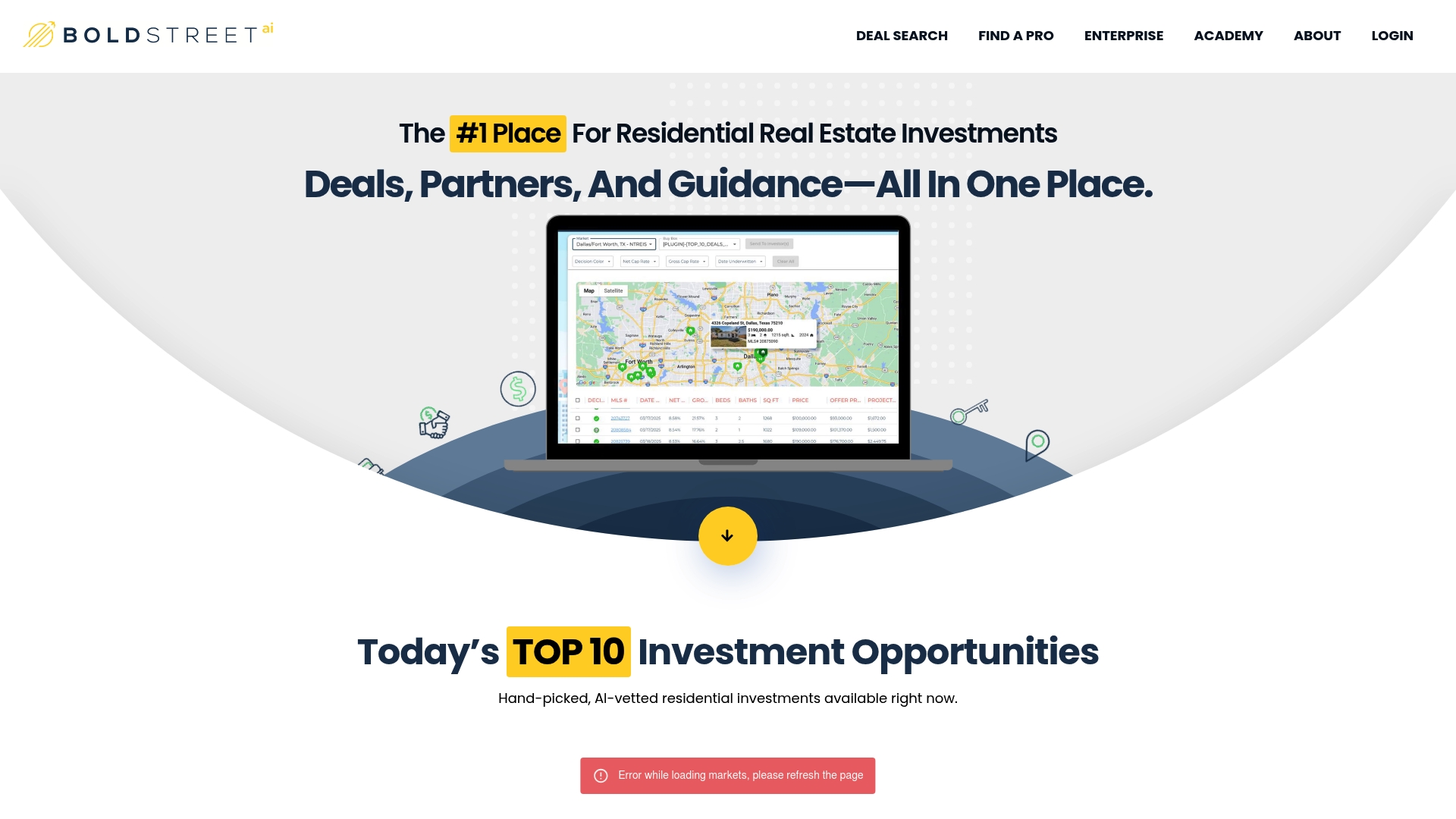
Bold Street AI is designed specifically to simplify real estate investing for beginners. Our platform connects you with experienced real estate agents, lenders, and property managers who understand your unique needs. Plus, our educational portal Bold Academy offers step-by-step guidance in concepts like analyzing investment properties, exploring financing options, and building your personal investment strategy. Visit Bold Street AI now and explore how you can start small, invest smart, and grow your portfolio with confidence. Begin your journey with the right tools and expert support today by checking out how to source investment properties and real estate financing options. Your successful real estate future starts here.
Frequently Asked Questions
What are the first steps I should take as a first-time real estate investor?
Start by clearly defining your investment goals. Consider what you want to achieve financially, whether it’s steady rental income, property appreciation, or quick returns from flipping. Draft a one-page investment strategy document to clarify your financial objectives and keep you focused.
How do I research local real estate markets effectively?
To research local real estate markets, analyze key factors such as economic indicators, population growth, and rental demand. Utilize resources like local real estate meetups or online forums to gather insights. Spend time studying specific neighborhoods and identifying potential investment opportunities that others might overlook.
What should I include in my real estate investment budget?
Your real estate investment budget should include down payment costs, closing fees, property maintenance, and potential income loss during vacancies. Make sure to allocate funds for renovations and an emergency repair fund. Track all investment-specific expenses in a dedicated savings account to maintain clear boundaries around your financial planning.
How can I build a team of professionals for my real estate investing?
Develop a support team that includes a real estate agent, attorney, accountant, and property inspector. Network strategically at local investor meetups to find professionals with experience in investment properties. Focus on interviewing multiple candidates to ensure you select those who align with your investment goals.
What financing options should I consider for real estate investments?
Consider various financing options such as conventional loans, portfolio loans, and private financing. Understand that investment properties usually require a higher down payment than primary residences. Seek pre-approval from lenders to clarify what you can afford and identify the best funding avenues for your investment plans.
How do I analyze a property for potential profit?
To analyze a property for profit potential, evaluate gross rental income, operating expenses, and net operating income. Look into metrics like capitalization rate and projected cash flow. Create a standardized analysis spreadsheet to maintain consistency and make informed decisions across multiple investment opportunities.
Recommended
- Beginner Real Estate Investment Guide for Confident First Steps | Bold Street AI
- Step by Step Real Estate Investing for Beginners | Bold Street AI
- Beginner Guide to Real Estate Portfolios for New Investors | Bold Street AI
- 7 Essential Residential Investing Tips for 2026 Beginners | Bold Street AI
- 7 Top-Tipps für einen erfolgreichen Wohnungsverkauf Reinheim
- 7 Top-Tipps für einen erfolgreichen Wohnungsverkauf Reinheim