
Building your residential real estate portfolio can feel lonely when every deal seems out of reach and trusted advice is hard to find. Investor networks offer a powerful solution by connecting new American investors with mentors, deal sources, and shared resources for smarter investing. By tapping into the power of social and professional connections, you gain access to valuable opportunities, practical support, and reliable guidance that would take years to find on your own.
Table of Contents
- Investor Networks Defined And Common Myths
- Types Of Real Estate Investor Networks
- How Investor Networks Drive Deal Flow
- Mentorship And Knowledge-Sharing Benefits
- Risks, Costs, And Best Networking Practices
Key Takeaways
| Point | Details |
|---|---|
| Investor networks provide valuable resources. | Joining networks enhances access to deal leads, reliable lenders, and mentors, significantly improving investment outcomes. |
| Myths hinder effective networking. | Misconceptions about exclusivity and guaranteed success prevent many from leveraging the full benefits of investor networks. |
| Different network types serve varying goals. | Local clubs, online communities, REITs, and syndications cater to investors’ diverse needs based on their experience and investment strategies. |
| Active participation is essential. | Regular engagement, reciprocal value exchange, and relationship building are critical for maximizing a network’s potential benefits. |
Investor networks defined and common myths
Investor networks are social and professional connections among real estate investors, lenders, agents, and other industry professionals who actively share information, opportunities, and resources. Think of them as communities built around a shared goal: helping members grow their portfolios through collaboration rather than isolation.
These networks function by facilitating information flow, resource sharing, and collaboration. When you join a network, you gain access to deal leads others have found, lending contacts who work with first-time investors, and experienced mentors who’ve already navigated the mistakes you’re about to make. The interconnected relationships within networks influence investment outcomes through mechanisms like trust-building, social capital, and strategic information sharing.
What Networks Actually Do
Effective investor networks serve several specific functions:
- Connect you with off-market deals before they hit public listings
- Provide vetted contractor and property manager referrals
- Offer access to investor-friendly lenders and financing options
- Share lessons learned from both successes and failures
- Create accountability partnerships for reaching investment goals
Real networks thrive on reciprocity—the best members give value before expecting returns, which builds trust and lasting relationships.
Myths That Hold New Investors Back
Several misconceptions prevent new investors from utilizing networks effectively. Understanding these myths helps you approach networking with realistic expectations.
Myth 1: Networks are only for elite or wealthy investors. False. Most successful networks actively recruit newer investors because they bring fresh energy and perspectives. Bold Street AI’s community, for example, welcomes investors at every experience level.
Myth 2: Joining a network guarantees success without effort. This one hurts because it’s partially true—networks help, but they don’t replace hard work. How networks influence investment success depends heavily on your willingness to participate, ask questions, and implement advice.
Myth 3: All networks provide equal value. Different networks focus on different markets, investment strategies, and experience levels. A network strong in single-family rentals may not serve syndication investors well.
Myth 4: You need to know someone to join. Most networks have open membership or clear pathways to entry. Your network becomes stronger precisely because new members bring unique perspectives and energy.
Myth 5: Virtual networks don’t work as well as in-person ones. Digital communities can move faster, reach geographically dispersed investors, and create searchable records of advice—real advantages over occasional meetups.
Why This Matters Now
New residential real estate investors face higher barriers than previous generations: rising competition for deals, stricter lending standards, and more complex regulatory environments. Networks level this playing field by giving you access to collective knowledge that would take years to develop alone.
The difference between an investor who joins a quality network and one who doesn’t often comes down to deal flow, financing options, and speed of execution. Networks compress your learning curve significantly.
Pro tip: When evaluating a network, ask current members about deals they’ve sourced through it and how often they actually connect with other investors outside formal meetings—those answers reveal real value.
Types of real estate investor networks
Real estate investor networks come in many forms, each designed to serve different investor goals and experience levels. Understanding the types available helps you choose the right community for your specific situation and investment strategy.
Local Real Estate Investment Clubs
These are the most accessible entry point for new investors. Local clubs typically meet monthly or weekly and bring together investors from your geographic area who focus on residential properties.
Local clubs offer:
- Face-to-face networking with nearby investors and professionals
- Education on local market conditions and investment strategies
- Guest speakers sharing practical experience and lessons learned
- Direct access to contractors, lenders, and property managers in your region
- Lower or no membership fees compared to other network types
Local clubs build real relationships because members see each other repeatedly and invest in the same neighborhoods where trust matters most.
Online and Virtual Communities
Digital platforms have transformed networking by removing geographic limitations. These communities include forums, Facebook groups, Slack channels, and dedicated membership websites where investors connect asynchronously.
Virtual communities excel at:
- Reaching investors across multiple states or nationwide
- Creating searchable archives of advice and answered questions
- Enabling 24/7 participation around your schedule
- Connecting niche-focused investors (fix-and-flip specialists, landlords, etc.)
- Providing affordable or free access to collective knowledge
Real Estate Investment Trusts (REITs) and Pooled Funds
Real Estate Investment Trusts legally pool funds from many investors to purchase large-scale income-producing properties. These structures offer passive investment without hands-on management.
REITs serve investors who want:
- Passive income from real estate without property management responsibilities
- Professional management of large portfolios
- Liquidity (publicly traded REITs can be bought and sold easily)
- Lower capital requirements than buying property outright
- Portfolio diversification across multiple properties and markets
Syndications and Private Investment Groups
These networks involve pooling capital for specific projects or ongoing investment vehicles. A sponsor or general partner manages the investment while limited partners contribute capital and share profits based on their investment amount.
Syndications work well for investors seeking:
- Access to larger, more complex projects (apartment buildings, commercial conversion)
- Professional deal sourcing and management
- Passive returns with limited liability
- Shared risk across multiple investors
- Tax advantages passed through from the investment structure
Developer Partnerships and Joint Ventures
These direct relationships connect individual investors with developers or experienced operators building larger projects. Partners share both capital contributions and decision-making responsibilities.
Joint ventures appeal to investors wanting:
- Hands-on involvement in deal decisions
- Higher return potential from direct ownership stakes
- Deeper relationships with experienced operators
- Control over specific aspects of the project
- Flexible arrangements tailored to partners’ capabilities and interests
Choosing Your Network Type
New investors typically start with local clubs or online communities to learn fundamentals and build relationships. As experience and capital grow, many move toward building investor networks that include syndications, partnerships, and more sophisticated structures.
Your choice depends on your timeline, capital, desired involvement level, and investment goals.
Pro tip: Start by attending three different local club meetings before joining any single network—you’ll quickly recognize which groups share your values and investment philosophy.
Here’s a summary comparing common types of real estate investor networks:
| Network Type | Typical Member Involvement | Deal Flow Potential | Best For |
|---|---|---|---|
| Local Clubs | In-person, regular meetings | Moderate, local deals | Beginners, local focus |
| Online Communities | Virtual, flexible participation | High, broad markets | Remote, niche investors |
| REITs & Pooled Funds | Passive, no management | Low, indirect access | Hands-off investors |
| Syndications & Joint Ventures | Investment plus partial management | High, large projects | Experienced, ambitious |
How investor networks drive deal flow
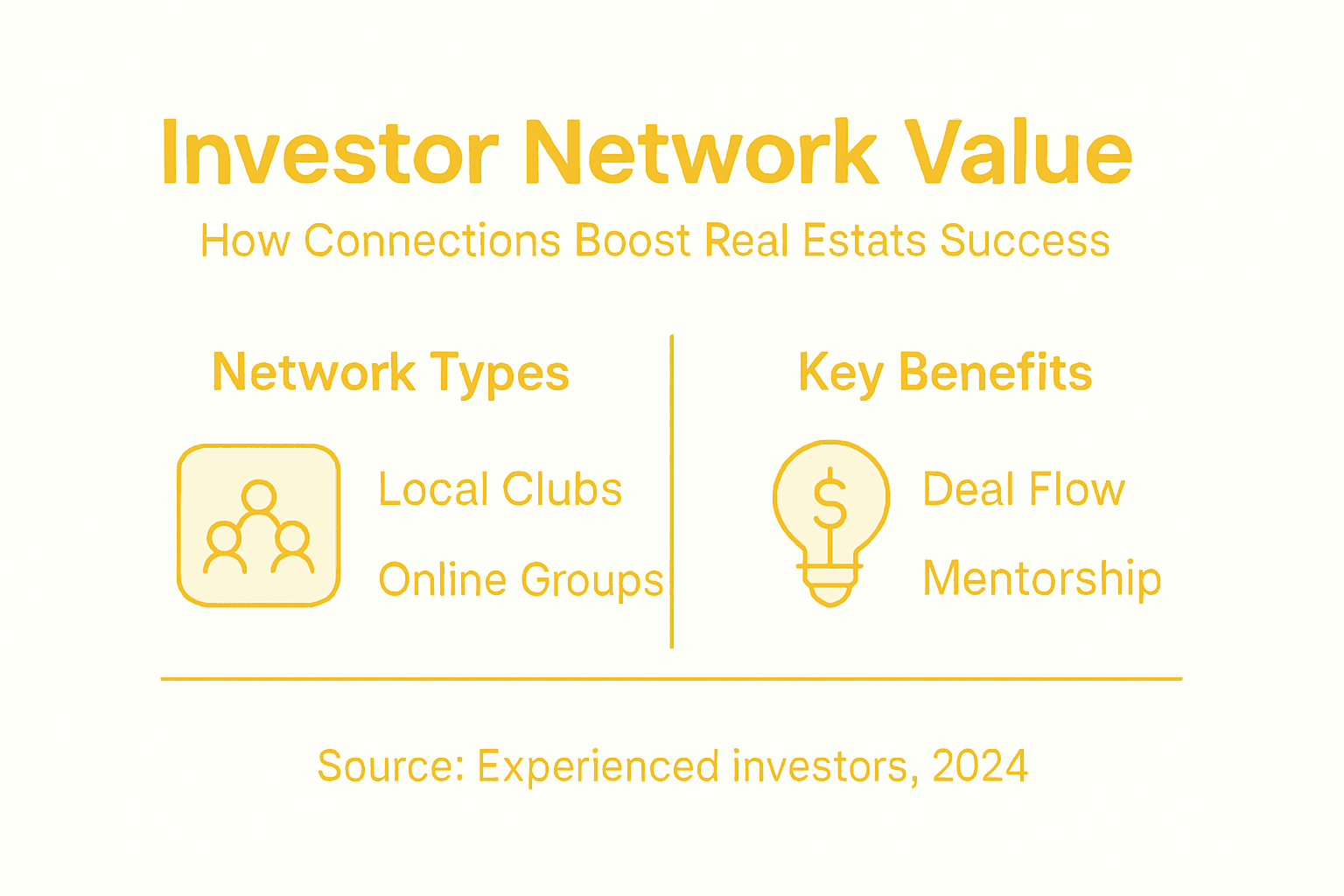
Deal flow—the steady stream of investment opportunities coming your way—separates successful investors from those who struggle to find properties. Networks are the primary engine that generates this deal flow, and understanding how they work reveals why membership in the right community transforms your investing reality.
The Information Advantage
Networks function as information distribution systems. When a member finds a promising property, that knowledge spreads through the network within hours or days, not weeks. Off-market deals circulate among members long before listing sites publish them.
This speed matters because:
- Early access lets you negotiate better terms before competition arrives
- Fewer bidders mean lower prices and less competitive intensity
- You can secure properties based on direct referrals from trusted sources
- Information quality improves when it comes from people you know and trust
Networks amplify opportunities by facilitating rapid dissemination of deal information, giving members reliable market intelligence faster than isolated investors can gather.
How Trust Accelerates Deals
Network relationships build social capital and reputation effects that smooth the entire deal process. When a lender knows you through a network referral, they move faster on applications. When a contractor has worked with your network contacts, they give you better pricing and prioritization.
Trust reduces friction at every stage:
- Lenders approve financing more quickly for network-referred borrowers
- Contractors and inspectors give honest assessments without pressure tactics
- Sellers accept lower offers from networked investors they’ve heard about
- Partners commit capital knowing your reputation precedes you
Mentorship Multiplies Your Opportunities
Experienced network members spot deals and opportunities you’d miss as a newer investor. They recognize value in distressed properties, understand nuanced market signals, and see potential where beginners see risk.
Mentorship accelerates deal sourcing by:
- Teaching you what profitable deals actually look like
- Introducing you to wholesalers, bird dogs, and other deal sources
- Showing you how to evaluate properties faster and more accurately
- Connecting you directly with their established deal pipelines
Collaboration Creates Bigger Deals
Some of the best opportunities require more capital or expertise than you possess alone. Networks enable partnerships where individual investors pool resources, knowledge, and connections to pursue larger projects.

Networks reduce information asymmetry and transaction costs by enabling social learning and repeated interactions, making it easier to find partners and execute collaborations that wouldn’t be possible independently.
Collaborative benefits include:
- Access to larger multifamily or development deals
- Shared risk across multiple investors on substantial projects
- Complementary skills (you handle construction, partner handles operations)
- Expanded geographic reach into new markets
Your Network Becomes Your Deal Source
Over time, an active network membership shifts your deal sourcing from advertising platforms to direct relationships. Instead of competing for properties on Zillow with 50 other investors, you receive calls about pocket listings from people who know you.
This transition takes commitment, but the payoff is substantial: deals flow to you rather than you constantly hunting for them.
Pro tip: Attend network meetings consistently for 90 days before evaluating whether you’re getting deal flow—relationships and reputation take time to generate meaningful referrals.
Mentorship and knowledge-sharing benefits
One of the most underrated advantages of investor networks is access to experienced mentors who have already made the mistakes you’re about to make. A good mentor compresses your learning curve from years into months, helping you avoid costly errors and identify opportunities faster.
Mentorship in networks works differently than formal education. Your mentor has skin in the game, understands your local market intimately, and genuinely wants to see you succeed. They share practical knowledge born from real deals—not textbook theories.
What Mentors Actually Teach You
Effective mentors within real estate networks provide guidance across multiple critical areas that directly impact your investing success.
Key knowledge areas include:
- Market analysis skills specific to your region and property type
- Financing strategies that fit your capital situation and credit profile
- Project management techniques for renovation and value-add deals
- Negotiation tactics used in actual deals they’ve completed
- Deal evaluation frameworks to quickly identify profitable opportunities
- Risk management strategies learned through their own experiences
Mentorship accelerates professional development by transferring practical knowledge and leadership skills that would take years to develop independently.
The Reciprocal Learning Advantage
The best mentorship relationships work both ways. Your mentor learns from your fresh perspective, technological fluency, and market insights. This reciprocal exchange creates deeper commitment and better guidance overall.
When mentors value what mentees bring:
- They stay more engaged and invested in your success
- They provide higher-quality guidance because they’re learning too
- The relationship feels like partnership, not charity
- You both benefit from cross-generational knowledge exchange
Building Confidence Through Guidance
New investors often struggle with decision paralysis. Should you make an offer on this property? Is the financing reasonable? Did you negotiate hard enough? A mentor helps you make decisions with confidence because you’re drawing on their accumulated wisdom.
Effective mentorship fosters deeper knowledge sharing and improves decision-making by combining their experiential knowledge with your research and analysis.
Confidence-building happens when mentors:
- Review your deal analysis before you commit capital
- Help you understand what you don’t yet know
- Normalize mistakes as part of learning, not failure
- Validate your thinking or point out blind spots kindly
Knowledge Transfer You Can’t Get Elsewhere
Some of the most valuable lessons come from informal conversations—lunch discussions about contractor quality, coffee talks about market timing, or texts about financing structures. This experiential knowledge never appears in courses or books.
Your network becomes a living library of:
- Which lenders actually fund new investors versus turning them away
- How to spot a property with hidden value that others missed
- When to walk away from a deal that looks good on paper
- How to build relationships with contractors who prioritize your projects
- What really happens after you buy—the operational reality versus theory
Creating Your Own Knowledge-Sharing Culture
As you grow as an investor, you become the mentor. The best networks maintain knowledge sharing across generations, where newer investors gradually transition into mentoring roles.
This creates sustainable advantage because knowledge compounds—each generation builds on what came before.
Pro tip: Ask potential mentors about one specific deal they’ve completed and request a detailed walkthrough of their analysis and execution—this reveals whether they actually share knowledge or just tell war stories.
Risks, costs, and best networking practices
Networking delivers tremendous value, but it’s not cost-free or risk-free. Understanding the real expenses and pitfalls helps you navigate networks strategically and protect yourself from common mistakes that derail new investors.
The Real Costs of Networking
Networking requires investment beyond just membership dues. Your time, attention, and mental energy all have real value. You’ll attend meetings, respond to messages, and participate in events—all hours you could spend on other activities.
Common networking costs include:
- Membership fees ranging from free to several hundred dollars annually
- Travel time and gas to attend local meetings and events
- Meals and refreshments at networking gatherings
- Opportunity cost of time spent building relationships instead of analyzing deals
- Potential losses from bad deals sourced through the network
Quality networks demand genuine participation—passive membership delivers minimal benefits.
Risks You Need to Know
Bad deal exposure. Networks circulate opportunities, but not every referral is solid. You remain responsible for thorough due diligence regardless of who brings you the deal. A trusted network member can steer you toward garbage investments if they misjudged the property.
Misinformation spreads easily. Someone shares incorrect market data, and it echoes through the network. You make decisions based on faulty information because it came from a seemingly credible source.
Unreliable partners. Networks introduce you to potential collaborators, but character isn’t always obvious initially. You might partner with someone who disappears mid-project or misrepresents their experience.
Reputational exposure. Your associations within a network affect how others perceive you. If you’re known as someone who promotes bad deals or fails to execute, your reputation suffers.
Strategic relationship-building and verification mitigate networking risks while maximizing opportunity flow.
Best Practices That Work
Successful networkers follow patterns that build trust while protecting themselves from downside risk.
Core practices include:
- Verify everything. A network referral saves you from cold-calling, not from analysis. Do your own underwriting.
- Build slowly. Deep relationships with five people serve you better than surface connections with fifty.
- Give before asking. The investors who get the best deals are those known for helping others first.
- Maintain professional integrity. Your reputation compounds—protect it obsessively.
- Stay engaged consistently. Networks reward regular participation, not sporadic attendance.
- Listen more than you pitch. Learning what others need helps you become valuable to them.
Understanding Network Dynamics
Trust-based relationships and regular engagement maximize benefits while minimizing exposure to misinformation and opportunism within your network.
Weak ties matter—acquaintances often bring better opportunities than close friends because they connect you to different circles. But strong ties provide reliability and honest feedback when you need it most.
Best strategy: Cultivate both. Build a few deep relationships where trust is absolute, and maintain broader connections that expand your opportunity set.
Use this quick reference to identify valuable networking practices:
| Practice | Trust Building Impact | Protection Against Risk |
|---|---|---|
| Verify all referrals | Strengthens integrity | Prevents bad deals |
| Give value first | Increases reputation | Attracts quality partners |
| Build deep relationships | Enables reliable support | Reduces exposure |
| Consistent engagement | Maintains opportunity flow | Avoids missed information |
Choosing Networks Wisely
Not all networks deserve your time. Visit potential networks before committing. Ask current members about deal flow, member quality, and actual outcomes from deals sourced there.
Red flags include:
- Pressure to recruit others as your primary benefit
- Testimonials only, no actual deal documentation
- Leadership that doesn’t actively invest themselves
- Membership exceeding 500 people in a local market
- High costs with no clear value proposition
Pro tip: Before joining, ask three random members for their honest assessment of deal quality and whether they’ve profited—their candid answers reveal the network’s real culture.
Unlock Real Estate Success Through Powerful Investor Networks
Navigating the challenges of real estate investing such as finding reliable deal flow, accessing trusted mentors, and connecting with the right professionals can feel overwhelming. This article highlights how strong investor networks build trust, accelerate access to off-market opportunities, and provide the mentorship you need to grow confidently. Bold Street AI addresses these exact pain points by offering a centralized platform where you can discover curated investment deals, connect with investor-friendly agents and lenders, and engage with an active community of fellow investors.
Accessing quality networks is critical because they open doors to faster financing, vetted contractors, and collaborative partnerships that traditional channels rarely provide. With Bold Street AI, you gain more than just listings; you gain trusted relationships and expert guidance through our educational portal, Bold Academy, designed specifically for new and seasoned investors alike.
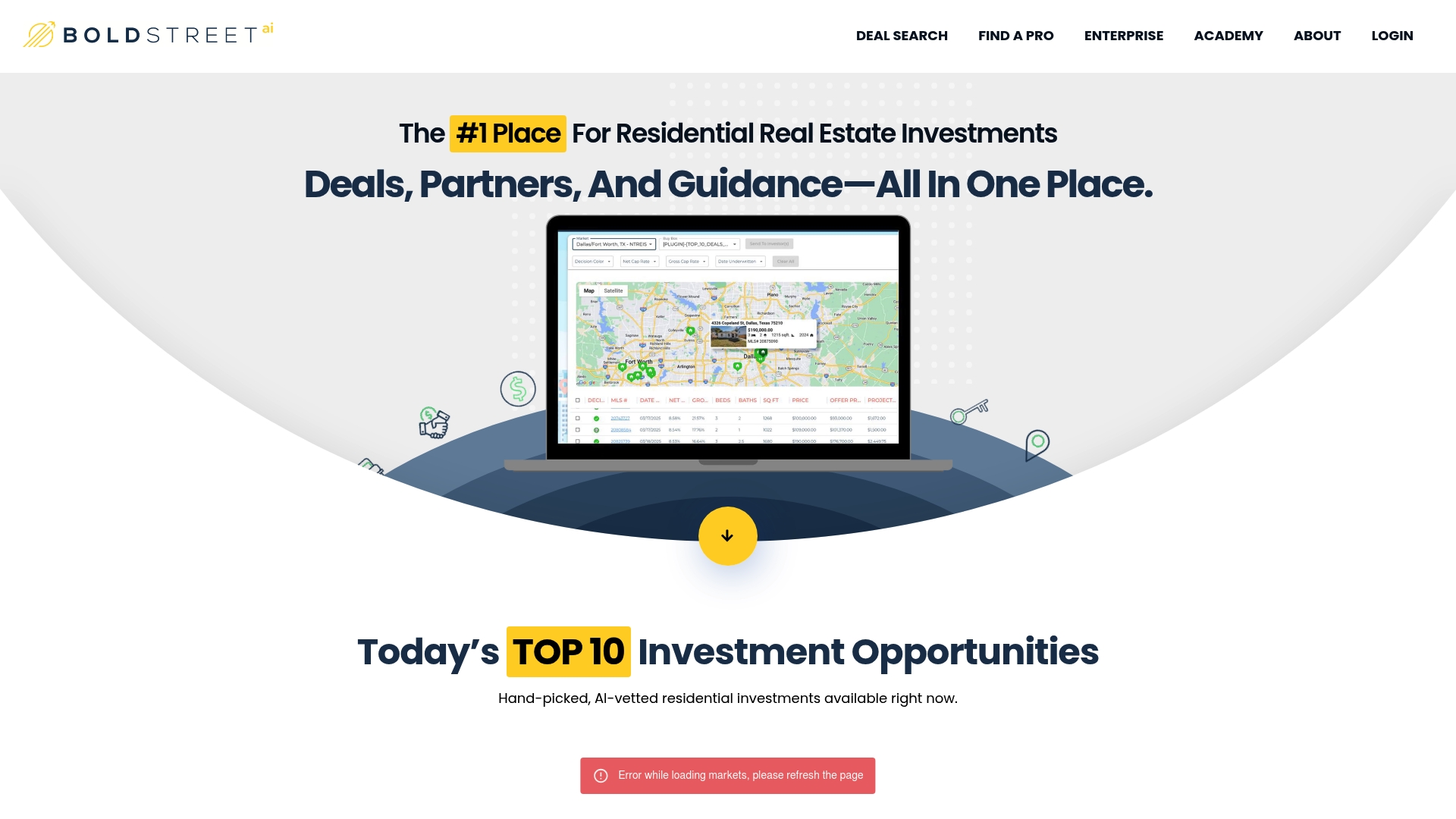
Ready to transform your investing journey with real connections and actionable opportunities? Explore how Bold Street AI can streamline your access to these networks, empower your decision-making with expert resources, and help you start building your portfolio today. Visit our platform to join a community committed to your real estate success.
Frequently Asked Questions
What are investor networks in real estate?
Investor networks are social and professional connections among real estate investors, lenders, agents, and other industry professionals who share information, opportunities, and resources to help members grow their portfolios.
How do investor networks contribute to deal flow?
Investor networks function as information distribution systems, enabling members to gain early access to deals, gather insights from trusted sources, and collaborate on opportunities, enhancing the overall investment process.
What myths about investor networks should new investors be aware of?
New investors should be cautious of myths such as networks being exclusive to wealthy investors, guaranteeing success without effort, providing equal value, requiring prior connections for membership, and the belief that virtual networks are less effective than in-person ones.
How can mentorship within investor networks benefit new investors?
Mentorship in investor networks provides new investors with invaluable guidance and insights from experienced members, helping them avoid costly mistakes, make informed decisions quickly, and develop essential skills in market analysis, financing, and property management.