
Many first-time investors in urban real estate feel uncertain about where to turn for trustworthy guidance and local expertise. Building a strong support network can make the difference between an isolated struggle and a path filled with shared learning and opportunity. By joining a community of fellow investors and tapping into Shared Knowledge, you gain access to strategies, insights, and mentorship that accelerate your journey and help you make smarter property decisions in American cities.
Table of Contents
- Community In Real Estate Investing Explained
- Types Of Investment Communities And Networks
- Collaboration And Shared Resources Among Investors
- Community Engagement In Urban Property Investments
- Risks And Challenges Of Investor Communities
- Comparing Independent Vs. Community-Based Investing
Key Takeaways
| Point | Details |
|---|---|
| Importance of Community | Real estate investing thrives on building strategic connections and leveraging collective knowledge to transform local economic landscapes. |
| Types of Investor Communities | Various investment community types, such as Publicly Traded REITs, Private Equity Firms, and Community Investment Trusts, cater to different participation levels and investment goals. |
| Collaboration Benefits | Effective collaboration among investors through knowledge sharing, resource pooling, and risk distribution enhances investment success and accelerates project implementation. |
| Community Engagement | Engaging with local communities is essential for creating sustainable and impactful developments, ensuring diverse voices are heard and respected in decision-making processes. |
Community in Real Estate Investing Explained
Real estate investing is more than just buying properties—it’s about building strategic connections and leveraging collective knowledge. Community wealth-building models demonstrate how collaborative investment approaches can transform local economic landscapes, especially in underserved neighborhoods.
At its core, community in real estate investing represents a powerful network of mutual support, knowledge exchange, and collaborative opportunity. Successful investors understand that individual success is intrinsically linked to the broader ecosystem of local market participants. This network includes:
- Fellow investors with complementary skills
- Local real estate professionals
- Property managers
- Financing experts
- Neighborhood community leaders
These connections provide critical advantages beyond individual capabilities. Shared Knowledge becomes a significant asset, enabling investors to:
- Gain market insights faster
- Identify emerging investment opportunities
- Mitigate risks through collective intelligence
- Access resources beyond personal networks
Community involvement transforms real estate investing from a solitary endeavor into a collaborative journey. By actively participating in local investment networks, investors can develop more robust strategies, understand nuanced market conditions, and create sustainable wealth-building approaches.
Pro tip: Build genuine relationships by consistently offering value to your network before seeking personal gains.
Types of Investment Communities and Networks
Real estate investment communities represent diverse structures that enable collaborative investment strategies. Neighborhood real estate investment models offer innovative approaches for investors to participate in local property development and wealth creation.
Investment communities can be categorized into several primary types, each with unique characteristics and participation mechanisms:
- Publicly Traded REITs: Highly liquid, professionally managed real estate investment trusts
- Private Equity Real Estate Firms: Exclusive investment groups targeting sophisticated investors
- Real Estate Investment Groups (REIGs): Collaborative networks pooling investor capital
- Community Investment Trusts: Local investment vehicles focused on neighborhood development
- Investment Cooperatives: Member-owned structures enabling collective property investments
Investor Participation Levels vary significantly across these community types. Real estate investment networks provide options ranging from completely passive to highly active involvement. Some networks require substantial capital commitments, while others allow smaller, more accessible entry points.
Each investment community type presents distinct advantages and challenges. Publicly traded REITs offer high liquidity and professional management, while community investment trusts provide more localized, impact-driven investment opportunities. Investors must carefully evaluate their financial goals, risk tolerance, and desired level of engagement when selecting an appropriate investment community.
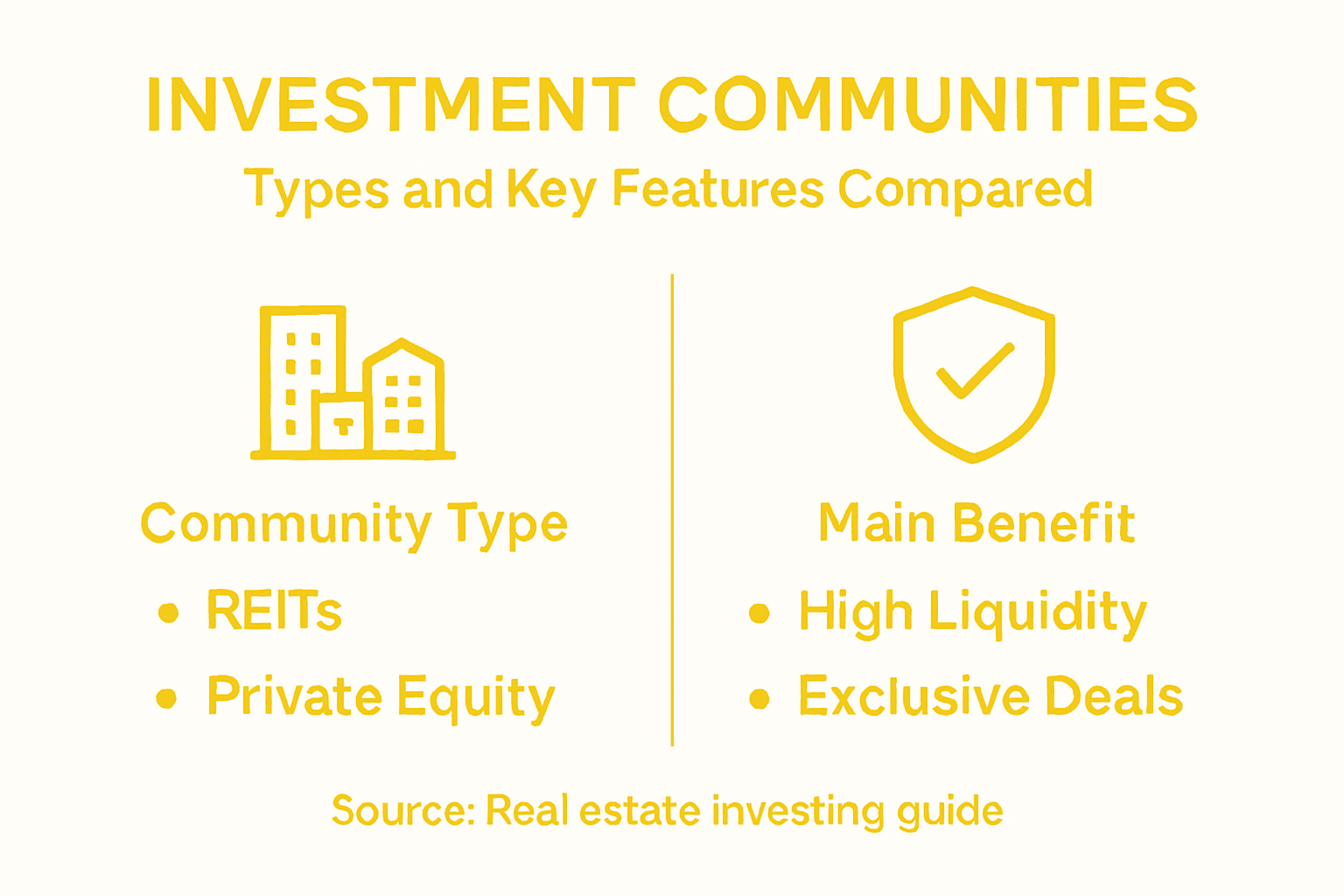
Here’s a summary comparing the main types of real estate investment communities and their key characteristics:
| Community Type | Participation Level | Main Advantage | Typical Investor Profile |
|---|---|---|---|
| Publicly Traded REITs | Passive | High liquidity, professional management | Individuals seeking easy entry |
| Private Equity Real Estate | Active or passive | Access to exclusive deals | Accredited, high-net-worth investors |
| Real Estate Investment Groups | Semi-active | Network support, pooled expertise | Small groups of local investors |
| Community Investment Trusts | Community-focused | Local impact, inclusive ownership | Neighborhood stakeholders |
| Investment Cooperatives | Highly collaborative | Shared control, collective benefits | Members with shared values |
Pro tip: Research multiple investment community types and attend local networking events to understand which model best matches your investment strategy and personal financial objectives.
Collaboration and Shared Resources Among Investors
Successful real estate investing transcends individual efforts, emphasizing the critical importance of building equitable investor partnerships. Collaboration transforms investment from a solitary endeavor into a powerful, collective strategy that leverages diverse skills, resources, and perspectives.
Investors can collaborate through multiple strategic approaches:
- Knowledge Sharing: Exchanging market insights and investment strategies
- Resource Pooling: Combining financial capital for larger investment opportunities
- Risk Mitigation: Distributing potential financial risks across multiple investors
- Skill Complementation: Utilizing different expertise within investment groups
- Network Expansion: Creating broader connections in real estate markets
Shared Resources become a powerful mechanism for accelerating investment success. Co-financing complex real estate projects enables investors to tackle more ambitious developments that would be challenging or impossible individually. These collaborative models provide significant advantages, including:
- Enhanced capital mobilization
- Reduced individual financial risk
- Access to broader investment opportunities
- Faster project implementation
- Increased learning and skill development
Effective collaboration requires transparent communication, mutual trust, and aligned investment goals. Successful investor networks establish clear expectations, define roles, and maintain open channels for ongoing dialogue and strategic planning.

Pro tip: Develop a comprehensive partnership agreement that clearly outlines each investor’s contributions, expectations, and potential exit strategies before initiating any collaborative investment.
Community Engagement in Urban Property Investments
Urban property investments require more than financial strategy—they demand meaningful community engagement approaches that ensure inclusive and equitable development. Successful investors recognize that understanding local community needs is fundamental to creating sustainable and impactful real estate projects.
Key components of effective community engagement include:
- Representation: Ensuring diverse voices are heard
- Transparency: Maintaining open communication channels
- Collaborative Decision-Making: Involving residents in development planning
- Cultural Sensitivity: Respecting local community dynamics
- Economic Empowerment: Creating opportunities for local residents
Meaningful Participation transforms traditional investment models by moving from engagement to ownership. This approach goes beyond consulting residents and instead empowers them to become active partners in urban development projects. Effective strategies for achieving this include:
- Hosting community workshops
- Creating resident advisory boards
- Developing participatory budgeting processes
- Implementing transparent reporting mechanisms
- Offering local job and skill development opportunities
Successful urban property investments recognize that community engagement is not a checkbox but a continuous, dynamic process. Investors who prioritize genuine dialogue, mutual respect, and shared value creation can transform traditional real estate development into a collaborative, socially responsible endeavor.
Pro tip: Schedule regular community listening sessions and create multiple accessible channels for residents to provide feedback and contribute to investment strategies.
Risks and Challenges of Investor Communities
Investor communities face complex challenges that extend beyond financial considerations, particularly when addressing local community inclusiveness and obligations. These risks require sophisticated understanding and proactive management to ensure sustainable and ethical investment strategies.
Key risks investors must navigate include:
- Conflict of Interest: Balancing investor and community priorities
- Legal Vulnerability: Potential disputes with local stakeholders
- Reputation Management: Maintaining community trust
- Financial Uncertainty: Managing complex investment dynamics
- Social Impact: Addressing potential negative community consequences
Investment Barriers significantly impact community investment potential, particularly in underserved and rural regions. These challenges manifest through multiple dimensions:
- Limited financial resources
- Fragmented funding sources
- Higher perceived investment risks
- Smaller project scales
- Capacity and infrastructure limitations
Successful investor communities must develop nuanced strategies that balance financial objectives with social responsibility. This requires transparent communication, collaborative problem-solving, and a commitment to creating mutually beneficial investment ecosystems.
Pro tip: Conduct thorough community impact assessments and develop flexible investment frameworks that prioritize both financial returns and local community development.
Comparing Independent vs. Community-Based Investing
Real estate investment strategies diverge significantly between independent and community-based approaches, each offering unique advantages and challenges. Community shareholding models provide innovative alternatives to traditional individual investment strategies, emphasizing collective wealth generation and local economic empowerment.
Key differences between independent and community-based investing include:
-
Investment Focus
- Independent: Individual financial returns
- Community-Based: Shared economic and social benefits
-
Decision-Making
- Independent: Singular investor control
- Community-Based: Collaborative, inclusive processes
-
Risk Management
- Independent: Individual risk absorption
- Community-Based: Distributed risk across network
Ownership Dynamics reveal fundamental distinctions in investment approaches. Community wealth-building models challenge traditional investment paradigms by prioritizing systemic equity and collective prosperity over pure financial metrics.
While independent investors typically seek maximum personal returns, community-based investing integrates broader social objectives. This approach creates opportunities for passive income, enhanced local control, and addressing structural economic inequities. Community investments can generate financial returns while simultaneously supporting neighborhood development, affordable housing, and local economic resilience.
This side-by-side view highlights the distinctions between independent and community-based real estate investing:
| Aspect | Independent Investing | Community-Based Investing |
|---|---|---|
| Decision Power | Sole investor makes decisions | Group consensus or democratic voting |
| Risk Exposure | Investor bears full risk | Risk shared within the community |
| Social Impact | Primarily financial focus | Local economic and social benefits |
| Project Scale | Limited by individual resources | Enables larger, more complex projects |
Pro tip: Evaluate your investment strategy holistically by considering both financial returns and potential community impact before committing capital.
Unlock the Power of Community in Your Real Estate Investments
Navigating the challenges of real estate investing requires more than capital it demands a strong network and strategic collaboration. This article highlights the critical role of community in sharing knowledge pooling resources and mitigating risks. If you want to overcome barriers such as limited market insights or finding trusted local professionals Bold Street AI is designed to empower you every step of the way. Our platform connects you with investor-friendly agents lenders and property managers while offering educational tools and a supportive community to build your confidence and grow your residential portfolio.
Discover curated investment opportunities and join a thriving network of like-minded investors ready to share insights and strategies. Act now to turn community collaboration into your competitive advantage. Visit Bold Street AI today and explore how you can start building wealth with expert guidance and genuine connections.
Frequently Asked Questions
What is the role of community in real estate investing?
Community plays a crucial role in real estate investing by providing a network of support, shared knowledge, and collaborative opportunities that enhance individual investors’ understanding of market dynamics and investment strategies.
How can investors benefit from participating in local investment networks?
Investors can benefit from local investment networks by gaining market insights, identifying emerging opportunities, and pooling resources to mitigate risks, leading to more effective investment strategies and community-centered projects.
What types of investment communities exist in real estate?
Real estate investment communities include publicly traded REITs, private equity firms, real estate investment groups, community investment trusts, and investment cooperatives, each offering different participation levels and advantages for investors.
What are the challenges of collaborating within investor communities?
Challenges of collaborating within investor communities include managing potential conflicts of interest, addressing legal vulnerabilities, ensuring effective reputation management, and balancing financial objectives with social responsibility.