
Starting a property investment journey can feel overwhelming without the right guidance. Many new American investors quickly realize that success in real estate depends on more than enthusiasm or luck. Building a strong foundation of cognitive skills and knowledge gives investors the confidence to interpret market signals, avoid costly mistakes, and recognize growth opportunities. This guide explains how education shapes smarter investing by helping you master the technical and strategic skills needed to thrive in residential property markets.
Table of Contents
- Defining Education’s Impact on Real Estate Investment
- Types of Knowledge Needed for Property Success
- Essential Skills for Residential Investors
- Risk Reduction Through Informed Decisions
- Avoiding Common Mistakes With Ongoing Learning
Key Takeaways
| Point | Details |
|---|---|
| Education Enhances Investment Success | A solid educational foundation significantly improves an investor’s analytical skills, enabling better decision-making in real estate markets. |
| Continuous Learning is Essential | Dedicating time to ongoing education fosters adaptability and keeps investors informed about market changes and investment strategies. |
| Soft Skills Complement Technical Knowledge | Skills like negotiation and communication are vital for building relationships and navigating challenges in real estate investments. |
| Effective Risk Management is Crucial | Systematic risk assessment and informed decision-making are keys to minimizing vulnerabilities and enhancing investment stability. |
Defining Education’s Impact on Real Estate Investment
Education is not merely an academic pursuit but a strategic investment that directly influences success in real estate investing. Cognitive skills and knowledge fundamentally transform an investor’s ability to navigate complex market landscapes and make informed decisions. Substantial research demonstrates that educational quality significantly impacts economic productivity and investment potential.
Real estate investing requires a multifaceted understanding that extends beyond basic financial literacy. Successful investors develop critical competencies through structured learning, which enables them to:
- Analyze market trends and economic indicators
- Understand complex financial instruments
- Evaluate property valuation methodologies
- Assess risk management strategies
- Comprehend legal and regulatory frameworks
The educational journey for real estate investors encompasses multiple dimensions of learning. Formal education provides foundational knowledge, while continuous professional development ensures investors remain adaptive in a dynamic market environment. Specialized training programs and targeted learning resources can dramatically accelerate an investor’s comprehension of sophisticated investment strategies.
Here is a summary of how different types of real estate education benefit investment outcomes:
| Type of Education | Primary Benefit | Impact on Investment Success |
|---|---|---|
| Formal Education | Foundational knowledge | Improves analysis and strategy |
| Professional Training | Specialized skills | Accelerates sophisticated investing |
| Continuous Learning | Adaptive mindset | Enables response to market changes |
| Peer Networking | Shared experiences | Broadens opportunity recognition |
Beyond technical knowledge, education cultivates essential soft skills critical for investment success. Critical thinking, analytical reasoning, and strategic decision-making are developed through structured learning experiences. These cognitive capabilities enable investors to interpret market signals, recognize emerging opportunities, and mitigate potential risks effectively.
Pro tip: Commit to ongoing learning by allocating at least 5-10 hours monthly to structured real estate education through courses, webinars, and professional development resources.
Types of Knowledge Needed for Property Success
Successful property investing demands a comprehensive understanding of multiple knowledge domains that extend far beyond basic real estate transactions. Investors must develop sophisticated expertise across various critical areas to build a resilient and profitable investment portfolio.
The primary knowledge domains essential for property investment success include:
- Financial Analysis: Understanding financial statements, cash flow projections, and investment return calculations
- Market Research: Identifying trends, analyzing local economic indicators, and predicting property value trajectories
- Legal Framework: Comprehending zoning laws, property rights, and regulatory compliance requirements
- Risk Management: Evaluating potential investment risks and developing mitigation strategies
- Property Valuation: Determining accurate property worth through comparative market analysis
Each knowledge domain requires specialized skills and continuous learning. Investors must develop both technical competencies and strategic thinking to navigate the complex real estate landscape effectively. Technical expertise involves understanding financial metrics, while strategic knowledge helps investors make informed decisions based on comprehensive market insights.
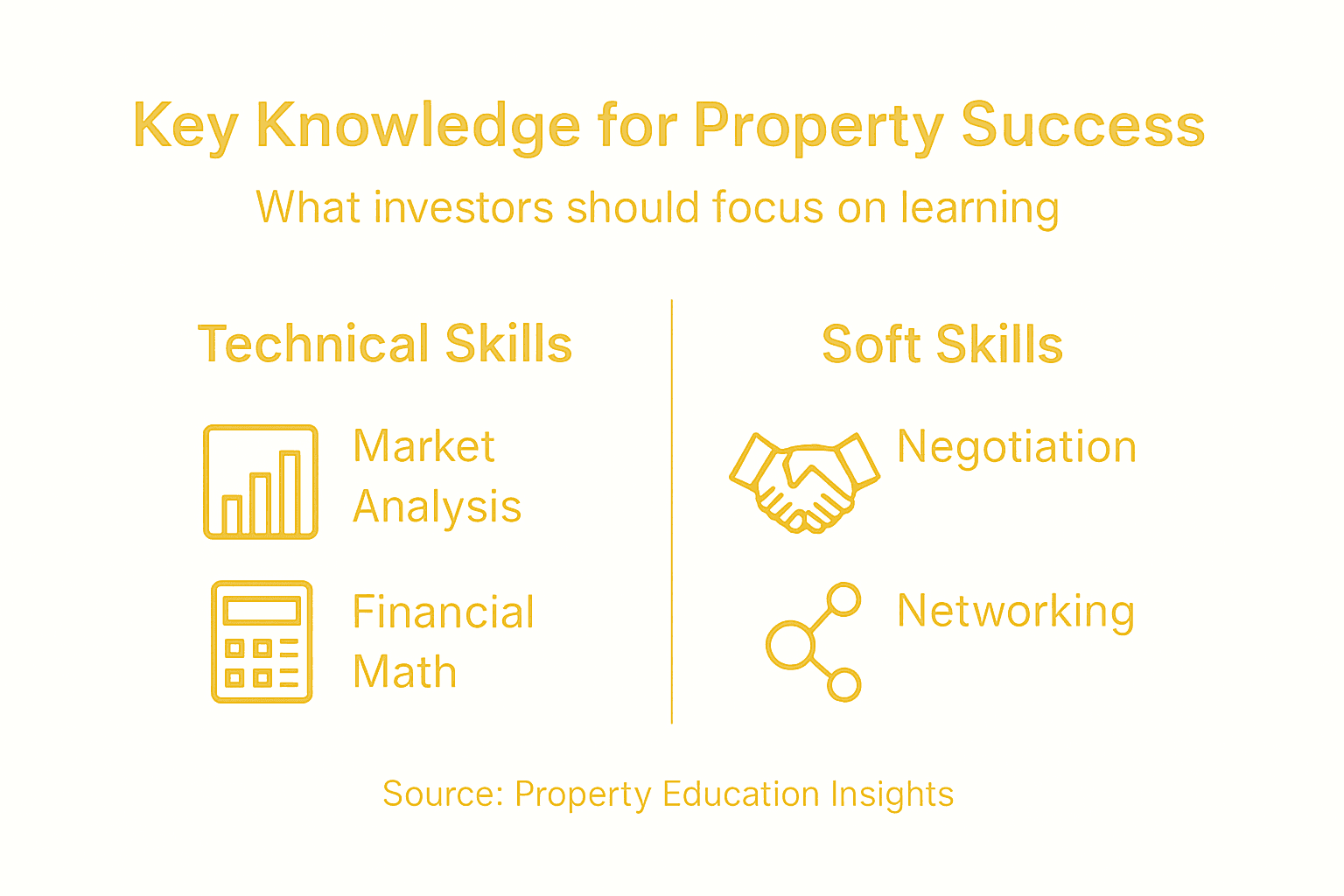
Beyond technical skills, successful property investors cultivate soft skills like negotiation, networking, and adaptability. These interpersonal capabilities complement technical knowledge, enabling investors to build relationships, identify unique opportunities, and navigate challenging market conditions with confidence.
Pro tip: Create a personal learning roadmap that dedicates specific time each month to deepening your expertise in at least one key property investment knowledge domain.
Essential Skills for Residential Investors
Residential real estate investing requires mastering a sophisticated set of skills that extend far beyond basic property purchasing. Success demands a strategic approach combining technical knowledge and interpersonal capabilities that transform potential challenges into profitable opportunities.
The critical skills residential investors must develop include:
- Financial Analysis: Understanding cash flow projections, return on investment calculations, and mortgage structures
- Market Research: Identifying emerging neighborhood trends, property value appreciation potential, and local economic indicators
- Negotiation: Crafting favorable purchase agreements, managing seller interactions, and securing optimal pricing
- Property Assessment: Evaluating structural integrity, potential renovation costs, and true market value
- Risk Management: Identifying potential investment risks and developing comprehensive mitigation strategies
Technical competence forms the foundation of successful residential investing. Analytical skills enable investors to distinguish between attractive opportunities and potential pitfalls. Investors must develop a deep understanding of financial metrics, learning to read market signals and interpret complex data that others might overlook.

Beyond technical skills, successful residential investors cultivate powerful soft skills like communication, patience, and adaptability. These interpersonal capabilities allow investors to build strong relationships with real estate agents, contractors, potential tenants, and other key stakeholders in the investment ecosystem.
These key soft skills complement technical abilities for residential investors:
| Soft Skill | How It Helps Investments | Example in Action |
|---|---|---|
| Communication | Builds trust and clarity | Negotiating with sellers |
| Patience | Avoids hasty decisions | Waiting for ideal property |
| Adaptability | Responds to market change | Adjusting strategy during downturn |
| Emotional Intelligence | Reduces impulsive actions | Keeping calm during negotiations |
Pro tip: Develop a continuous learning habit by dedicating at least two hours weekly to studying market trends, investment strategies, and expanding your residential real estate knowledge base.
Risk Reduction Through Informed Decisions
Effective risk management represents the cornerstone of successful real estate investing, transforming potential financial vulnerabilities into strategic opportunities. Informed investors understand that risk reduction is not about eliminating all potential challenges, but systematically identifying, analyzing, and mitigating potential investment threats.
Key strategies for minimizing investment risks include:
- Comprehensive Due Diligence: Conducting thorough property and market research before any investment
- Financial Buffer: Maintaining adequate cash reserves to handle unexpected expenses
- Diversification: Spreading investments across different property types and locations
- Professional Assessments: Engaging licensed inspectors and appraisers for objective property evaluations
- Market Trend Analysis: Continuously monitoring local economic indicators and real estate market dynamics
Quantitative risk analysis enables investors to make data-driven decisions that significantly reduce potential financial exposure. By developing a systematic approach to evaluating investment opportunities, residential investors can create a robust framework that transforms uncertainty into calculable and manageable risk.
Beyond technical assessments, successful risk reduction requires developing a disciplined mindset. Investors must cultivate emotional intelligence to avoid impulsive decisions, maintaining a strategic perspective that prioritizes long-term stability over short-term gains.
Pro tip: Create a personalized risk assessment checklist that you complete for every potential investment, including financial, structural, and market-related evaluation criteria.
Avoiding Common Mistakes With Ongoing Learning
Investors frequently encounter predictable pitfalls that can be mitigated through continuous education. Understanding these common mistakes transforms potential setbacks into valuable learning opportunities that strengthen long-term investment strategies.
The most prevalent mistakes residential real estate investors tend to make include:
- Unrealistic Expectations: Overestimating potential returns and underestimating investment complexity
- Poor Market Research: Failing to thoroughly investigate local market conditions and trends
- Inadequate Financial Planning: Insufficient cash reserves and poor budgeting strategies
- Emotional Decision-Making: Allowing personal biases to override objective investment criteria
- Neglecting Professional Advice: Avoiding consultation with experienced real estate professionals
Continuous learning serves as the most effective defense against these common investment errors. By developing a systematic approach to knowledge acquisition, investors can transform potential mistakes into strategic insights that refine their investment approach.
Successful investors view each investment experience as an educational opportunity, maintaining a growth mindset that values learning over immediate success. This approach requires humility, curiosity, and a willingness to adapt strategies based on new information and market dynamics.
Pro tip: Create a personal investment journal documenting each investment decision, including lessons learned and strategies for future improvement.
Empower Your Real Estate Journey Through Education and Expert Support
The article highlights how critical education and continuous learning are for mastering financial analysis, market research, and risk management in residential property investing. Many investors feel overwhelmed by complex market data and worry about making well-informed decisions that truly reduce risk. At Bold Street AI, we understand these challenges and offer a comprehensive platform to bridge the gap between knowledge and real-world investing success. Our educational portal, Bold Academy, combined with access to investor-friendly agents, lenders, and property managers, provides exactly what you need to build confidence and sharpen both your technical and strategic skills.

Begin transforming your real estate investing approach today by leveraging expert guidance, curated opportunities, and continuous learning. Explore how you can grow your portfolio smarter and safer by starting with Bold Street AI. Discover the perfect match for your unique investing goals with our professional connections and dive into our educational resources designed specifically for beginners and experienced investors alike. Don’t let common pitfalls hold you back—take action now to become the savvy investor you aspire to be.
Frequently Asked Questions
What is the importance of education in real estate investing?
Education equips investors with cognitive skills and knowledge necessary to navigate complex market landscapes, make informed decisions, and manage risks effectively.
What types of education should I pursue for successful property investing?
Investors should focus on formal education, professional training, continuous learning, and peer networking to develop a comprehensive understanding of real estate investment strategies.
How can I improve my financial analysis skills for real estate investing?
To improve financial analysis skills, consider dedicating time to study financial statements, cash flow projections, and investment return calculations through structured courses or seminars.
What common mistakes can I avoid by pursuing ongoing education in real estate?
Ongoing education helps prevent common mistakes such as having unrealistic expectations, poor market research, inadequate financial planning, and emotional decision-making in investment scenarios.
Recommended
- Step by Step Real Estate Investing for Beginners | Bold Street AI
- Beginner Real Estate Investment Guide for Confident First Steps | Bold Street AI
- 7 Essential Steps for a Residential Investing Checklist | Bold Street AI
- Real Estate Investment Terms Explained: What Beginners Need | Bold Street AI
- Discover the Basics: Your Guide to Property Investment in New Zealand – Mortgage Managers