
Most American investors discover that property data gaps can derail even well planned investments. When so much is at stake in a dynamic real estate market, having reliable figures and market insights is critical for confident decisions. This guide breaks down the step by step process to help new investors organize key figures, calculate accurate cash flows, and compare each opportunity using proven American market benchmarks. With the right tools and facts, you can increase your odds of finding profitable investments and safeguarding your growing portfolio.
Table of Contents
- Step 1: Gather Key Property And Market Data
- Step 2: Calculate Cash Flow And Expenses Accurately
- Step 3: Evaluate Potential Returns And Risks
- Step 4: Verify Figures With Real-World Benchmarks
- Step 5: Decide On Investment Suitability Confidently
Quick Summary
| Key Insight | Explanation |
|---|---|
| 1. Gather comprehensive market data | Utilize economic databases and local records to analyze property trends and obtain vital market insights. |
| 2. Master accurate cash flow calculations | Systematically track potential income and expenses to evaluate the financial viability of your investment property. |
| 3. Evaluate returns using comprehensive metrics | Calculate potential profits and risks through advanced financial frameworks, ensuring a thorough assessment of investment performance. |
| 4. Validate figures with real-world benchmarks | Compare your investment metrics against industry standards to ensure realistic performance expectations and reduce biases. |
| 5. Assess investment suitability confidently | Analyze how properties align with your financial goals and risk tolerance through structured evaluations and scenario projections. |
Step 1: Gather key property and market data
Successful real estate investment starts with thorough data collection. In this crucial step, you will systematically compile essential information about potential investment properties and their surrounding market conditions.
Begin by accessing comprehensive economic databases like the Federal Reserve Economic Data to understand broader residential investment trends. This platform provides extensive time series covering private fixed investment, price indexes, and quarterly investment rates from 1929 to 2025. Investors can leverage these datasets to understand historical market performance and predict future trajectories.
Next, collect localized property data through multiple sources. Start with county assessor records to obtain property tax histories, previous sale prices, and precise square footage details. Simultaneously, gather neighborhood demographic information including median income levels, population growth rates, and employment statistics. Online real estate platforms and local multiple listing services (MLS) can provide additional insights into recent comparable sales and current market valuations.
Compare your collected data against broader economic indicators from resources like World Bank Open Data to contextualize local market conditions within regional and national economic frameworks. Look for trends in urbanization, economic growth, and infrastructure development that might impact property values.
Here’s a quick reference table summarizing key data sources for property and market analysis:
| Data Source | Type of Data Provided | Best Use in Investment Analysis |
|---|---|---|
| Federal Reserve Economic Data | National economic trends, price indexes | Predict market cycles and investment timing |
| County Assessor Records | Property tax history, sales records | Verify local property valuation and history |
| MLS and Real Estate Platforms | Comparable sales, active listings | Assess current market value and competition |
| World Bank Open Data | Regional economic indicators | Contextualize local data within wider trends |
| Neighborhood Demographics | Income, employment, population growth | Evaluate area growth and rental demand |
Pro tip: Create a standardized digital spreadsheet to organize your research data, making comparisons and analysis significantly more efficient and systematic.
Step 2: Calculate cash flow and expenses accurately
Accurate cash flow analysis is the financial heartbeat of successful real estate investing. In this critical step, you will learn how to systematically evaluate the potential income and expenses associated with your investment property.
Start by mastering Free Cash Flow calculation techniques that go beyond simple accounting earnings. This means carefully tracking all income streams including rental revenues, while meticulously documenting every potential expense. Break down your expenses into categories such as mortgage payments, property taxes, insurance, maintenance costs, property management fees, and potential vacancy reserves. Pay special attention to both fixed and variable expenses that can impact your overall investment returns.
Utilize detailed financial modeling to project your net operating income. Subtract all operational expenses from gross rental income to determine your actual cash flow. Net Present Value analysis can help you understand the true long term financial potential of the property by accounting for factors like capital expenditures, depreciation, and changes in working capital. This approach provides a more comprehensive view of the investment than simple cash flow snapshots.

Remember that conservative estimation is key. Always build in buffer amounts for unexpected repairs, potential vacancy periods, and market fluctuations to ensure your financial projections remain realistic and sustainable.
Pro tip: Create a dynamic spreadsheet template that automatically calculates cash flow projections, allowing you to quickly adjust variables and assess different investment scenarios.
Step 3: Evaluate potential returns and risks
Assessing the potential returns and risks is a critical step in making informed real estate investment decisions. This process requires a comprehensive approach that goes beyond surface level financial metrics to truly understand the investment landscape.
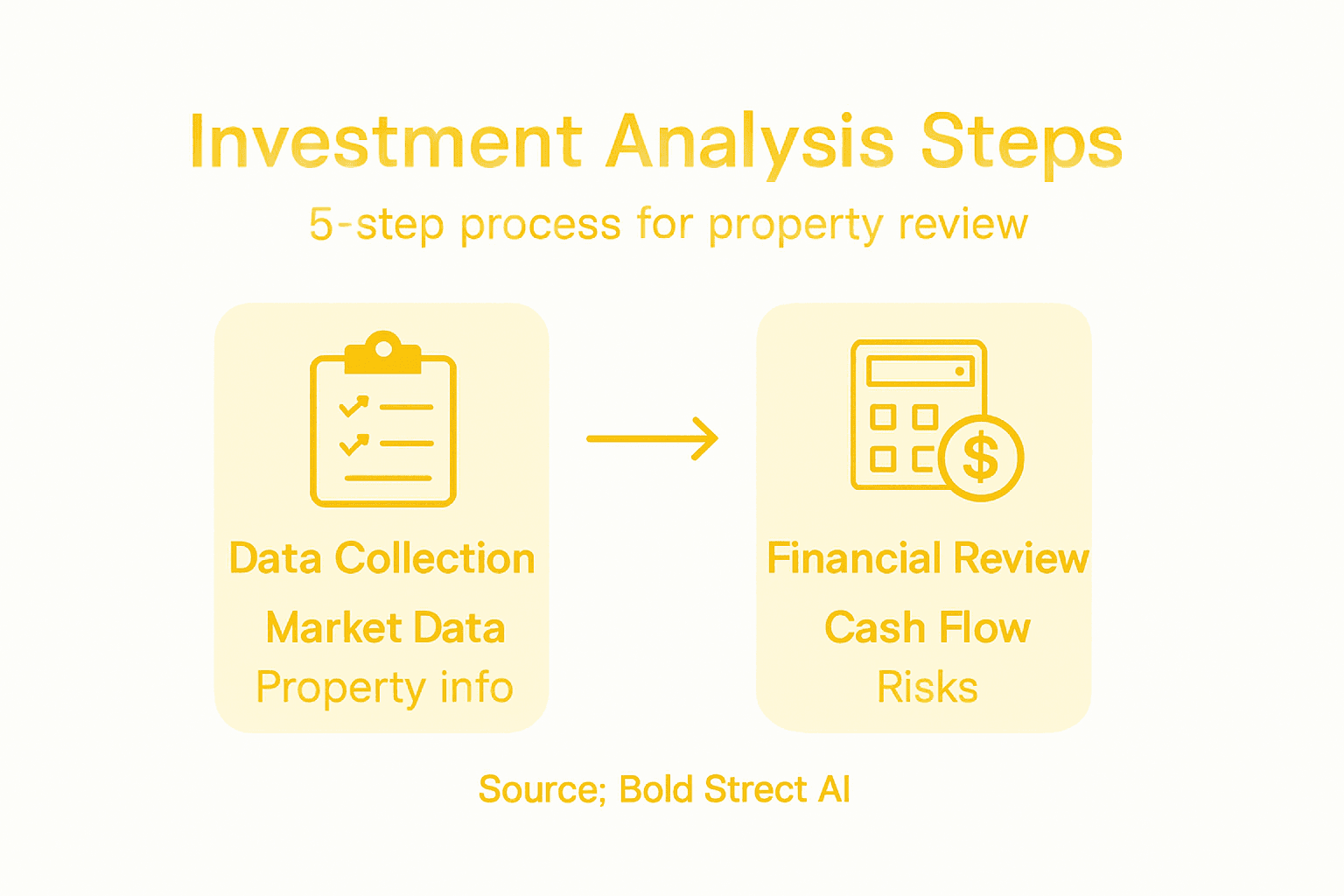
Start by mastering investment return calculation techniques that provide a holistic view of potential profitability. This means analyzing not just the raw numbers, but understanding the nuanced factors that contribute to overall investment performance. Calculate total returns by incorporating rental income, property appreciation, tax benefits, and potential equity buildup. Pay close attention to annualized returns, which give you a more standardized view of performance across different investment timelines.
Utilize advanced financial frameworks like those recommended by the CFA Institute for capital investment analysis. This involves employing sophisticated metrics such as Net Present Value (NPV), Internal Rate of Return (IRR), and Return on Invested Capital (ROIC). These tools help you assess not just potential returns, but also the inherent risks associated with the property. Consider factors like local market volatility, potential repair costs, neighborhood development trends, and economic indicators that could impact your investment’s long term performance.
Remember that risk evaluation is just as important as return projection. Develop a comprehensive risk assessment that includes potential scenario analyses, understanding worst case scenarios, and building financial buffers to protect your investment.
Pro tip: Create a risk scoring system that objectively ranks potential investments based on multiple financial and market factors, allowing for more systematic and emotionally detached decision making.
Step 4: Verify figures with real-world benchmarks
Validating your investment property calculations against established market standards is crucial for making informed and realistic investment decisions. This step transforms your initial projections from theoretical estimates into data driven insights.
Start by leveraging real estate benchmarking techniques that provide objective comparison points for your investment metrics. This means meticulously comparing your property’s key performance indicators like net cash flow, internal rate of return, and capitalization rate against industry standards. Look for properties that align with or exceed regional and national performance benchmarks, which will help you filter out potentially underperforming investments.
Utilize comprehensive economic databases like Federal Reserve Economic Data to cross reference your investment figures. These authoritative sources offer detailed indices tracking construction costs, market trends, and financial flows that can validate your initial calculations. Pay special attention to regional economic indicators that might impact property performance, such as employment rates, population growth, and local infrastructure development.
Remember that benchmarking is not about finding a perfect match, but understanding how your potential investment compares to broader market trends. Be prepared to adjust your expectations and calculations based on these comprehensive comparisons.
The following table compares key real estate investment performance metrics and their significance:
| Metric | What It Measures | Why It Matters | Typical Benchmark |
|---|---|---|---|
| Net Cash Flow | Profit after expenses | Shows true earning potential | Positive, sustainable monthly surplus |
| Internal Rate of Return (IRR) | Annualized investment return | Evaluates long-term profitability | 8%–12% for residential real estate |
| Capitalization Rate | Income vs. property value | Assesses income yield efficiency | 4%–10% depending on market |
| Net Present Value (NPV) | Investment value over time | Accounts for future cash flows | Always positive for viable deals |
Pro tip: Create a standardized benchmarking scorecard that allows you to objectively rate potential investments against multiple market indicators, removing emotional bias from your decision making process.
Step 5: Decide on investment suitability confidently
Confidently determining whether an investment property matches your financial goals requires a systematic and thorough evaluation process. This crucial step transforms your research into a clear decision making framework that aligns with your investment strategy.
Apply rigorous investment suitability standards that professional investors use to assess potential opportunities. This means comprehensively analyzing how the property fits within your total investment portfolio, considering factors such as risk tolerance, expected returns, investment timeline, and overall financial objectives. Evaluate the property not just in isolation, but as part of your broader wealth building strategy.
Utilize detailed capital investment analysis techniques to objectively assess economic profitability and financial feasibility. This involves creating multiple scenario projections that stress test the investment under different market conditions. Consider potential variations in rental income, maintenance costs, market appreciation, and unexpected expenses. Your goal is to develop a robust understanding of the property’s potential performance across various economic environments.
Remember that suitability is deeply personal. What works for one investor might not align with your specific financial goals, risk appetite, or investment strategy. Trust your research, but also trust your instincts about whether the property genuinely fits your long term investment vision.
Pro tip: Create a personalized investment suitability scorecard with weighted criteria that helps you objectively evaluate each potential property against your specific financial objectives.
Take Control of Your Real Estate Investment Journey Today
Analyzing investment properties step-by-step can feel overwhelming when faced with the challenges of gathering accurate data, calculating cash flow, evaluating risks, and benchmarking against market standards. You want clear insights and trustworthy guidance to confidently decide if a property fits your financial goals. This article highlights the essential skills you need to master such as cash flow projection, risk scoring, and investment suitability evaluation — all of which require tools and expert support to truly streamline your process.
Unlock the full potential of your real estate investments with Bold Street AI. Our digital platform simplifies each critical step by connecting you to curated investment opportunities, local real estate professionals, and a wealth of educational resources through Bold Academy. Whether you are verifying figures or building a personalized suitability scorecard, Bold Street AI empowers you to make data-driven decisions with confidence. Start building your investment portfolio on a trusted foundation now by exploring our comprehensive hub and discovering how to transform analysis into real success.
Frequently Asked Questions
How do I gather key property and market data for analysis?
Successful analysis starts with collecting comprehensive economic data and local property information. Access sources like economic databases, county assessor records, and real estate platforms. Organize your findings in a digital spreadsheet for efficient analysis.
What steps should I take to calculate cash flow and expenses for an investment property?
Begin by tracking all income streams and documenting every potential expense associated with the property. Break down costs into categories, and use financial modeling to project your net operating income. Create a dynamic spreadsheet that updates projections as you input different variables.
How can I evaluate the potential returns and risks of an investment property?
Assess returns by calculating total profits from rental income, appreciation, and tax benefits. Conduct risk evaluations by analyzing factors such as market volatility and repair costs. Develop a risk scoring system to objectively compare potential investments.
What methods should I use to verify my figures against real-world benchmarks?
Utilize real estate benchmarking techniques to compare your investment metrics with Industry standards. Analyze key performance indicators like cash flow and capitalization rate against regional data. Adjust your expectations based on these comparisons to ensure your projections align with market realities.
How do I decide if an investment property is suitable for my financial goals?
Conduct a comprehensive analysis to see how the property fits within your overall investment portfolio. Consider your risk tolerance, expected returns, and investment timeline. Create a personalized scorecard to objectively evaluate each potential property against your financial objectives.
Recommended
- How to Underwrite a Real Estate Property – Bold Street AI
- Navigating the Terrain: Common Challenges for Real Estate Agents Working with Residential Real Estate Investors – Bold Street AI
- Bold Street AI – #1 Place For Residential Investment
- Find a Pros – Bold Street AI
- Role of Packing in Apartment Moves: Ensuring a Smooth Transition