
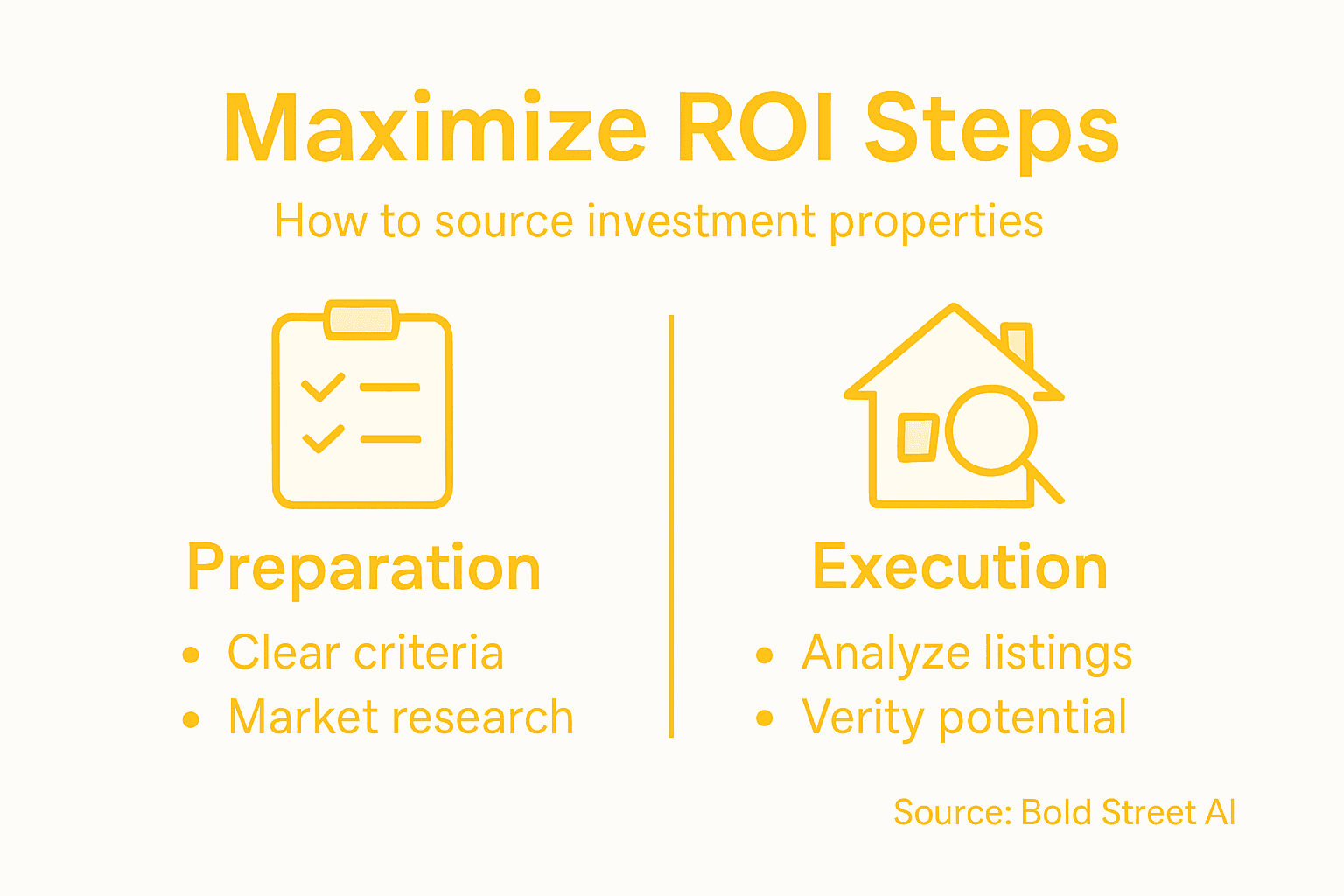
Finding the right investment property as a first-time investor in the United States can feel overwhelming with so many choices and unknowns. Every decision impacts your long-term success, from setting clear financial goals to understanding the dynamics of different American markets. Drawing from expert strategies, this guide breaks the process into practical steps that help you clarify your goals, research promising markets, and confidently evaluate each property for its income potential.
Table of Contents
- Step 1: Define Your Investment Criteria
- Step 2: Research Target Markets
- Step 3: Analyze Property Listings
- Step 4: Engage With Local Professionals
- Step 5: Verify Property Potential
Quick Summary
| Key Insight | Explanation |
|---|---|
| 1. Define Clear Investment Criteria | Establish specific financial goals and property types to effectively focus your investment strategy. |
| 2. Conduct In-Depth Market Research | Analyze demographic and economic indicators to identify promising markets for investment opportunities. |
| 3. Utilize a Structured Property Analysis | Develop a systematic approach to evaluate listings based on financial metrics and property condition. |
| 4. Build Relationships with Local Professionals | Networking with industry experts can reveal hidden opportunities and provide valuable market insights. |
| 5. Implement Thorough Verification Processes | Diligently assess potential properties through financial, physical, and market analyses to mitigate risks. |
Step 1: Define your investment criteria
Defining your investment criteria creates a strategic roadmap for sourcing properties that align with your financial goals. This crucial step helps you filter opportunities efficiently and focus on investments most likely to generate strong returns.
To establish clear investment criteria, start by determining your fundamental objectives. Consider these key parameters:
- Financial goals: Short-term cash flow or long-term appreciation?
- Risk tolerance: Conservative returns or higher-risk investments?
- Investment horizon: 3-5 years or 10-15 years?
- Property types: Single-family homes, multi-family units, or mixed-use properties?
Your criteria should include specific, measurable benchmarks. Analyzing investment properties requires precise metrics like minimum cash-on-cash return, target cap rates, and acceptable price-to-rent ratios. Experienced investors typically seek properties offering at least 1% monthly rent-to-purchase price ratio and a cap rate between 4-10%.
Here’s a comparison of key real estate investment metrics and how each impacts decision making:
| Metric | Definition | Impact on Investment |
|---|---|---|
| Cap Rate | Net operating income divided by property price | Indicates potential return |
| Price-to-Rent Ratio | Purchase price divided by annual rent | Assesses value for rental |
| Cash-on-Cash Return | Annual pre-tax cash flow over cash invested | Measures immediate profitability |
| Vacancy Rate | Percentage of unoccupied units | Signals local market demand |
Geographic location plays a critical role in defining investment parameters. Research local market trends, population growth, job market stability, and neighborhood development potential. Focus on areas with consistent demand, strong rental markets, and potential for appreciation.
Developing clear investment criteria transforms property hunting from a scattered approach to a targeted, strategic process.
Pro tip: Create a detailed investment criteria spreadsheet with non-negotiable requirements and flexible preferences to streamline your property sourcing efforts.
Step 2: Research target markets
Researching target markets is a critical step in your real estate investment journey, helping you identify locations with the most promising potential for property appreciation and rental income. This strategic investigation will guide your investment decisions and minimize potential risks.
Start by analyzing comprehensive market indicators through these key research methods:
- Demographic trends: Population growth, age distribution, and income levels
- Economic indicators: Job market stability, unemployment rates, and industry diversity
- Real estate metrics: Housing market dynamics including median home prices, rental rates, and vacancy percentages
Dive deep into local economic conditions by examining specific data points. Look for markets with strong job creation, consistent population growth, and emerging industries. College towns, technology hubs, and areas with robust healthcare or manufacturing sectors often provide stable investment opportunities.
Understand the nuanced characteristics of potential markets. Investigate infrastructure developments, city planning initiatives, and neighborhood transformation projects. These factors can signal future property value increases and potential rental demand.

This summary shows how market types influence real estate investment outcomes:
| Market Type | Main Opportunity | Primary Risk | Typical Investor Focus |
|---|---|---|---|
| College Town | Consistent rental demand | Seasonality, turnover | Student housing, rentals |
| Tech Hub | High appreciation potential | Rapid price swings | Growth, long-term holds |
| Suburban Growth | Stable families, new jobs | Slower value growth | Starter homes, rentals |
| Downtown Core | Premium rents, walkability | High acquisition costs | Upscale rentals, condos |
Market research transforms random property selection into a calculated investment strategy.
Pro tip: Create a comparative spreadsheet tracking multiple markets, using color-coded indicators to quickly assess and compare investment potential across different regions.
Step 3: Analyze property listings
Analyzing property listings is a critical skill that transforms raw data into actionable investment insights. This step requires a systematic approach to evaluating potential real estate opportunities and identifying properties with genuine profit potential.
Begin by developing a comprehensive analysis framework focusing on these essential evaluation criteria:
- Financial metrics: Gross rental income, expenses, net operating income
- Property condition: Age, recent renovations, potential repair costs
- Market comparables: Similar property values in the neighborhood
- Potential value-add opportunities: Renovation or repositioning potential
Property underwriting techniques are crucial for extracting meaningful insights from listings. Examine each property’s financial performance by calculating key metrics like cash flow, capitalization rate, and potential return on investment. Look beyond surface-level numbers to understand the property’s true income-generating capabilities.
Cross-reference listing information with multiple data sources. Investigate local market trends, check property history, and verify all presented financial claims. Pay special attention to rental income potential, vacancy rates, and any existing lease structures that could impact your investment strategy.
Smart investors treat property listings as detailed financial narratives, not just marketing materials.
Pro tip: Create a standardized scoring system for property listings, assigning weighted points to each critical evaluation criteria to objectively compare potential investments.
Step 4: Engage with local professionals
Engaging with local real estate professionals is your strategic pathway to uncovering hidden investment opportunities and gaining insider market knowledge. This critical networking step can dramatically accelerate your property sourcing and investment success.
Build a robust professional network by targeting key industry experts:
- Real estate agents: Specializing in investment properties
- Property managers: With local market expertise
- Attorneys: Familiar with real estate transactions
- Lenders: Experienced in investment property financing
- Contractors: Knowledgeable about renovation potential
Real estate networking strategies are essential for developing meaningful professional relationships. Attend local real estate investor meetups, join professional associations, and participate in industry events to expand your connections. Be prepared to offer value first – share insights, refer opportunities, and demonstrate genuine interest in collaborative relationships.
Approach each professional interaction as a two-way partnership. Ask insightful questions about local market trends, seek advice on potential properties, and develop a reputation as a serious, professional investor. Many off-market opportunities emerge through personal connections and trusted referral networks.
Professional relationships are the hidden currency of successful real estate investing.
Pro tip: Create a comprehensive contact management system to track interactions, follow up consistently, and nurture relationships with key local professionals.
Step 5: Verify property potential
Verifying property potential is the critical due diligence phase that separates successful investors from those making uninformed decisions. This step transforms your property evaluation from speculation to strategic investment by thoroughly examining every aspect of the potential acquisition.
Conduct a comprehensive verification process through these essential components:
- Financial performance: Historical income and expense records
- Physical inspection: Detailed property condition assessment
- Market analysis: Neighborhood growth potential and comparable sales
- Legal considerations: Zoning restrictions, property liens, potential encumbrances
- Potential improvements: Renovation opportunities and value-add strategies
Real estate investment analysis requires meticulous examination of both tangible and intangible factors. Hire professional inspectors to conduct thorough property assessments, including structural evaluations, pest inspections, and systems functionality. Review tax records, rental history, and utility costs to validate the property’s true financial performance.
Calculate potential returns using multiple scenarios. Develop conservative, moderate, and optimistic financial projections that account for potential market fluctuations, unexpected repairs, and vacancy periods. This approach provides a robust understanding of the property’s true investment potential.
Verification is the shield that protects your investment from hidden risks and unexpected challenges.
Pro tip: Create a standardized verification checklist with weighted scoring to objectively evaluate each property’s potential and compare multiple investment opportunities.
Unlock Smart Investment Opportunities with Bold Street AI
Sourcing investment properties for maximum ROI requires clear criteria, thorough market research, precise property analysis, and reliable local connections. If you find yourself overwhelmed by these crucial steps or want to avoid costly mistakes, Bold Street AI is designed to help you. Our platform streamlines the entire process by connecting you with investor-friendly agents, lenders, and property managers who understand your goals and risk tolerance. We also provide powerful tools to analyze listings and verify property potential so you can confidently make informed decisions.

Take control of your real estate investing journey today by exploring curated investment opportunities and accessing expert insights through our educational portal. Visit Bold Street AI now to start building your profitable portfolio. Don’t miss out on the chance to transform your property sourcing strategy into a targeted, efficient, and rewarding experience.
Frequently Asked Questions
What criteria should I define for sourcing investment properties?
Defining clear investment criteria involves evaluating your financial goals, risk tolerance, investment horizon, and preferred property types. Start by listing specific metrics like desired cash-on-cash returns or target cap rates to guide your property searches effectively.
How can I research target markets for real estate investments?
To research target markets, analyze demographic trends, economic indicators, and housing market dynamics. Focus on areas with strong job growth and consistent population increases, and create a comparative spreadsheet to track metrics for different locations.
What financial metrics should I analyze when assessing property listings?
When analyzing property listings, key financial metrics include gross rental income, net operating income, and expenses. Calculate metrics such as cash flow and capitalization rate to determine the property’s profitability and sustainability.
How do I verify the potential of a property before purchasing?
Verifying a property’s potential involves conducting a thorough financial performance review, performing a physical inspection, and analyzing local market conditions. Create a verification checklist to systematically assess all aspects of the property and compare them with your investment criteria.
What types of local professionals should I engage for investment insights?
Engage with local real estate agents, property managers, real estate attorneys, lenders, and contractors. Building relationships with these professionals can provide you with valuable market insights and access to off-market opportunities that may enhance your investment strategy.
Recommended
- Step by Step Real Estate Investing for Beginners | Bold Street AI
- Step-by-Step Guide to Analyzing Investment Properties | Bold Street AI
- 7 Examples of Investment Strategies for New Property Investors | Bold Street AI
- 7 Key Examples of Residential Investment Strategies | Bold Street AI
- Gold und Immobilien: Diversifikation für Krisenzeiten – GoldSilberMarkt
- 7 Google Ads Tips Every London Business Should Know