
Every American property investor eventually faces the question of how to transition out of their real estate holdings while protecting profits. With market fluctuations and unpredictable economic shifts, finding the right exit strategy becomes vital for long-term success and financial stability. By exploring proactive exit planning and building flexibility into every investment, new investors can learn how to create resilient portfolios that thrive despite market volatility.
Table of Contents
- Defining Real Estate Exit Strategies
- Primary Types of Exit Strategies Explained
- Process and Timing for Each Strategy
- Legal, Tax, and Compliance Considerations
- Risks, Costs, and Common Pitfalls
Key Takeaways
| Point | Details |
|---|---|
| Real Estate Exit Strategy Importance | Having a well-defined exit strategy is crucial for maximizing financial returns and adapting to market conditions. |
| Multiple Exit Options | Investors should consider various exit strategies like selling, refinancing, or renting to enhance financial flexibility. |
| Timing and Planning | Precise timing and advance planning are essential to capitalize on optimal market conditions for exits. |
| Legal and Tax Considerations | Understanding legal and tax implications is vital for successful execution and to avoid potential pitfalls. |
Defining Real Estate Exit Strategies
A real estate exit strategy represents a calculated plan for property investors to transition out of their investments while maximizing financial returns. Exit strategies in business contexts involve systematic methods for transferring ownership or winding down operations in a controlled, strategic manner.
At its core, a real estate exit strategy involves predetermined plans for selling, transferring, or repositioning an investment property to achieve optimal financial outcomes. These strategies are not one-size-fits-all but require nuanced approaches tailored to individual investment goals, market conditions, and personal financial objectives.
Key components of effective real estate exit strategies typically include:
- Establishing clear investment timelines
- Understanding potential market appreciation
- Identifying multiple potential buyer segments
- Calculating potential tax implications
- Evaluating property improvement opportunities
- Assessing current market conditions
Proactive exit planning transforms property investment from a passive asset into a dynamic financial instrument. Comprehensive owner readiness planning emphasizes that successful exits are not accidental but meticulously engineered outcomes.
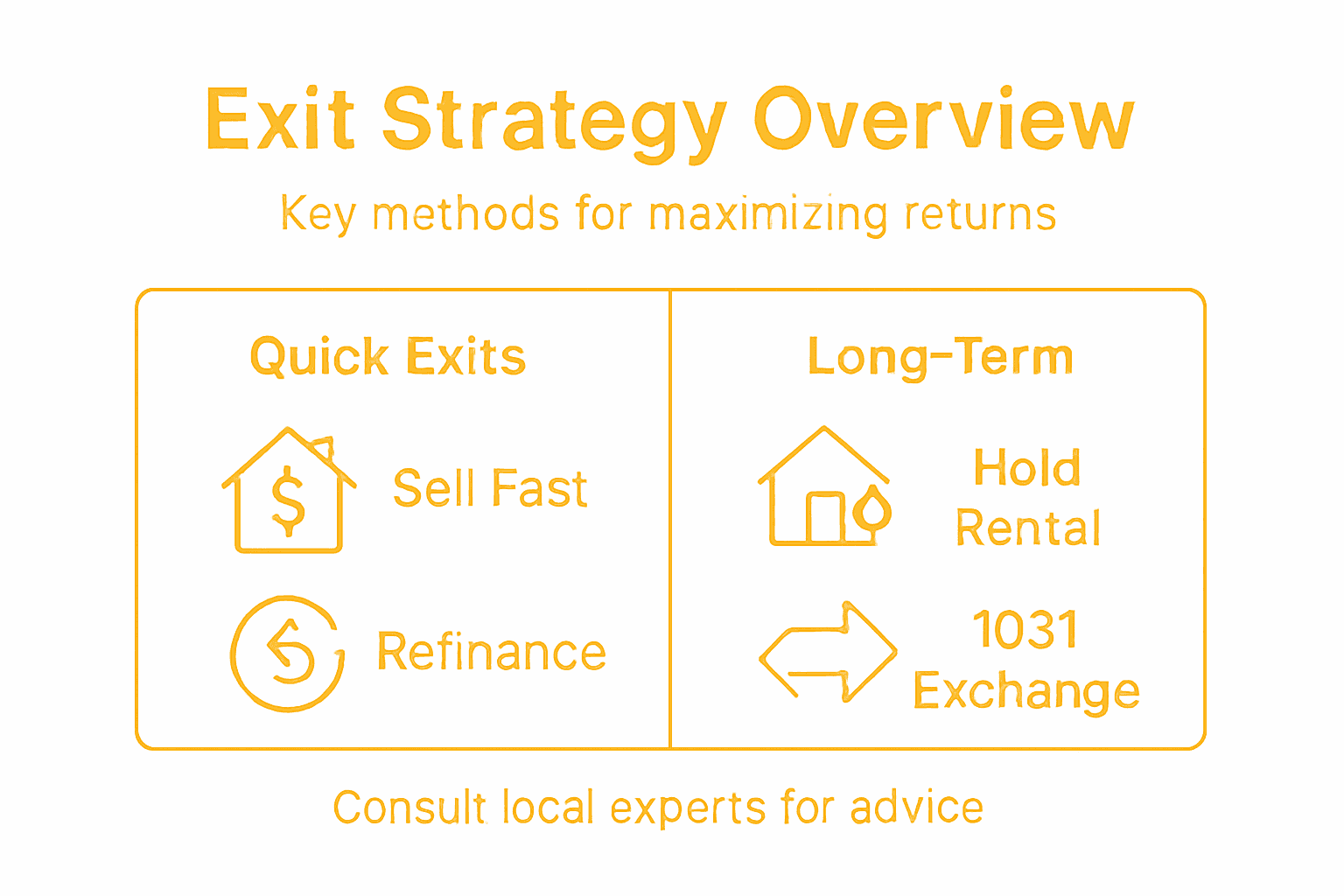
Financial flexibility remains the hallmark of sophisticated real estate investment. Investors who develop multiple exit pathways create resilient investment portfolios capable of adapting to shifting market dynamics.
Pro tip: Always develop at least three potential exit strategies for each real estate investment to ensure maximum adaptability and minimize potential financial risks.
Primary Types of Exit Strategies Explained
Real estate investors have multiple exit strategy options designed to maximize financial returns and align with individual investment goals. Various exit strategies provide flexibility in managing property investments across different market conditions and personal financial objectives.
The primary exit strategies for real estate investors typically include:
- Sell and Cash Out: Directly selling the property at market value
- Refinance: Extracting equity while maintaining property ownership
- Rental Property Conversion: Transforming the property into a long-term income generator
- 1031 Exchange: Deferring capital gains tax by reinvesting proceeds into similar properties
- Owner Financing: Selling the property while acting as the lender
- Partnership Dissolution: Selling or transferring ownership shares
Comprehensive exit planning requires understanding the nuanced implications of each strategy. Exit strategies for business owners emphasize that successful transitions are meticulously engineered rather than accidental outcomes.

Each exit strategy carries unique financial considerations, tax implications, and potential risks. Sophisticated investors develop multiple exit pathways, ensuring they can adapt to changing market dynamics and personal financial needs.
Here’s how the main real estate exit strategies compare regarding liquidity, tax impact, and long-term potential:
| Strategy | Liquidity Speed | Tax Considerations | Long-term Wealth Impact |
|---|---|---|---|
| Sell and Cash Out | Fast sell, immediate funds | Capital gains taxes due upon sale | Ends asset appreciation, funds redeployed |
| Refinance | Moderate, requires approval | Tax-free cash if structured properly | Property retained for further gains |
| Rental Property Conversion | Low, income over time | Rental income taxes apply | Ongoing wealth accumulation |
| 1031 Exchange | Delayed, needs replacement | Tax deferral if rules followed | Allows portfolio growth and scaling |
| Owner Financing | Payout over term, gradual | Installment sale taxation methods | Generates recurring income stream |
| Partnership Dissolution | Depends on agreement terms | Split gains per ownership structure | Ends joint ownership, funds available |
Pro tip: Consult with a tax professional and real estate attorney before finalizing any exit strategy to understand the full financial and legal implications of your chosen approach.
Process and Timing for Each Strategy
Real estate exit strategies require precise timing and methodical execution to maximize investment returns. Strategic exit planning demands comprehensive preparation well in advance of the actual transition, ensuring investors can capitalize on optimal market conditions.
Timing considerations for different exit strategies include:
-
Sell and Cash Out: – Ideal timing during peak market appreciation
- Typically 3-5 years after initial investment
- Monitor local market trends closely
-
Refinance:
- Best executed when property value increases
- Typically 2-4 years after initial purchase
- Requires strong credit and equity buildup
-
Rental Property Conversion:
- Minimum 1-2 years of ownership recommended
- Assess rental market demand before transitioning
- Evaluate potential cash flow and maintenance costs
-
1031 Exchange:
- Strict 45-day identification window
- Complete exchange within 180 days
- Requires precise tax planning and timing
Comprehensive exit preparation involves multiple strategic steps. Exit strategy development emphasizes the importance of continuous assessment and flexible planning to adapt to changing market dynamics.
Successful real estate investors understand that timing is everything. Market conditions, personal financial goals, and economic indicators all play crucial roles in determining the most opportune moment to execute an exit strategy.
Pro tip: Create a detailed timeline and contingency plan for your exit strategy, reviewing and updating it annually to ensure alignment with your evolving investment objectives.
Legal, Tax, and Compliance Considerations
Navigating the complex landscape of real estate exit strategies requires a comprehensive understanding of legal, tax, and regulatory requirements. Tax implications for homeowners can significantly impact the financial outcomes of property investments, making thorough research and professional guidance essential.
Key legal and tax considerations include:
-
Capital Gains Tax:
- Potential exclusion of up to $250,000 for single filers
- Up to $500,000 exclusion for married couples filing jointly
- Requires primary residence ownership and use tests
-
Reporting Requirements:
- Mandatory disclosure of property sales
- Detailed documentation of purchase and sale prices
- Tracking improvements and associated expenses
-
Regulatory Compliance:
- Residential real estate transaction reporting
- Compliance with federal and state regulations
- Potential additional reporting for investment properties
-
Entity Structuring:
- Tax implications of different ownership structures
- Potential benefits of LLC or trust ownership
- Consultation with tax professionals recommended
Proactive compliance is crucial for minimizing legal risks and maximizing financial returns. Investors must stay informed about changing regulations and potential tax implications that could impact their exit strategies.
Successful real estate investors understand that legal and tax considerations are not afterthoughts but integral components of a comprehensive investment strategy. Careful planning and professional guidance can help navigate these complex requirements effectively.
Pro tip: Maintain meticulous records of all property-related expenses, improvements, and transactions, and consult with a qualified tax professional before executing any exit strategy.
Risks, Costs, and Common Pitfalls
Real estate exit strategies come with inherent financial complexities that can significantly impact investment returns. Real estate market disruptions highlight the critical importance of understanding potential risks before executing any investment transition.
Key risks and potential pitfalls include:
-
Financial Risks:
- Unexpected market downturns
- Reduced property valuation
- Liquidity challenges
- Higher transaction costs
-
Operational Risks:
- Incomplete due diligence
- Inadequate property maintenance
- Misaligned exit timing
- Poor market research
-
Regulatory Risks:
- Changing tax legislation
- Zoning restrictions
- Compliance complications
- Unexpected legal barriers
-
Market Condition Risks:
- Investment market volatility
- Economic recession impacts
- Regional market fluctuations
- Shifting demographic trends
Comprehensive risk management requires proactive assessment and strategic planning. Investors must develop robust contingency plans that anticipate potential challenges and provide flexible response mechanisms.
The following table highlights common risks in real estate exit strategies and recommended mitigation actions:
| Risk Category | Typical Scenario | Mitigation Strategy |
|---|---|---|
| Financial | Unexpected market decline | Maintain cash reserves, diversify |
| Operational | Missed deadlines or poor planning | Establish clear process checklists |
| Regulatory | New local or federal legislation | Stay updated, consult professionals |
| Market Conditions | Shifting buyer demand or recessions | Flexible exit planning, ongoing review |
Successful real estate investors understand that risk mitigation is not about eliminating all potential challenges but about creating strategic buffers that protect investment value and minimize potential financial exposure.
Pro tip: Conduct thorough due diligence, maintain a robust financial reserve, and continuously educate yourself about local market trends to effectively navigate potential investment risks.
Navigate Your Real Estate Exit Strategies with Confidence
Real estate exit strategies demand precise timing, thorough planning, and a clear understanding of market dynamics to maximize your returns and avoid common pitfalls. If you are looking to develop multiple exit pathways like selling, refinancing, or leveraging a 1031 exchange, the complexity can feel overwhelming. Bold Street AI is designed to simplify this journey by connecting you with trusted real estate professionals, providing tailored educational resources, and helping you uncover curated investment opportunities that align with your goals.

Take control of your investment future today. Visit Bold Street AI to explore proven strategies, access personalized guidance from expert agents and lenders, and join a community dedicated to empowering investors at every level. Don’t let uncertainty hold you back from maximizing your property’s potential. Start your exit strategy the smart way with Bold Street AI and transform your investments into lasting wealth.
Frequently Asked Questions
What are common real estate exit strategies?
Common exit strategies include selling and cashing out, refinancing, converting rental properties, utilizing a 1031 exchange, owner financing, and partnership dissolution. Each strategy has unique financial considerations and implications.
How do I determine the best time to exit a real estate investment?
Timing for an exit strategy is crucial and depends on market conditions, personal financial goals, and property performance. It’s typically best to exit during peak market conditions or when property value has significantly increased.
What are the tax implications of selling a property?
When selling a property, capital gains tax may apply, with potential exclusions available for primary residences. It’s essential to understand the reporting requirements and consult a tax professional to handle any complexities associated with your specific situation.
What risks should I consider when planning a real estate exit strategy?
Key risks include financial market downturns, operational issues like inadequate due diligence, regulatory changes, and needing to adjust to shifting buyer demands. Proactive risk management and contingency planning are vital to mitigating these risks.
Recommended
- 7 Examples of Investment Strategies for New Property Investors | Bold Street AI
- 7 Key Examples of Residential Investment Strategies | Bold Street AI
- Real Estate Investment Strategies 2026: What Works Now | Bold Street AI
- Why Invest in Residential Real Estate 2026 – Smart Wealth Strategies | Bold Street AI