
Every new investor faces a crucial choice when stepping into the American real estate market in 2026. The old strategies that once made passive income almost automatic no longer deliver the same results, especially with higher financing costs and rising competition in private credit. As the U.S. market pivots, understanding cutting-edge investment strategies and seeking out real mentorship can help you avoid missteps and make confident, informed decisions in a changing industry.
Table of Contents
- Defining Real Estate Investment Strategies 2026
- Major Asset Types and New Market Segments
- Innovative Financing and Fractional Ownership Models
- Tech-Driven Approaches and Data Analytics
- Understanding Risk, Regulation, and Tax Law Changes
- Common Pitfalls and Keys to Sustainable Success
Key Takeaways
| Point | Details |
|---|---|
| Define Your Strategy Carefully | A clear real estate investment strategy involves answering critical questions about property types, financing, and targeted returns. This strategy should be flexible, adapting to market changes and personal circumstances. |
| Embrace Diverse Asset Types | Consider broadening your portfolio to include small multifamily properties and land in growth markets. These can optimize cash flow and offer potential appreciation. |
| Leverage Technology and Data | Utilize predictive analytics and property management software to make informed investment decisions and improve operational efficiency. Data-driven insights can enhance your strategy and reduce risks. |
| Stay Informed on Regulations and Risks | Understanding tax laws, regulatory changes, and liability exposure is crucial for profitability. Make informed decisions by consulting professionals before engaging in investments. |
Defining Real Estate Investment Strategies 2026
A real estate investment strategy in 2026 is your playbook for how you’ll acquire, manage, and profit from residential properties. It’s not just about buying a house and hoping the value goes up. Instead, it’s a deliberate framework that accounts for your financial goals, risk tolerance, market conditions, and available capital. The strategies that work now differ significantly from those that dominated previous decades, largely due to shifting economic conditions and how investors access capital.
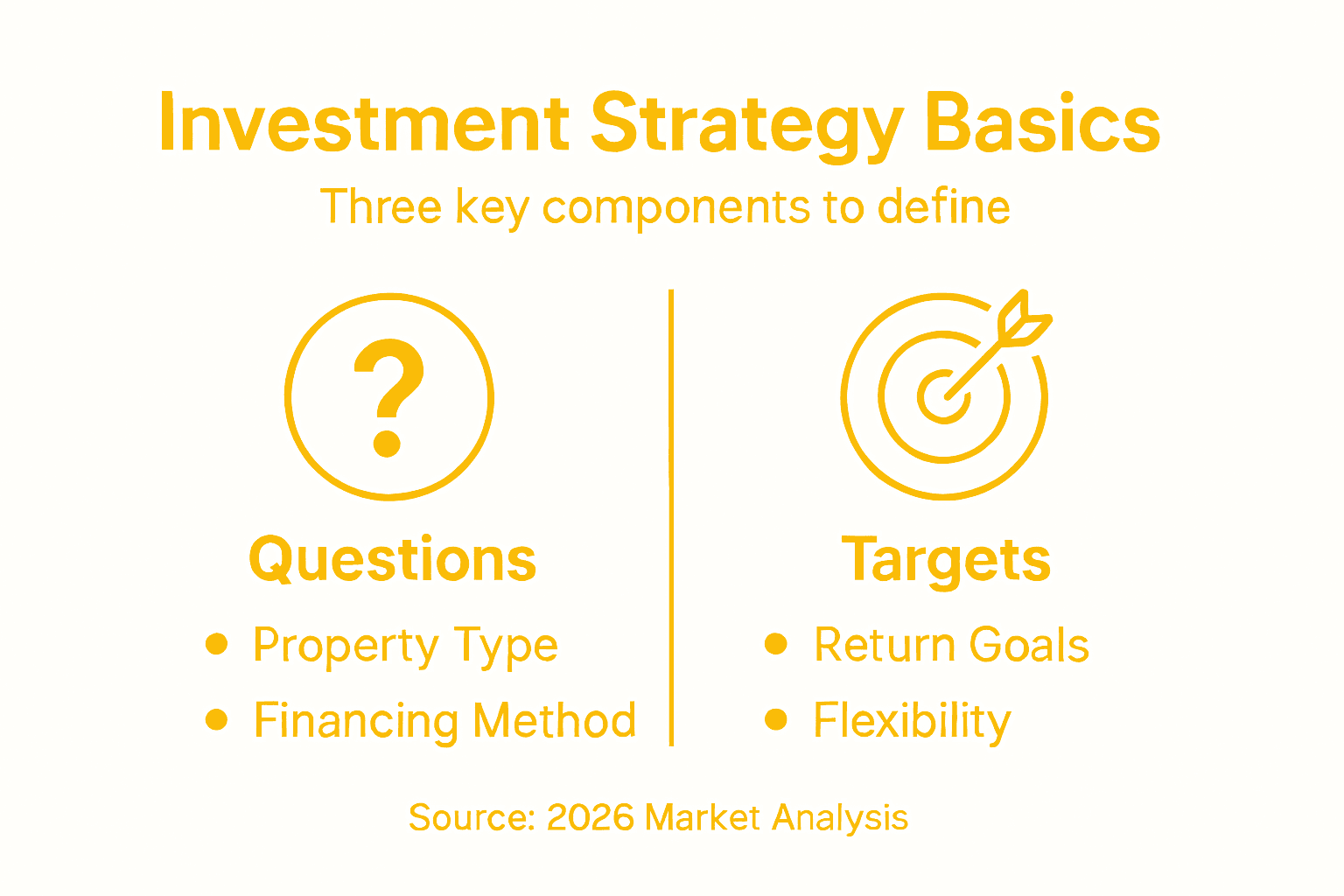
When you define your strategy, you’re essentially answering three core questions: What types of residential properties fit your investment goals? How will you finance them? And what returns are you targeting? These questions force you to think beyond impulse decisions. For instance, someone with limited capital might focus on single-family homes in emerging neighborhoods, while another investor with substantial resources could pursue small multifamily properties for steady cash flow. The 2026 real estate market outlook shows that property selection and management have become the primary drivers of investment success, meaning your strategy must account for which specific asset classes align with current conditions and your capacity to manage them.
What makes 2026 different from previous years is the convergence of three major factors: higher financing costs that demand smarter deal analysis, technological tools that provide unprecedented market transparency, and demographic shifts creating specific housing demand patterns. Modern investors can’t rely on broad market appreciation alone. Instead, successful strategies emphasize income-driven approaches, where monthly rental income covers your costs and generates profit regardless of property value fluctuations. This shift toward fundamentals rather than speculation has changed which strategies actually work. Understanding these distinctions allows you to build a strategy that’s resilient through market cycles rather than dependent on one outcome.
Your strategy also needs flexibility built in. Markets move faster now than they did a decade ago, and properties that made sense six months ago might face different conditions today. This means your strategy isn’t set in stone at year one. Instead, think of it as a living document that you review and adjust as market conditions change, your personal circumstances evolve, or new opportunities emerge. The most successful investors combine clear strategic vision with the agility to pivot when data suggests a different approach would generate better returns.
Pro tip: Write down your three core investment questions (property type, financing method, and return targets) before analyzing any deals—this clarity prevents emotional decisions when you encounter an attractive property that doesn’t fit your actual strategy.
Major Asset Types and New Market Segments
The residential real estate market in 2026 isn’t monolithic anymore. Success depends on understanding which specific asset types match your goals and capital, then identifying undervalued segments within those categories. The traditional single-family rental still works, but savvy investors are branching into complementary niches that offer better cash flow or appreciation potential.
Single-family homes remain the foundation for many portfolios because they’re straightforward to manage, attract stable tenants, and offer clear exit strategies. However, small multifamily properties (two to four units) are gaining traction among investors who want higher income without the complexity of larger buildings. These properties generate substantially more rental income than single-family homes on similar investment amounts, yet stay within the scope where you can self-manage or hire local property managers affordably. Land investments are another compelling segment gaining momentum, particularly parcels in emerging neighborhoods where demographic growth suggests future development or appreciation. Expanding into diverse residential asset types allows you to optimize for your specific financial capacity and management style.

Beyond traditional residential, the boundaries of what qualifies as real estate investment are shifting. While commercial sectors like data centers and office space fall outside residential focus, understanding the broader market context matters. Real estate debt is growing faster than equity, with private credit becoming increasingly attractive to sophisticated investors. This trend affects how you’ll access financing in 2026, since lenders are becoming more selective about residential deals. Geographic diversification within the residential sector is also critical. Instead of focusing solely on your local market, consider opportunities in emerging secondary markets with strong demographic tailwinds, cheaper acquisition prices, and solid rental demand. These markets often have lower competition from institutional investors, meaning you face less pricing pressure and can negotiate better terms.
The key shift happening now is that investors are moving from passive, core asset strategies toward more active, hands-on approaches that require deeper market knowledge. You might buy a single-family home in a stable neighborhood for steady cash flow, simultaneously pursue a small multifamily property in an appreciating area, and hold land in a high-growth corridor. This layered approach provides income today while positioning you for different outcomes across market cycles.
Here’s how core residential asset types compare in 2026:
| Asset Type | Typical Investor Profile | Income Potential | Management Complexity |
|---|---|---|---|
| Single-Family Home | First-time or conservative buyer | Moderate, stable rents | Low, easy to self-manage |
| Small Multifamily (2-4) | Experienced seeking higher cash | High, multiple units | Moderate, some supervision |
| Land in Growth Markets | Long-term, risk-tolerant | Appreciation focused | Low, until developed |
| Fractional Ownership | Low capital, diversifier | Proportional to share | Minimal, third-party managed |
Pro tip: Analyze each asset type’s cash-on-cash return in your specific market before investing, not just overall appreciation potential, since 2026 financing costs reward deals with strong monthly income over speculative appreciation plays.
Innovative Financing and Fractional Ownership Models
Traditional real estate financing has always worked one way: you get a loan for the full property, you own it outright, and you manage it yourself. That model still exists in 2026, but the investment landscape now offers alternatives that lower barriers to entry and spread risk across multiple investors. Understanding these newer approaches expands your toolkit for building wealth, especially if you have limited capital or want exposure to premium properties without the management burden.
Fractional ownership platforms allow multiple investors to buy shares of a single property rather than each acquiring an entire asset. Think of it like owning a piece of premium real estate alongside other investors through a regulated structure. Small and medium Real Estate Investment Trusts now enable you to purchase shares in high-value Grade A properties with investments far smaller than traditional property purchases would require. Instead of needing $300,000 to buy a rental property outright, you might invest $10,000 to $50,000 and own a proportional stake in a professionally managed residential complex. This approach democratizes access to institutional-quality assets while reducing your management responsibilities since professional teams handle tenant relations, maintenance, and operations.
Tokenized real estate platforms built on blockchain technology represent the cutting edge of fractional ownership. Digital tokens represent your ownership stake, and you can buy, sell, or trade these tokens more fluidly than traditional real estate shares. The technology improves operational efficiency and creates new liquidity opportunities, though the regulatory landscape is still evolving. For beginners evaluating how to start their investment journey, exploring financing options tailored to your situation helps you compare traditional mortgages against fractional ownership or alternative lending structures.
The practical reality is that fractional ownership and tokenized real estate aren’t replacements for direct property ownership. They’re complementary strategies. You might use traditional financing to acquire a single-family rental for hands-on management and maximum leverage, while simultaneously investing a smaller amount in fractional ownership of multifamily properties for passive income and diversification. This hybrid approach lets you benefit from both direct control and professional management depending on your goals. The key consideration is understanding each model’s liquidity, tax implications, and management expectations before committing capital.
Pro tip: Compare the fee structures of fractional ownership platforms carefully, since annual management fees ranging from 0.5% to 2% significantly impact your long-term returns compared to self-managing a direct property investment.
Tech-Driven Approaches and Data Analytics
The residential real estate investors who succeed in 2026 don’t rely on gut instinct or outdated market knowledge. They use technology and data to make smarter acquisition decisions, identify undervalued properties, optimize pricing for rental income, and manage portfolios efficiently. The barrier to entry for these tools has dropped dramatically, meaning even solo investors can access analytical capabilities that were reserved for large institutions just five years ago.
Predictive analytics powered by machine learning now helps investors forecast which neighborhoods will appreciate, estimate optimal rental rates based on comparable properties, and identify investment properties before they hit the mainstream market. Instead of manually researching comparable sales and rent rolls, you can input property details into platforms that instantly analyze market data, tenant demand patterns, and appreciation trends. AI-powered real estate technologies are transforming how investors evaluate opportunities, with over 700 AI-focused companies now serving the real estate sector. These tools improve valuation accuracy and provide predictive market intelligence that significantly reduces the risk of overpaying for properties or underestimating rental income potential.
Beyond acquisition analysis, data analytics drives operational efficiency in property management. Platforms now track maintenance schedules, automate tenant communication, analyze expense patterns, and forecast cash flow with precision. Property management software integrates tenant data, rent collection, maintenance requests, and financial reporting into single dashboards, reducing time spent on administrative tasks by hours each month. Digital transformation across real estate combines AI, big data, and machine learning to streamline workflows and enhance decision-making throughout the investment lifecycle. Augmented reality tools even allow remote property tours and design visualization, helping you evaluate properties without traveling or conducting in-person inspections.
The practical application for your portfolio is straightforward: leverage these tools to identify undervalued opportunities others miss, then use operational analytics to maximize profit margins. You might use data analytics to discover that a particular neighborhood’s rent growth is outpacing local awareness, allowing you to acquire properties before prices fully adjust. Then, implement property management software to optimize tenant retention and reduce vacancy, directly improving your cash-on-cash returns. The investors gaining competitive advantage aren’t necessarily smarter than competitors—they’re simply using available data systematically to make better decisions consistently.
The following table summarizes how modern technology is transforming real estate investing:
| Technology | Main Use Case | Investor Benefit |
|---|---|---|
| Predictive Analytics | Valuing and finding deals | Better deal selection, less risk |
| Property Management | Automating admin tasks | Saves time, reduces errors |
| Blockchain Platforms | Fractional ownership, trades | Greater liquidity, easy access |
| Augmented Reality | Remote tours, design review | Faster decisions, lower costs |
Pro tip: Start with a data-first approach to analyzing your first deal: use free or low-cost tools to compare comparable properties, analyze neighborhood trends, and stress-test your underwriting assumptions before making offers, since accurate analysis prevents costly mistakes more effectively than advanced technology eliminates them.
Understanding Risk, Regulation, and Tax Law Changes
Real estate investing in 2026 happens within a framework of tax rules, regulatory requirements, and risk factors that directly impact your profitability. Ignoring these elements costs money. A property that looks profitable on paper can become a tax burden or regulatory nightmare if you don’t understand the rules governing your specific situation. The good news is that the tax landscape for residential real estate investors remains favorable, but it’s shifting in ways you need to understand before committing capital.
Start with taxes. The Qualified Business Income (QBI) deduction remains permanently extended, allowing you to deduct up to 20 percent of your qualified real estate income, which translates to meaningful tax savings on rental profits. However, bonus depreciation is phasing down significantly, dropping from 40 percent in 2025 to 20 percent in 2026. This matters if you’re buying properties expecting aggressive depreciation deductions in early years. Real Estate Professional Status continues as a valuable strategy that allows you to deduct real estate losses against other income, but the Internal Revenue Service is increasing scrutiny on who qualifies. If you spend substantial time on real estate activities and claim professional status, document your hours meticulously. One-031 exchanges remain powerful tools for deferring capital gains when you sell a property and reinvest proceeds into another qualifying property, allowing you to defer taxes indefinitely if you keep upgrading properties strategically.
Regulatory changes are expanding rapidly. New anti-money laundering rules from FinCEN now require detailed beneficial ownership reporting on all-cash residential transactions involving entities or trusts. If you’re buying through a limited liability corporation or trust, expect increased documentation requirements and longer closing timelines. State regulations are tightening as well, particularly around digital marketing and artificial intelligence use in real estate advertising. These compliance burdens affect agents and title companies, but ultimately impact you through higher closing costs and extended timelines.
Risk management requires understanding liability exposure. Residential rental properties carry liability risks from tenant injuries, property damage claims, and employment issues if you hire contractors or staff. Most investors mitigate this through proper business entity formation (typically LLCs), adequate insurance coverage, and clear lease documentation. Keep properties properly maintained to reduce injury risks, and maintain umbrella insurance policies that extend beyond standard landlord coverage. The fundamental principle is separating personal assets from investment property liability by using legal entities and comprehensive insurance.
Pro tip: Consult a CPA who specializes in real estate before your first purchase, not after, since tax strategy decisions made at acquisition time compound into thousands of dollars in savings or missed deductions over your holding period.
Common Pitfalls and Keys to Sustainable Success
Investors who fail in real estate typically don’t lack capital or market access. They fail because they make preventable mistakes that compound over time. Understanding these pitfalls before you encounter them prevents costly errors that can take years to recover from. The good news is that most mistakes are predictable and avoidable if you know what to watch for.
The biggest pitfall is underestimating costs. New investors budget for mortgage, taxes, and insurance, then get blindsided by maintenance expenses that devour their cash flow projections. Roof leaks, HVAC failures, and tenant turnover costs add up fast. Budget 1 percent of your property value annually for maintenance, then add 50 percent more as a safety buffer. Another critical mistake is making emotional decisions rather than data-driven ones. You see a property you love in a neighborhood with strong appreciation potential, so you overpay or accept weaker cash flow than your criteria allow. Stick to your investment parameters even when a deal feels tempting. Regional market disparities also trip up investors who assume conditions in their home market apply everywhere. A neighborhood thriving in one city might be declining in another. This is why thorough market research examining local employment, population trends, and rent growth patterns is non-negotiable before acquiring properties in new markets.
Successful investors in 2026 prioritize cash flow over appreciation. With elevated interest rates making leverage more expensive, deals that don’t generate solid monthly income become liabilities rather than assets. They also diversify across asset types and geographic regions instead of concentrating everything in one market or property type. A portfolio combining single-family homes in stable neighborhoods, small multifamily properties in appreciating markets, and land in high-growth corridors weathers market cycles better than concentrated bets. Creative financing strategies and AI-powered market analysis help you identify undervalued assets and structure deals that work in a higher-rate environment. Most importantly, successful investors maintain detailed financial records, hire professional property managers rather than trying to self-manage everything, and establish clear exit strategies before acquiring each property.
The path to sustainable success requires discipline more than luck. You need a written investment plan defining your target properties, financing approach, and performance metrics. You need systems for tracking income and expenses so you understand actual returns versus projections. You need professional advisors including a CPA, real estate attorney, and insurance specialist. When you combine these fundamentals with data-driven decision-making and patience, real estate becomes a reliable wealth-building vehicle rather than a source of stress and disappointment.
Pro tip: Create a spreadsheet tracking three specific numbers for every property: actual monthly cash flow after all expenses, annual return on invested capital, and days-on-market metrics, since reviewing these quarterly identifies problems early before they threaten your overall portfolio performance.
Unlock Smarter Strategies for Real Estate Investing in 2026
Navigating higher financing costs and the need for income-driven residential property investments demands clear strategies and reliable support. The challenges of identifying the right property types, securing innovative financing options, and leveraging technology for data-driven decisions can feel overwhelming. If you want to avoid emotional missteps and underestimating costs while building a portfolio that adapts to market shifts, expert guidance is essential.
Bold Street AI is designed specifically to simplify these hurdles. Our platform connects you with local investor-friendly agents, lenders, and property managers who understand 2026 market dynamics. Whether you want to explore tailored financing options for investors or sharpen your approach with our educational resources at Bold Academy, Bold Street AI empowers you with tools and mentorship to move confidently forward.
Start building a resilient real estate portfolio today by discovering curated investment opportunities and connecting with professionals who can help you make data-backed decisions. Visit Bold Street AI now and take control of your residential real estate journey with clarity and confidence.
Frequently Asked Questions
What are the core components of a real estate investment strategy in 2026?
A successful real estate investment strategy should address three key questions: the types of residential properties that align with your goals, the financing methods you will use, and the targeted returns. This framework helps in making informed decisions rather than impulsive ones.
How have financing options for real estate investments changed in 2026?
In 2026, traditional financing models are still prevalent, but new alternatives like fractional ownership and tokenized real estate allow investors to share ownership of properties and reduce management burdens. These options lower barriers to entry, making investing more accessible.
What are some common pitfalls to avoid when investing in real estate?
Investors often underestimate costs beyond the mortgage, taxes, and insurance, leading to cash flow issues. Emotional decision-making and assuming market conditions are uniform across locations are also common mistakes. Thorough market research is essential to avoid these pitfalls.
How can technology improve my real estate investment strategy in 2026?
Technology enhances investment strategies through predictive analytics, which help identify undervalued properties and forecast market trends. Property management software automates administrative tasks, while data analytics drives operational efficiency, thereby maximizing profit margins.
Recommended
- Real Estate Investment Trends 2026: What New Investors Need to Know | Bold Street AI
- 7 Examples of Investment Strategies for New Property Investors | Bold Street AI
- 2024 is the Perfect Time to Become a Real Estate Investor – Bold Street AI
- 7 Types of Real Estate Investments for New Investors | Bold Street AI