
Starting out as a residential property investor can feel overwhelming once you realize the sheer number of terms and concepts thrown around in real estate discussions. Understanding the meaning behind phrases like “real property,” “amortization,” and “collateral” is not just about learning jargon. It helps you protect your investments and avoid costly mistakes. This guide breaks down the most important real estate investment terms so you can make smarter decisions and confidently grow your portfolio.
Table of Contents
- Core Real Estate Investment Terms Defined
- Types of Investment Properties and Deals
- Financing Terms Every Investor Should Know
- Key Metrics and Performance Indicators
- Legal, Tax, and Regulatory Terms Explained
- Common Pitfalls in Investment Terminology
Key Takeaways
| Point | Details |
|---|---|
| Understanding Real Property | Familiarize yourself with core concepts like real property rights, including the right to use, control, and dispose of land. |
| Essential Terminology | Grasp critical terms such as Amortization, Deed of Trust, and Collateral to navigate real estate transactions effectively. |
| Diverse Investment Opportunities | Explore various real estate categories and investment methods, including direct ownership and REITs, to align with financial goals. |
| Financing Knowledge is Crucial | Master financing terms and metrics like equity and cash flow to make informed decisions and manage investment risks effectively. |
Core Real Estate Investment Terms Defined
Real property represents one of the most fundamental concepts in real estate investment, encompassing land and everything permanently attached to it. This includes buildings, natural resources, and improvements that become part of the property’s inherent value. Understanding real property rights means recognizing the four key privileges investors enjoy: the right to use, control, possess, and ultimately dispose of the land and its assets.
Investors must familiarize themselves with several critical legal and financial terms that shape real estate transactions. Amortization refers to the systematic repayment of a loan through scheduled payments that cover both principal and interest over time. When exploring financing options, you’ll encounter terms like deed of trust, which serves as a legal document transferring property ownership to a third-party trustee as security for a loan until the debt is fully repaid.
Other essential terms include assignment of leases, which allows investors to transfer lease agreements from one party to another, and collateral, the asset pledged to secure a loan. Understanding these fundamental real estate investment terms helps protect your investment and navigate complex financial landscapes. Knowing precisely what each term means can prevent costly misunderstandings and help you make more informed decisions.
Pro tip: Always consult a real estate attorney or experienced investor to clarify any terms you do not fully understand before making significant investment commitments.
Here’s a quick reference to core real estate investment terms and their practical business impact:
| Term | Definition | Business Impact |
|---|---|---|
| Real Property | Land and attached assets | Determines ownership scope and legal rights |
| Amortization | Scheduled loan repayment of principal and interest | Affects investment cash flow and loan expenses |
| Deed of Trust | Document securing property title with a trustee | Protects lender, defines foreclosure process |
| Assignment of Leases | Transfer of lease agreements to another party | Enables flexibility in property management |
| Collateral | Asset pledged against a loan | Reduces lender risk, influences loan terms |
Types of Investment Properties and Deals
Real estate investment offers diverse opportunities across multiple property categories, each with unique characteristics and potential returns. Commercial real estate investments encompass a wide range of property types including office buildings, retail spaces, industrial facilities, multifamily residential properties, and specialized sectors like hospitality and self-storage. These different categories provide investors with multiple strategies for generating income and building long-term wealth.
Residential investment properties typically include single-family homes, multi-unit apartment complexes, condominiums, and townhouses. Each property type presents distinct advantages and challenges. Single-family homes often appeal to new investors due to lower entry costs and easier management, while multi-unit properties can generate more consistent rental income through multiple tenant streams. Real estate investment strategies vary depending on the specific property type and the investor’s financial goals.

Investors can engage with real estate through direct ownership or indirect investment vehicles. Direct ownership involves purchasing and managing physical properties, while indirect methods include real estate investment trusts (REITs), mortgage-backed securities, and real estate mutual funds. These alternative approaches allow investors to participate in real estate markets with different levels of capital commitment and hands-on involvement.
Pro tip: Research local market conditions and zoning regulations thoroughly before committing to any specific type of real estate investment to minimize potential risks and maximize potential returns.
Compare the primary types of real estate investment vehicles and their typical investor involvement:
| Investment Method | Description | Capital Required | Investor Involvement |
|---|---|---|---|
| Direct Ownership | Own and manage physical property | High initial investment | Hands-on, high |
| Real Estate Trusts | Shares in property portfolios | Moderate to low | Passive, limited |
| Mortgage-Backed Sec. | Investment in mortgage pools | Flexible, lower minimums | Passive, no property |
| Mutual Funds | Invest in real estate companies | Very flexible | Fully passive |
Financing Terms Every Investor Should Know
Understanding key financing terminology is crucial for real estate investors navigating complex investment landscapes. Essential financial concepts like equity, assets, and capital form the foundation of sound investment strategies. Equity represents the ownership interest in a property, calculated by subtracting any outstanding loans from the property’s total market value. Assets include any property or resources with monetary value that can potentially generate income or appreciate over time.
Investors must familiarize themselves with critical loan-related terms that impact investment decisions. Amortization describes the systematic process of gradually paying down a loan through regular payments that cover both principal and interest. Credit score plays a pivotal role in determining loan eligibility and interest rates, with higher scores typically resulting in more favorable lending terms. Collateral represents the assets pledged to secure a loan, which can be seized by lenders if the borrower defaults on payment obligations.
Some additional financing terms investors should understand include interest rates, which determine the cost of borrowing money, and debt service coverage ratio (DSCR), a metric that measures a property’s ability to generate sufficient income to cover loan payments. Banking terminology can seem complex, but mastering these concepts empowers investors to make more informed financial decisions and evaluate potential real estate investments more effectively.
Pro tip: Develop a comprehensive understanding of financing terms by creating a personal glossary and consulting with financial professionals who specialize in real estate investments.
Key Metrics and Performance Indicators
Real estate benchmarking provides investors with critical tools for evaluating investment performance through a comprehensive set of key performance indicators (KPIs). Net Operating Income (NOI) represents the total revenue generated by a property minus operating expenses, excluding mortgage payments and capital expenditures. Capitalization rate (cap rate) measures a property’s potential return by dividing the NOI by the property’s current market value, offering a quick snapshot of investment profitability.
Investors rely on several essential metrics to assess potential real estate investments. The Gross Rent Multiplier (GRM) helps quickly estimate a property’s value by dividing the property’s price by its gross annual rental income. Cash-on-Cash Return calculates the annual cash flow generated relative to the initial cash investment, providing insight into the property’s immediate financial performance. The Debt Service Coverage Ratio (DSCR) demonstrates a property’s ability to cover loan payments through its generated income.
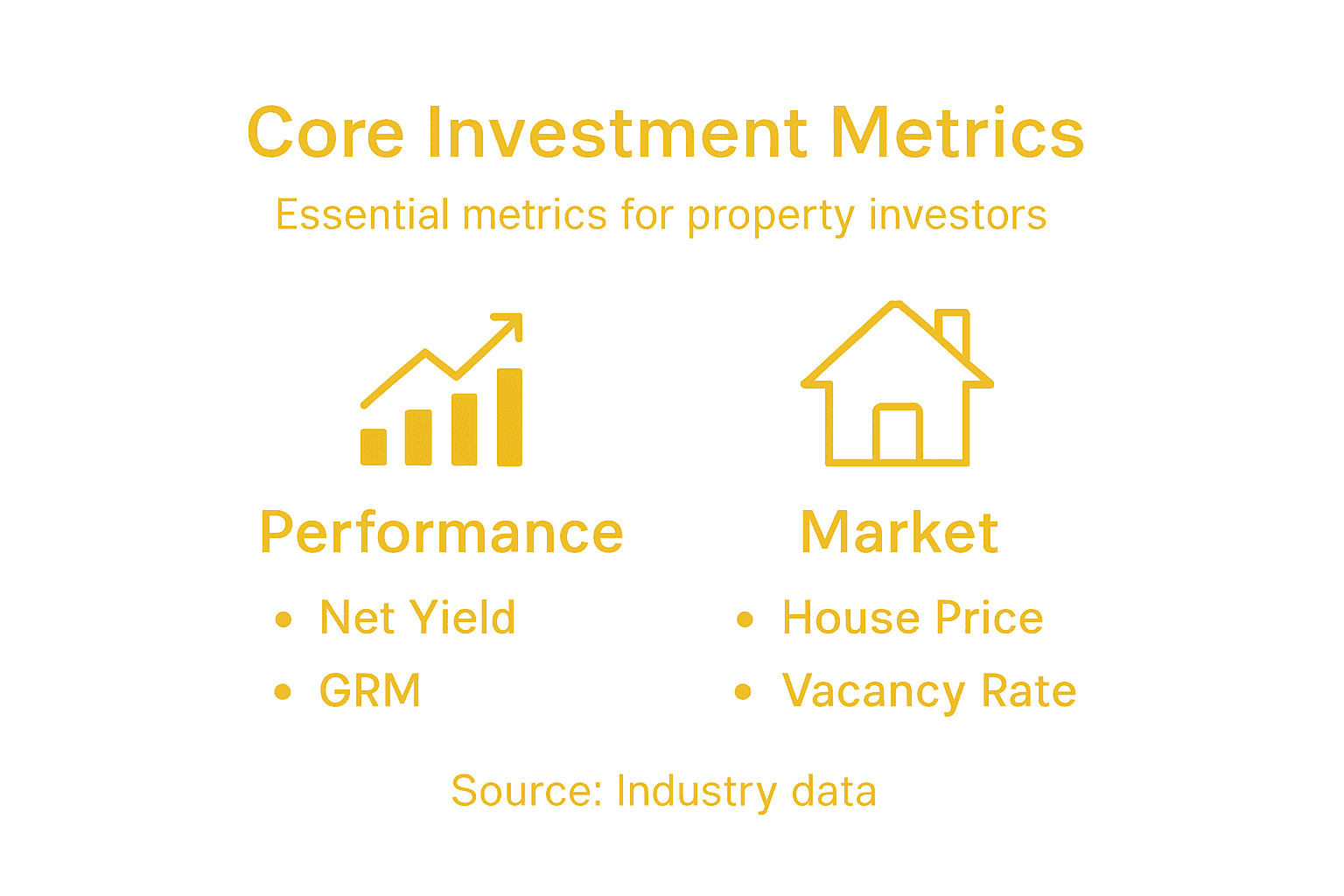
House price indicators play a crucial role in understanding broader market dynamics. Advanced investors track metrics like Internal Rate of Return (IRR), which measures the profitability of investments by calculating the annual growth rate of an investment over time. The Loan-to-Value Ratio helps lenders and investors assess risk by comparing the loan amount to the property’s appraised value, with lower ratios typically indicating less financial risk.
Pro tip: Create a standardized spreadsheet to track these key metrics consistently across all your potential and current real estate investments, allowing for easy comparison and performance monitoring.
Legal, Tax, and Regulatory Terms Explained
Legal property concepts form the foundation of real estate investment understanding. Real property distinguishes itself from personal property by its permanent nature, encompassing land and anything permanently attached. Zoning regulations dictate how properties can be used, divided, and developed, directly impacting an investor’s potential strategies and property value. Investors must understand the critical differences between various property classifications, which determine ownership rights, tax implications, and potential investment opportunities.
Key legal terms investors should comprehend include assignment of leases, which allows the transfer of lease agreements between parties, and bankruptcy-remote entities, specialized legal structures designed to protect real estate investments from broader financial risks. The deed of trust serves as a critical legal document that transfers property ownership to a third-party trustee, providing security for loan agreements and establishing clear terms of property ownership and potential foreclosure processes.
American Bar Association legal resources highlight the importance of understanding default provisions, which outline the consequences when a property owner fails to meet specific contractual obligations. Tax implications are equally crucial, with terms like capital gains and depreciation playing significant roles in investment strategies. Environmental regulations and compliance add another layer of complexity, requiring investors to navigate local, state, and federal requirements that can impact property use and value.
Pro tip: Consult with a real estate attorney and tax professional to thoroughly understand the legal and tax implications specific to your investment strategy and local jurisdiction.
Common Pitfalls in Investment Terminology
Investment mistakes often stem from misunderstanding key terminology and failing to recognize critical nuances in real estate investing. Unrealistic return expectations represent one of the most significant traps for new investors, who frequently misinterpret marketing materials or anecdotal success stories as typical investment outcomes. Investors must understand that while some properties can generate substantial returns, consistent performance requires strategic planning, thorough research, and realistic projections.
Risk assessment plays a crucial role in avoiding investment pitfalls. Concentration risk occurs when investors place too much capital into a single property type or geographic region, leaving themselves vulnerable to localized market fluctuations. Liquidity risk represents another critical concept, where investors might find themselves unable to quickly sell a property without significant financial penalties, especially in markets with limited buyer demand or complex regulatory environments.
Emotional decision-making frequently leads investors astray, particularly when misinterpreting technical terms. Short-term performance can be misleading, causing investors to make hasty decisions based on temporary market conditions. Common terminology misunderstandings include conflating appreciation with cash flow, or misinterpreting potential rental income as guaranteed revenue. Successful investors learn to distinguish between theoretical projections and practical, sustainable investment strategies.
Pro tip: Develop a disciplined approach by creating a standardized evaluation framework that objectively assesses potential investments, reducing the impact of emotional or terminology-based misunderstandings.
Master Real Estate Terms and Invest with Confidence
Understanding complex real estate investment terms like amortization, deed of trust, and collateral can feel overwhelming for beginners. This challenge often leads to uncertainty and hesitation before making crucial investment decisions. If you want to turn confusion into clarity and confidently navigate the legal and financial language of real estate, you are not alone. Many investors struggle with unrealistic return expectations and risk management because they lack clear education and trusted resources.
Bold Street AI is designed to solve these challenges by being your all-in-one platform for residential real estate investing. Whether you are seeking curated investment opportunities, expert guidance to decode financing options, or connections with investor-friendly agents and lenders, Bold Street AI is your essential partner. With educational resources like Bold Academy and a supportive community, you can build your knowledge and make smarter investment choices without feeling lost.
Take the first step to overcome terminology hurdles and start building your real estate portfolio with confidence today.
Discover how easy residential real estate investment can be at Bold Street AI.

Ready to move beyond confusion? Visit Bold Street AI now to access expert mentorship, explore profitable listings, and learn key investment concepts that every beginner needs to know. Empower yourself with knowledge and start investing the right way today.
Frequently Asked Questions
What is real property in real estate investment?
Real property refers to land and everything permanently attached to it, such as buildings and natural resources. Understanding real property rights is crucial for investors, as it encompasses the rights to use, control, possess, and dispose of the land and its assets.
What does amortization mean in real estate financing?
Amortization is the process of gradually repaying a loan through scheduled payments that cover both the principal and interest over a specified period. This impacts cash flow and overall investment expenses for real estate investors.
What are the different types of real estate investment properties?
Real estate investment properties can be categorized into commercial properties (like office buildings, retail spaces, and industrial facilities) and residential properties (such as single-family homes and multifamily units). Each category has its own unique advantages, challenges, and potential returns.
Why is understanding financing terms important for real estate investors?
Familiarity with financing terms, such as equity, collateral, and interest rates, is essential for real estate investors. These terms help them make informed financial decisions, evaluate potential investments, and understand the risks associated with different financing options.