
Most advice about real estate investing overlooks the massive influence technology and global regulations will have by 2026. For american and international newcomers, these changes bring both fresh opportunities and new hurdles. With over 60 percent of real estate growth linked to smart technology adoption, investors who adapt early stand to benefit the most. This article breaks down what emerging real estate investors need to know to stay ahead, minimize risk, and build a more resilient portfolio in a rapidly evolving market.
Table of Contents
- Defining 2026 Real Estate Investment Trends
- Key Asset Classes Gaining Momentum
- How Technology And ESG Are Shaping Investments
- Financing And Regulatory Shifts Worldwide
- Risks, Costs, And Common Newcomer Mistakes
Key Takeaways
| Point | Details |
|---|---|
| Adaptability is Key | Investors must prioritize flexible strategies that integrate technology and sustainability. |
| Focus on Emerging Asset Classes | Target data centers, industrial logistics, and senior living facilities for robust returns. |
| Rigorous Risk Management | Develop comprehensive frameworks to assess risks, regulatory compliance, and market dynamics. |
| Diversification is Essential | Spread investments across various geographical markets to mitigate economic volatility. |
Defining 2026 Real Estate Investment Trends
The real estate investment landscape in 2026 is transforming dramatically, driven by complex economic signals and technological innovations. Investors are moving beyond traditional approaches, recognizing that market adaptability now trumps rigid investment strategies. Emerging market trends suggest a pragmatic approach to real estate investment that balances risk management with strategic opportunity identification.
Key investment trends for 2026 are characterized by three primary dynamics: technological integration, sustainability focus, and geographic diversification. Artificial intelligence and data analytics are reshaping how investors evaluate property potential, enabling more precise risk assessment and valuation models. Smart investors are leveraging advanced predictive tools to identify emerging markets and potential high-growth zones before they become mainstream investment targets.
Geographic diversity is becoming critical, with successful investors spreading risk across multiple markets rather than concentrating investments in single regions. This approach mitigates potential economic volatility and provides more resilient portfolio performance. European market research indicates a growing emphasis on long-term city and sector fundamentals that go beyond short-term market fluctuations, suggesting investors should prioritize comprehensive, data-driven market analysis.
Pro tip: Develop a dynamic investment strategy that integrates technological tools, prioritizes ESG considerations, and maintains geographic flexibility to navigate the complex 2026 real estate market.
Key Asset Classes Gaining Momentum
The 2026 real estate investment landscape is experiencing a significant transformation, with several asset classes emerging as primary investment targets. Global market forecasts highlight technology-driven and service-oriented property segments as key growth opportunities for savvy investors looking to diversify their portfolios and capitalize on emerging market trends.

Five primary asset classes are gaining substantial momentum in 2026. Data centers represent a critical investment sector, driven by exponential digital infrastructure growth and artificial intelligence expansion. Industrial logistics continues to show strong performance, particularly in regions experiencing supply chain restructuring and e-commerce acceleration. Multifamily residential properties remain attractive, offering stable income streams and resilience against economic fluctuations. Senior living facilities are experiencing unprecedented demand as global populations age, presenting investors with long-term growth potential. Adaptive reuse commercial properties are also emerging as innovative investment opportunities, allowing investors to transform existing structures for modern economic needs.
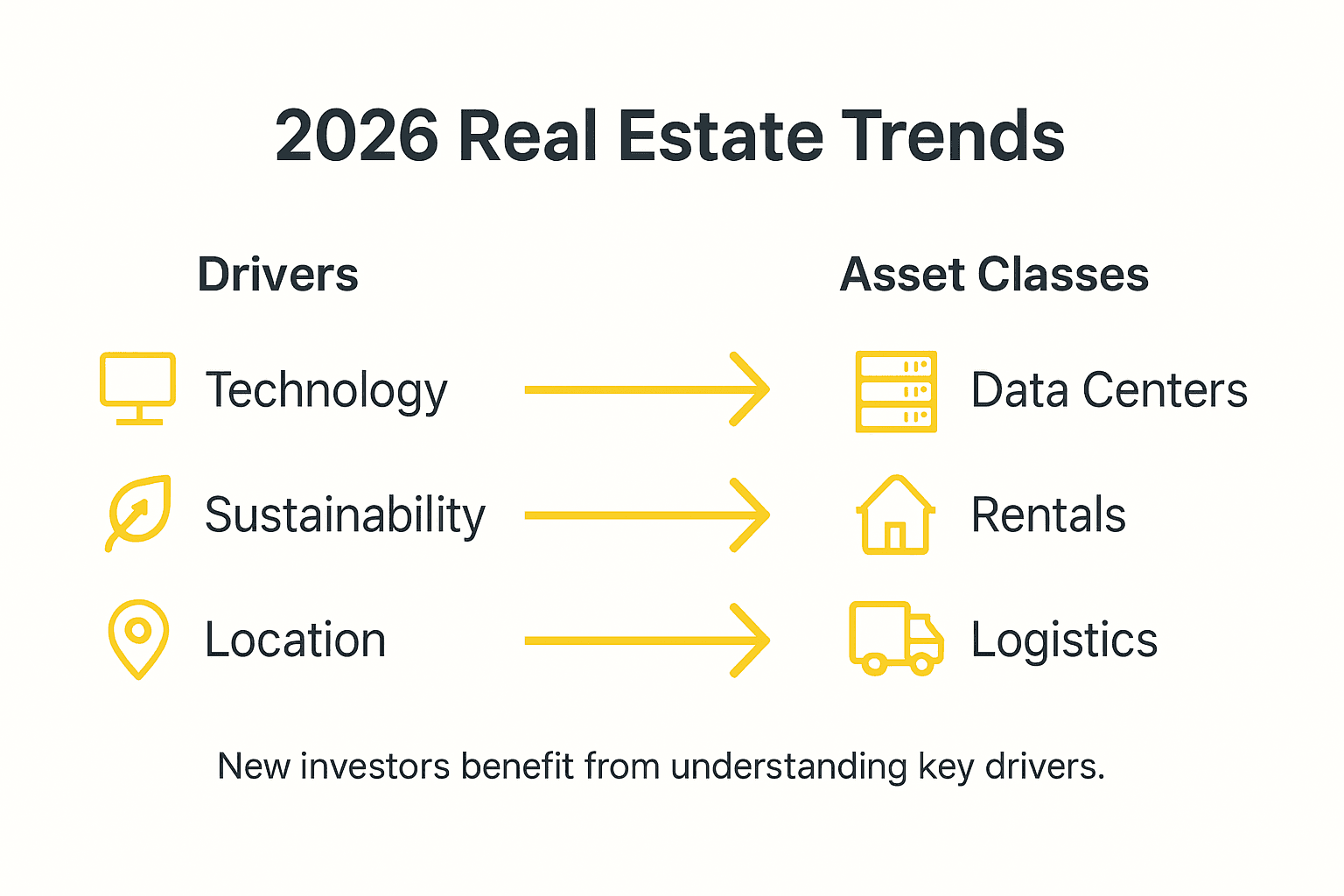
Investors are increasingly prioritizing properties with robust operational models and strategic locations. Rental market dynamics are evolving, with a clear bifurcation between regulated long-term leases and professional short-term rental operations, reflecting sophisticated investor strategies that respond to changing regulatory landscapes and tenant preferences. This nuanced approach requires deeper market understanding and more dynamic investment methodologies.
Pro tip: Focus on asset classes with demonstrable technological infrastructure, strong demographic trends, and flexible operational models to build a resilient real estate investment portfolio in 2026.
How Technology and ESG Are Shaping Investments
Technological innovations and environmental sustainability are fundamentally restructuring real estate investment strategies in 2026. Investors are no longer viewing technology and sustainability as optional enhancements, but as critical components of successful investment approaches. The convergence of artificial intelligence, data analytics, and environmental considerations is creating a sophisticated ecosystem that demands both strategic thinking and adaptive capabilities.
Artificial intelligence is revolutionizing multiple dimensions of real estate investment. Predictive analytics enable more accurate market forecasting, allowing investors to identify emerging trends before they become mainstream. Machine learning algorithms are transforming property valuation, risk assessment, and investment decision-making processes by processing complex datasets with unprecedented speed and accuracy. In the ESG realm, technology is helping investors track carbon emissions, energy efficiency, and sustainability metrics with granular precision, enabling more responsible investment strategies.
Digital transformation is reshaping investment approaches across the real estate value chain, with technology and sustainability becoming integral rather than peripheral considerations. Smart building technologies, Internet of Things (IoT) sensors, and advanced data management platforms are creating more transparent, efficient, and responsive investment environments. Investors are increasingly prioritizing properties that demonstrate technological resilience, environmental compliance, and adaptive potential, reflecting a broader shift toward holistic, future-oriented investment methodologies.
Here is a summary of how technology and ESG trends are transforming real estate investment:
| Innovation Area | Impact on Investment Decisions | Resulting Investor Advantage |
|---|---|---|
| Predictive Analytics | Early trend detection | Improved market timing |
| Smart Building Tech | Enhanced operational transparency | Increased property value |
| ESG Data Tracking | Sustainable asset evaluation | Better regulatory compliance |
| IoT Sensors | Real-time property monitoring | Portfolio risk reduction |
Pro tip: Develop a comprehensive technology and ESG assessment framework that evaluates potential investments across multiple dimensions, including digital infrastructure, sustainability metrics, and long-term adaptability.
Financing and Regulatory Shifts Worldwide
Global real estate financing in 2026 is experiencing unprecedented transformation driven by complex regulatory landscapes and strategic capital deployment. Investors are navigating an increasingly intricate financial environment characterized by tighter credit conditions, heightened regulatory scrutiny, and a more selective approach to capital investment. The traditional financing models are giving way to more nuanced, risk-aware strategies that prioritize compliance and long-term sustainability.
The regulatory framework is rapidly evolving, with governments worldwide implementing more stringent requirements for real estate investments. Short-term rental regulations are becoming more complex, creating significant barriers for speculative investors. Tax transparency and construction standards are now critical considerations, effectively filtering out less sophisticated market participants. Institutional investors are adapting to these changes by developing more robust due diligence processes, leveraging sophisticated risk management techniques to navigate the increasingly complex global investment landscape.
Financing sources are diversifying, with traditional banking institutions becoming more cautious. Family offices and private equity firms are emerging as crucial capital providers, bringing more flexible and innovative funding approaches. This shift is fundamentally restructuring how real estate investments are financed, with a greater emphasis on comprehensive risk assessment, regulatory compliance, and long-term value creation. Investors must now demonstrate not just financial capability, but also strategic alignment with evolving regulatory expectations and market dynamics.
The following table compares financing and regulatory evolutions shaping global investment strategies in 2026:
| Change Driver | Investor Response | Strategic Benefit |
|---|---|---|
| Stringent Regulations | Enhanced due diligence | Reduced legal and compliance risk |
| Diverse Capital Sources | Use of private equity, family offices | Increased funding flexibility |
| Tax Transparency | Sophisticated financial modeling | Long-term portfolio resilience |
| Higher Credit Barriers | Flexible capital strategies | Improved risk mitigation |
Pro tip: Develop a comprehensive compliance and financing strategy that incorporates advanced risk assessment tools, maintains flexible capital sourcing, and anticipates regulatory changes across multiple jurisdictions.
Risks, Costs, and Common Newcomer Mistakes
Real estate investment in 2026 presents a complex landscape of risks and potential pitfalls for new investors that require strategic navigation and sophisticated understanding. The market demands more than traditional investment approaches, challenging newcomers to develop nuanced, comprehensive risk management strategies. Economic volatility, changing regulatory environments, and increasingly complex financial mechanisms are creating a high-stakes investment ecosystem that requires careful, methodical preparation.
Several critical mistakes can derail new investors’ efforts. Speculative buying remains a significant risk, with many newcomers mistaking market momentum for sustainable growth potential. Inadequate due diligence frequently leads to overlooking critical asset quality factors, regulatory compliance requirements, and long-term operational costs. Investors must develop comprehensive risk assessment frameworks that go beyond surface-level financial analysis, incorporating detailed market research, regulatory landscape evaluation, and sophisticated financial modeling.
Financial risks extend beyond initial investment considerations. Rising financing costs, stringent ESG requirements, and increasingly complex tax regulations create multiple layers of potential financial exposure. New investors must recognize that successful real estate investment in 2026 requires a holistic approach that balances immediate financial considerations with long-term strategic planning. This means developing robust risk management protocols, maintaining financial flexibility, and continuously educating oneself about evolving market dynamics and regulatory environments.
Pro tip: Develop a comprehensive risk management strategy that includes scenario planning, maintains financial reserves, and prioritizes continuous market education to navigate the complex 2026 real estate investment landscape.
Navigate 2026 Real Estate Investment Trends with Confidence
The 2026 real estate market presents unique challenges for new investors including complex regulations, shifting financing landscapes, and the critical need for technology and ESG integration. If you feel overwhelmed by the need for precise market analysis, risk management, and finding trustworthy professionals, Bold Street AI is designed with you in mind. Our platform directly addresses these pain points by connecting you to local real estate agents, lenders, and property managers who understand emerging investment trends and can offer personalized guidance.
Take control of your investment journey today by exploring curated opportunities and accessing expert educational resources through Bold Street AI. Build your portfolio with confidence using our tools that simplify financing choices and provide mentorship tailored to your goals. Don’t let uncertainty slow you down—start learning, connecting, and investing smarter now at Bold Street AI and discover how to master the complexities of residential real estate in 2026 and beyond.
Frequently Asked Questions
What are the key trends shaping real estate investment in 2026?
Key trends in 2026 include technological integration, a focus on sustainability, and geographic diversification. Investors are leveraging AI and data analytics for better market insights, while emphasizing environmental, social, and governance (ESG) considerations.
Which asset classes should new investors consider in 2026?
Investors should focus on data centers, industrial logistics, multifamily residential properties, senior living facilities, and adaptive reuse commercial properties, as these sectors show significant growth potential and resilience in the current market.
How is technology influencing real estate investment strategies?
Technology is transforming investment strategies through predictive analytics, machine learning, and smart building technologies. These innovations enhance property valuation, risk assessment, and overall operational efficiency, making them integral to modern investment approaches.
What common mistakes should new investors avoid in real estate?
New investors should avoid speculative buying, inadequate due diligence, and overlooking regulatory compliance. A comprehensive understanding of market dynamics and robust risk management frameworks are essential for long-term success.
Recommended
- 2024 is the Perfect Time to Become a Real Estate Investor – Bold Street AI
- Navigating the Terrain: Common Challenges for Real Estate Agents Working with Residential Real Estate Investors – Bold Street AI
- Predicted Fed Rate Cuts in 2024: Implications for the Real Estate Market and Investor Strategies – Bold Street AI
- Blog – Bold Street AI
- Outsourced Real Estate Marketing – More Leads, Less Effort – Stealth Agents
- How to Show Traction to Investors: Step-by-Step Guide | siift