
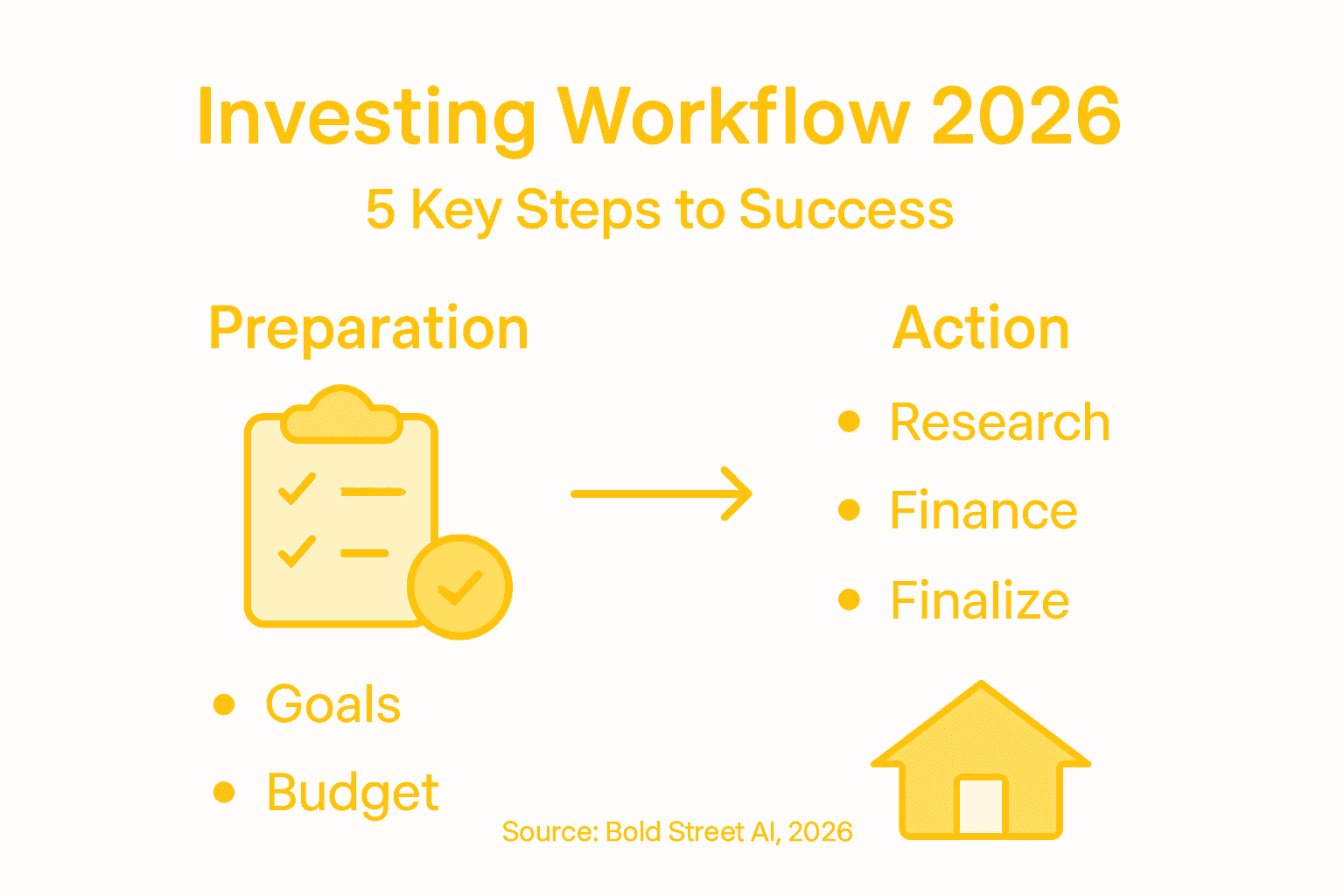
Securing your first residential real estate investment can feel like stepping into unknown territory. With so many moving parts, newcomers often wonder how to set clear goals, pick the right market, and build a solid team. This guide simplifies each stage of the process, from defining your investment goals and budget to connecting with vetted professionals and evaluating funding options, using proven strategies and the latest insights from trusted organizations like the National Association of REALTORS®.
Table of Contents
- Step 1: Define Investment Goals And Budget
- Step 2: Research Markets And Discover Properties
- Step 3: Connect With Vetted Real Estate Professionals
- Step 4: Evaluate Financing And Submit Offers
- Step 5: Verify Deal Quality And Finalize Transaction
Quick Summary
| Key Point | Explanation |
|---|---|
| 1. Define SMART investment goals | Establish specific, measurable, achievable, relevant, and time-bound goals that align with your financial profile and risk tolerance. |
| 2. Conduct thorough market research | Analyze key market indicators and property trends to identify promising investment opportunities and potential risks. |
| 3. Build a reliable professional network | Connect with trusted real estate agents, attorneys, and mortgage specialists to gain insights and support in your investment journey. |
| 4. Evaluate multiple financing options | Understand different lending strategies and compare interest rates and terms to determine the best financing for your goals. |
| 5. Perform comprehensive due diligence | Verify property titles, inspections, and compliance to protect your investment from potential legal and financial issues. |
Step 1: Define investment goals and budget
Defining your residential real estate investment goals and budget is the critical first step in creating a strategic and successful investment approach. This foundational planning stage will help you align your financial resources with your long-term wealth-building objectives.
Start by conducting a comprehensive assessment of your current financial situation. Analyze your real estate investment goals through a systematic approach that considers multiple factors:
- Current income and stable cash flow
- Existing savings and liquid assets
- Risk tolerance level
- Investment time horizon
- Personal financial objectives
Your goals might range from generating passive monthly rental income to building long-term equity through property appreciation. Some investors aim to acquire multiple rental properties, while others focus on strategic property flipping for short-term profits. The key is matching your investment strategy with your personal financial profile and risk comfort level.
Your investment goals should be specific, measurable, achievable, relevant, and time-bound (SMART).
Break down your budget by calculating exactly how much capital you can allocate to real estate investments. Consider not just the purchase price, but also renovation costs, potential vacancy periods, maintenance expenses, and emergency reserves. Most successful investors recommend having 3-6 months of property expenses saved as a financial buffer.
Pro tip: Always build a 10-15% buffer into your initial investment budget to account for unexpected expenses and market fluctuations.
Step 2: Research markets and discover properties
Researching real estate markets and identifying promising property investment opportunities requires a strategic and systematic approach. This step transforms your investment goals into actionable insights by understanding market dynamics and discovering potential investment properties.
US residential market trends reveal critical factors investors must consider when evaluating potential investments. Begin by analyzing key market indicators:
- Median home prices in target regions
- Population growth and demographic shifts
- Local employment rates and job market stability
- Rental market demand and occupancy rates
- Infrastructure and development projects
Utilize multiple research channels to gather comprehensive market intelligence. Online real estate platforms, local multiple listing services (MLS), and county property records can provide valuable data about potential investment opportunities. Focus on metro areas with strong economic fundamentals and consistent property value appreciation.
Successful property research combines data-driven analysis with strategic market understanding.
When evaluating potential markets, compare metro area property values to identify regions with sustainable growth potential. Look beyond current pricing and assess long-term appreciation trends, local economic indicators, and potential future development that could impact property values.

Pro tip: Create a standardized evaluation spreadsheet to systematically compare and score potential investment markets across multiple performance metrics.
Step 3: Connect with vetted real estate professionals
Building a network of trusted real estate professionals is crucial for successful residential property investing. This step will help you identify and connect with experienced agents, brokers, and specialists who can provide valuable insights and support throughout your investment journey.
Real estate professional networks offer strategic resources for investors seeking reliable partnerships. Start by identifying key professionals who can enhance your investment strategy:
- Real estate agents specializing in investment properties
- Local property managers
- Real estate attorneys
- Mortgage loan specialists
- Home inspection professionals
Research potential professionals through credible industry organizations and professional directories. Reputable real estate associations provide extensive resources for finding vetted professionals committed to ethical practices and industry standards.
A strong professional network can be your most valuable asset in real estate investing.
Evaluate potential professionals by checking their credentials, experience in investment properties, and track record. Schedule initial consultations to assess their expertise and compatibility with your investment goals. Look for professionals who demonstrate deep market knowledge and proven investment experience.
Pro tip: Request references from at least three recent clients and conduct thorough background checks before finalizing any professional partnerships.
Step 4: Evaluate financing and submit offers
Evaluating financing options and preparing strategic property offers is a critical milestone in your residential real estate investment journey. This step transforms your market research and networking into concrete investment opportunities by securing the right financial approach and crafting competitive purchase proposals.
Residential real estate lending standards provide crucial guidance for investors navigating financing options. Begin by understanding your potential financing strategies:
- Conventional mortgage programs
- FHA loan opportunities
- VA loan options
- Portfolio lender financing
- Private money lending sources
Compare different financing approaches by analyzing interest rates, loan terms, and qualification requirements. Calculate your potential debt-to-income ratio and cash reserves to determine the most suitable lending strategy for your investment goals.
Here’s a comparison of common residential real estate financing options and their typical characteristics:
| Financing Type | Down Payment | Loan Term Length | Main Benefit |
|---|---|---|---|
| Conventional Loan | 15-20% | 15-30 years | Lower rates, standard terms |
| FHA Loan | 3.5% (minimum) | 15-30 years | Lower down payment option |
| VA Loan | 0% for qualified | 15-30 years | No down payment for veterans |
| Private Lender | 10-25% | Short-term (1-5 years) | Flexible qualification |
Smart financing is the foundation of successful real estate investing.
When submitting offers, incorporate transaction reporting requirements to ensure compliance and transparency. Develop a comprehensive offer package that demonstrates your financial preparedness, including pre-approval letters, proof of funds, and detailed investment strategy.
Pro tip: Always maintain a 10-20% buffer in your financing strategy to account for unexpected expenses and potential market fluctuations.
Step 5: Verify deal quality and finalize transaction
Verifying deal quality and finalizing your residential real estate transaction represents the most critical phase of your investment journey. This step ensures you protect your financial interests by conducting comprehensive due diligence and navigating complex transaction requirements.
Residential real estate transaction reporting involves multiple layers of verification and compliance checks. Begin your comprehensive deal verification process by examining key elements:
- Property title documentation
- Seller disclosure statements
- Professional home inspection reports
- Appraisal value confirmation
- Municipal code compliance records
- Zoning restrictions assessment
Conduct a thorough legal and financial review to uncover potential risks or hidden complications. Engage a real estate attorney to help interpret complex legal documents and verify the transaction meets all regulatory requirements.
Below is a summary of key deal verification steps and why they are important:
| Verification Step | Why It Matters |
|---|---|
| Title Review | Confirms legal ownership |
| Inspection Analysis | Uncovers property condition issues |
| Appraisal Confirmation | Verifies true market value |
| Compliance Check | Ensures legal and code adherence |
| Zoning Assessment | Confirms allowed property uses |
Meticulous verification protects your investment and prevents future legal complications.
When evaluating international investment scenarios, understand legal investment guidelines that might impact your transaction. Pay special attention to tax implications, ownership structures, and potential reporting requirements that could affect your investment strategy.
Pro tip: Create a comprehensive checklist of all transaction verification steps and cross-reference each item methodically to ensure nothing is overlooked during the final transaction process.
Simplify Your Residential Investing Journey with Bold Street AI
The article you just explored highlights common challenges like defining clear investment goals, researching promising markets, connecting with trusted real estate professionals, evaluating financing options, and verifying deal quality. These steps can feel overwhelming especially when you need reliable support at every stage of your residential real estate investment journey. Bold Street AI understands these pain points and offers a streamlined platform designed to empower both beginners and experienced investors.
With Bold Street AI you gain access to curated investment opportunities, investor-friendly agents, lenders, and property managers all in one trusted hub. The platform also features educational resources through Bold Academy to guide you in making smart financing choices and performing thorough due diligence. By joining this transparent and user-friendly community you do not have to navigate complex investment workflows alone.
Discover how Bold Street AI can transform your approach to residential real estate investing by connecting you directly with the right professionals and providing the education needed for confident decision-making today.
Explore curated investment opportunities now
Take control of your investment success by visiting Bold Street AI. Start matching with vetted real estate experts and uncover financing options that suit your goals. Begin your journey to strategic investing with clear guidance at https://www.boldstreet.ai/ and see your residential portfolio grow with confidence.
Frequently Asked Questions
What are the first steps in the Residential Investing Workflow?
Begin by defining your investment goals and budget, as these are crucial for a successful strategy. Assess your financial situation, consider your income, expenses, and risk tolerance, then allocate capital for purchase and operational costs, including a buffer for unexpected expenses.
How do I research markets and find potential properties?
Research markets by analyzing key indicators such as median home prices, population growth, and rental demand. Utilize online platforms and local listing services to gather comprehensive data, and create an evaluation spreadsheet to compare potential investment opportunities systematically.
What types of real estate professionals should I connect with?
Connect with a network of professionals such as real estate agents specializing in investment properties, property managers, and mortgage loan specialists. Schedule initial consultations with these professionals to assess their expertise and compatibility with your investment goals.
How do I evaluate financing options for real estate investments?
Evaluate various financing options, such as conventional loans, FHA loans, and private money lending, to determine the best fit for your strategy. Compare interest rates and loan terms, then calculate your potential debt-to-income ratio before proceeding with any financing arrangement.
What steps should I take to verify the quality of a deal before finalizing?
To verify deal quality, conduct a thorough examination of key documents including property titles, inspection reports, and seller disclosures. Create a checklist of verification steps to ensure compliance and to protect your investment from potential risks or complications.
What should I take into account during the final transaction process?
Focus on meticulous verification, including legal and financial reviews, to ensure that all aspects of the transaction are compliant and in order. Double-check zoning restrictions and appraisal values to secure your investment as you finalize the deal.
Recommended
- 7 Essential Residential Investing Tips for 2026 Beginners | Bold Street AI
- 7 Essential Steps for a Residential Investing Checklist | Bold Street AI
- Why Invest in Residential Real Estate 2026 – Smart Wealth Strategies | Bold Street AI
- 7 Key Examples of Residential Investment Strategies | Bold Street AI
- Immobilienmakler Vorderer Odenwald | Haus verkaufen mit Lauria Immobilien