
Investing in residential real estate in the United States can feel like a leap into the unknown for first-time buyers. The promise of passive income and long-term wealth is real, but choosing the right property, understanding local market shifts, and planning for costs require careful strategy. For those navigating their first purchase in 2026, this guide breaks down how single-family homes make up about 70 percent of American households, what makes different property types appealing, and how smart planning leads to lasting financial gains.
Table of Contents
- Residential Real Estate Investing Defined Clearly
- Types of Residential Properties and Their Appeal
- How Returns and Value Are Generated in 2026
- Risks, Costs, and Common Investor Pitfalls
- Tax Advantages and Regulatory Changes for 2026
Key Takeaways
| Point | Details |
|---|---|
| Understanding Property Types | Choose the appropriate residential property type—single-family homes, small multi-family properties, or land—based on your investment goals and risk tolerance. |
| Focus on Cash Flow | Prioritize positive cash flow from rental income to maintain financial stability, especially during market downturns. |
| Plan for Hidden Costs | Anticipate and budget for expenses beyond mortgage payments, including taxes, maintenance, and property management fees. |
| Leverage Tax Advantages | Utilize tax benefits such as depreciation and capital gains treatment to maximize your investment returns. |
Residential Real Estate Investing Defined Clearly
Residential real estate investing means purchasing, owning, and managing properties designed for people to live in, then generating profit or building wealth through rental income, property appreciation, or resale. This is distinct from commercial properties like office buildings or retail spaces. When you invest in residential real estate, you’re essentially becoming a property owner who either rents out homes to tenants or holds properties for long-term appreciation. The key concept here is straightforward: you buy a property, someone pays you to live there (or you wait for its value to increase), and you build wealth over time.
Residential properties fall into specific categories that shape your investment approach. Single-family homes are the most common starting point for new investors because they’re easier to understand and finance. Then there are small multi-family properties with two to four units, where you might live in one unit while renting out the others, or rent all units to different tenants. Land investments also fit under residential real estate when zoned for residential use. Understanding residential real estate types and risks helps you pick the right property category for your financial goals and risk tolerance.
Real estate investing is considered a large asset class offering long-term passive income, appreciation potential, and tax advantages that stocks and bonds simply don’t provide. But here’s what separates successful residential real estate investors from those who stumble: they understand the local market, know how to evaluate properties accurately, and have realistic expectations about cash flow and appreciation timelines. This isn’t a quick flip situation for most people. It’s a wealth-building vehicle that compounds over years and decades. You’re not just buying a house; you’re entering into a business relationship with tenants, managing maintenance, handling taxes, and navigating market cycles.
Pro tip: Start by clearly defining your investment goal for 2026: are you seeking monthly rental income, long-term appreciation, or a combination of both? This single decision shapes everything from the property type you target to the location you choose and the financing structure you pursue.
Types of Residential Properties and Their Appeal
Not all residential properties work the same way or appeal to the same investors. Your choice of property type shapes your cash flow, management responsibilities, and long-term returns. Understanding what each type offers helps you match your investment style with the right property. The main residential categories break down into single-family homes, small multi-family properties, and land, each with distinct advantages depending on your goals and experience level.
Single-family homes dominate the American housing market, making up approximately 70% of households in the United States. They appeal to beginner investors because they’re straightforward to understand, easier to finance, and typically attract stable, long-term tenants. You collect rent from one household, handle one set of maintenance issues, and benefit from simpler property management. The downside is lower cash flow per dollar invested compared to multi-family units, but the stability and ease make them ideal for first-time investors building confidence. Small multi-family properties with two to four units offer a middle ground. You might live in one unit while renting the others (a common strategy called house hacking), or rent all units separately. This approach spreads your cash flow across multiple tenants and generates more monthly income than a single-family home. The trade-off is slightly more complex management and higher initial investment requirements. Land investments appeal to patient investors willing to wait for appreciation or development opportunities. Residential land zoned for future housing development can deliver substantial returns, though it generates no immediate rental income.
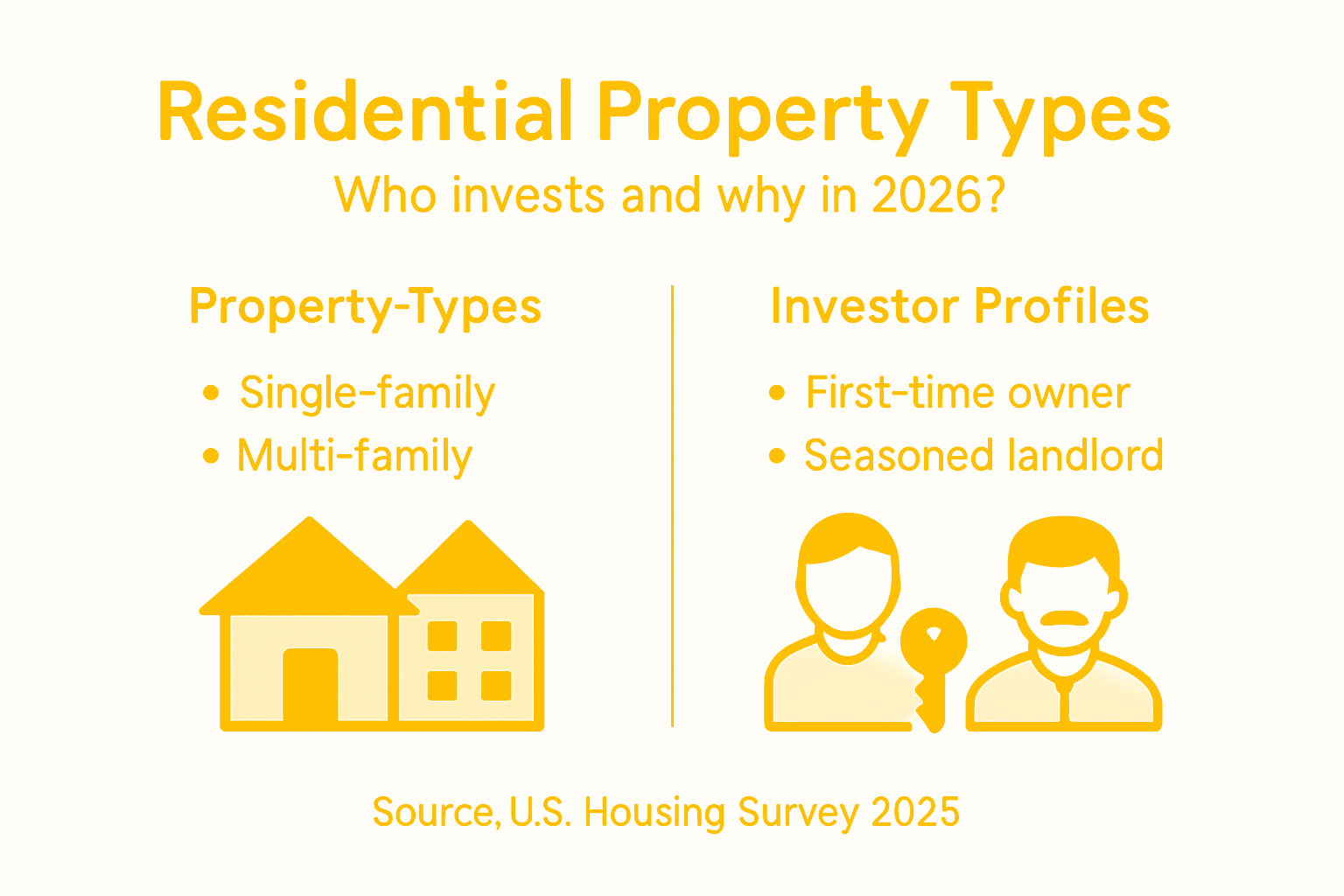
Your property type decision also connects to investment strategies that work for new property investors, such as buy-and-hold, house hacking, or value-add approaches. Single-family homes pair well with buy-and-hold strategies, while small multi-family properties work better for house hacking or rental income maximization. Single-family homes make up the majority of residential property ownership across the country, which means more market data is available, rental demand tends to be stable, and resale is typically easier. Consider your timeline, capital availability, and comfort with tenant management when choosing. A property that’s perfect for your neighbor might not match your situation at all.
Pro tip: Start with the property type that aligns with your available capital and risk tolerance, not the one that sounds most impressive. Single-family homes teach you the fundamentals without overwhelming complexity, making them the smartest entry point for most new investors in 2026.
Here’s a comparison of major residential property types for investors:
| Property Type | Typical Investor Profile | Cash Flow Potential | Management Challenge |
|---|---|---|---|
| Single-Family Home | First-time, conservative | Moderate, stable | Simple, one tenant |
| Small Multi-Family | Growth-focused, hands-on | Higher, diversified | Moderate, multiple tenants |
| Residential Land | Patient, speculative | None (until developed) | Low, but long horizon |
How Returns and Value Are Generated in 2026
Residential real estate generates wealth through two primary mechanisms: rental income and property appreciation. Understanding how these work together in 2026 is critical because the market landscape has shifted from the rapid appreciation years of the early 2020s. Today’s investor needs to think like a business owner collecting rent first, then treating appreciation as a bonus. This dual-income approach separates successful investors from those who get caught off guard by market shifts.

Rental income is your predictable, recurring revenue stream. Each month, tenants pay you to live in your property, and that money flows directly into your pocket after expenses. Think of it as passive income, though managing tenants and maintenance isn’t completely passive. In 2026, residential real estate market conditions remain stable with relatively flat national house prices across most regions, which means rental income becomes even more important to your overall returns. A property generating 8 to 12 percent annual cash-on-cash returns from rent is performing solidly. You calculate this by dividing your annual net rental income by your initial cash investment. For example, if you put down 25,000 dollars and collect 2,500 dollars in annual net rent, that’s a 10 percent cash-on-cash return. This income covers your mortgage, property taxes, insurance, maintenance, and hopefully leaves money in your pocket.
Property appreciation happens when your home’s value increases over time. House prices in the U.S. significantly impact consumer spending and financial stability, and smart investors monitor price trends and economic conditions affecting these changes. In 2026, expect modest appreciation rather than the explosive gains of recent years. Regional variations matter tremendously. Some markets appreciate 3 to 5 percent annually while others flatline or decline. The key is that appreciation amplifies your returns through leverage. If you put 25,000 dollars down on a 200,000 dollar property and it appreciates 5 percent (10,000 dollars), your equity jumped 40 percent from your initial investment. That’s the power of real estate leverage.
The real wealth building happens when both income streams work together. You collect monthly rental income covering your mortgage and generating cash flow, while the property appreciates underneath you, building equity automatically. Over 10 or 20 years, this combination creates substantial wealth without requiring you to do much except maintain the property and handle tenant issues.
Pro tip: Focus first on finding properties with positive cash flow and reasonable appreciation potential in your target market rather than chasing the highest appreciation numbers. Cash flow keeps you in the game during market downturns; appreciation rewards your patience.
Summary of returns and value drivers in residential real estate:
| Source of Return | How Generated | Typical Annual Range | Key Influencing Factors |
|---|---|---|---|
| Rental Income | Rent from tenants | 8-12% cash-on-cash | Local demand, expenses |
| Property Appreciation | Increase in property value | 3-5% for 2026 (varies) | Market cycle, location |
| Tax Benefits | Depreciation, deductions | Varies by individual | Tax law, entity structure |
Risks, Costs, and Common Investor Pitfalls
Residential real estate investing is not risk-free, and pretending otherwise is how investors lose money. The good news is that most risks are manageable if you understand them upfront and plan accordingly. The bad news is that new investors often underestimate costs, overlook market fluctuations, and skip crucial due diligence. Your success in 2026 depends on recognizing these pitfalls before they drain your cash flow or force you to sell at a loss.
Costs are often the biggest surprise for first-time investors. Beyond your mortgage payment, you face property taxes, insurance, maintenance, repairs, vacancy periods when units sit empty, and property management fees if you hire someone to handle tenants. A common mistake is calculating only the mortgage and rent without accounting for these expenses. A property with 1,500 dollars in monthly rent might have 400 dollars in taxes, 150 dollars in insurance, 200 dollars in maintenance reserves, and 225 dollars in property management, leaving just 525 dollars in actual cash flow. That 35 percent drop from gross rent catches many investors off guard. Political and economic uncertainties, regulatory changes, and market volatility create additional cost pressures through rising property taxes, changing insurance rates, and unexpected maintenance issues.
Market and operational risks require constant attention. The residential real estate market faces affordability crises and limited property supply that can affect rental demand and property values in your area. A neighborhood can shift rapidly. Jobs disappear, schools change, crime rates move up, and suddenly your rental property attracts different tenants or sits vacant longer. Mortgage rate changes affect your borrowing costs and buyer pool if you need to sell. Regional variations mean that what works in Austin might not work in rural Pennsylvania. New investors commonly fail to thoroughly research local market conditions, zoning regulations, or upcoming developments that could impact their investment.
Common pitfalls stem from emotional decision-making rather than data. Investors fall in love with a property and ignore red flags. They overestimate rental income based on optimistic assumptions. They neglect to build cash reserves for vacancies and emergencies. They fail to screen tenants properly, leading to problem renters, evictions, and lost months of income. They avoid professional inspections to save 500 dollars, then face a 15,000 dollar roof replacement. The pattern is clear: shortcuts cost more than doing things right. Using proper property analysis prevents most of these mistakes by forcing you to run real numbers and face hard truths before committing capital.
Pro tip: Build a 12-month expense reserve into your investment plan before purchasing any property. This cushion covers unexpected repairs, extended vacancies, and market downturns without forcing you into panic decisions or desperate sales.
Tax Advantages and Regulatory Changes for 2026
Tax benefits are one of the most underutilized wealth-building tools in residential real estate investing. The government actively encourages real estate investment through tax incentives, and if you do not take advantage of them, you are leaving money on the table. In 2026, these advantages remain intact, but regulatory changes are shifting how investors report ownership and structure their investments. Understanding both sides of this equation directly impacts your bottom line and compliance obligations.
Tax advantages in residential real estate come in multiple forms. First, there is depreciation, a non-cash deduction that reduces your taxable income each year. You can depreciate the building portion of your property (not the land) over 27.5 years, meaning you claim roughly 3.6 percent of that building value as a deduction annually. If your building is worth 150,000 dollars, you deduct about 5,450 dollars each year, lowering your taxable income from rental operations. You receive a deduction without spending any money. Second, you deduct all legitimate expenses: mortgage interest, property taxes, insurance, maintenance, repairs, property management fees, and utilities. These deductions can significantly reduce or even eliminate taxable income from your rental properties. Third, capital gains from appreciation receive favorable tax treatment when you sell. Residential real estate investors benefit from continued tax advantages including capital gains treatment, allowing you to pay lower tax rates on appreciation profits compared to ordinary income rates. If you hold a property for more than one year, you qualify for long-term capital gains rates, which are substantially lower than regular income tax rates.
Regulatory changes for 2026 affect how you document and structure your investments. The IRS is increasing emphasis on beneficial ownership reporting and transparency, meaning you need cleaner records and clearer documentation of who owns what property and why. Many U.S. states are implementing tax policy changes including reductions in income tax rates and updates in property tax administration, which directly affects your state-level tax burden. Some states are becoming more competitive for real estate investors through lower rates, while others are increasing property tax collection. Partnership and REIT structures offer tax advantages for larger portfolios, but documentation requirements are stricter. Opportunity zones continue to provide incentives for investing in designated underserved areas, allowing you to defer and potentially reduce capital gains taxes if you invest in qualified properties.
Why this matters now. Many new investors overlook tax planning entirely, focusing only on cash flow and appreciation. That approach leaves thousands of dollars in unnecessary taxes. A qualified tax professional or accountant familiar with real estate can save you far more than their fees cost. State tax variations are significant. Buying in a state with lower income tax rates or more favorable property tax structures amplifies your returns considerably.
Pro tip: Before purchasing any property, consult with a tax professional to understand depreciation schedules, entity structure options, and state-specific advantages. One conversation early saves you thousands in wasted tax opportunities and compliance mistakes.
Take Control of Your Residential Real Estate Journey in 2026
Understanding the complexities of residential real estate investing in 2026 can feel overwhelming. The challenge lies in balancing rental income, managing expenses, navigating local market fluctuations, and leveraging tax advantages to build lasting wealth. If you want to avoid common pitfalls like underestimating costs or ignoring critical due diligence you need a trusted guide by your side. Bold Street AI is designed to simplify these challenges by connecting you with investor-friendly agents, lenders, and property managers who understand your goals whether you seek stable cash flow or long-term appreciation.

Start strong with access to curated investment opportunities and step-by-step educational resources at Bold Street AI that empower you to analyze properties confidently and design your best investment strategy. Explore tailored financing options and join a community of like-minded investors sharing success stories and insights. Visit our platform now and take your first step toward building a resilient residential real estate portfolio in 2026.
Discover how to avoid costly mistakes and maximize your returns with expert support at Bold Street AI and deepen your investing skills through Bold Academy today.
Frequently Asked Questions
What is residential real estate investing?
Residential real estate investing involves purchasing, owning, and managing properties designed for people to live in, with the aim of generating profit through rental income or property appreciation.
What types of residential properties are available for investment?
The main types of residential properties include single-family homes, small multi-family properties (two to four units), and residential land zoned for future development, each offering distinct advantages based on investor goals and experience.
How do I generate returns from residential real estate?
Returns in residential real estate are primarily generated through rental income and property appreciation. Rental income provides regular cash flow, while appreciation increases the property’s value over time, enhancing overall wealth.
What risks should I be aware of when investing in residential real estate?
Investors face various risks including costs that exceed initial estimates, market fluctuations affecting property values and rental demand, and operational challenges like tenant management. Understanding these risks and preparing for them is crucial for success.
Recommended
- Residential Real Estate: Shaping Modern Portfolios | Bold Street AI
- Real Estate Investment Trends 2026: What New Investors Need to Know | Bold Street AI
- Residential Real Estate Explained: Key Types and Risks | Bold Street AI
- 7 Examples of Investment Strategies for New Property Investors | Bold Street AI
- Residential Construction in Ontario – What Homeowners Need to Know