
Buying your first property as a new investor can feel overwhelming, especially when every decision carries the weight of uncertainty. For Americans entering real estate, joining investor communities offers concrete support through networking, mentorship, and shared resources. These groups focus on purchasing residential properties for rental income or resale, allowing members to pool capital and tap into collective expertise. Discover how real estate investor communities provide an essential framework for smarter investing and risk reduction on your path to financial growth.
Table of Contents
- What Are Real Estate Communities for Investors
- Types of Real Estate Communities Explained
- Key Benefits: Networking, Mentorship, Support
- How Communities Help Reduce Investment Risks
- Comparing Communities to Going Solo
Key Takeaways
| Point | Details |
|---|---|
| Real Estate Investor Communities Offer Access and Support | Joining a community provides vital networking opportunities, mentorship, and resources essential for navigating the complexities of real estate investing. |
| Diverse Community Types Cater to Varying Needs | Investors should choose their community type based on personal goals, whether it be local meetups, formal partnerships, or online platforms. |
| Shared Knowledge Reduces Risks | Collective intelligence within communities helps prevent costly mistakes and enhances due diligence through shared experiences and resources. |
| Collaboration Accelerates Success | Teaming up with experienced investors leads to quicker deals, expanding portfolios without the burden of managing every aspect alone. |
What Are Real Estate Communities for Investors
Real estate investor communities are groups of individuals or institutions united by a common goal: making money through residential property. These aren’t casual social clubs—they’re strategic networks where members share deals, knowledge, and resources to build wealth together.
At their core, investor communities focus on purchasing residential properties either for rental income or future resale. Members pool capital, share management responsibilities, and leverage collective expertise to navigate a complex market more effectively than solo investors ever could.
Types of Real Estate Investor Communities
Investor communities take different forms depending on member goals and structure:
- Local meetup groups: Investors gathering monthly to discuss trends, share leads, and build relationships in your area.
- Online platforms: Digital networks connecting thousands of investors across multiple states, offering forums, webinars, and deal-sharing systems.
- Formal partnerships: Legal entities where multiple investors pool capital to purchase and manage properties together.
- Real estate investment clubs: Members paying dues to access deals, mentorship, and educational content.
- Mastermind groups: Smaller, invitation-only circles of experienced investors who meet regularly to solve specific challenges.
What These Communities Actually Do
A real estate investor community operates as a collective framework where investors pool resources and strategize approaches. Think of it like a gym membership—you pay to access tools and expertise you couldn’t afford alone.
Here’s what members typically gain:
- Deal flow: Access to off-market properties before they hit public listings.
- Capital connections: Meet lenders, hard money sources, and co-investment partners.
- Experience sharing: Learn from investors who’ve already made (and fixed) your mistakes.
- Economies of scale: Bulk discounts on contractors, property management, and insurance.
- Market intelligence: Real-time insights on neighborhood trends, price movements, and investment opportunities.
Why Communities Transform Your Investor Journey
New investors often feel isolated, unsure whether their decisions are sound or reckless. Communities eliminate that paralysis. You’re surrounded by people who’ve bought their first property, scaled to five, and everything in between.

The role of community in real estate investing goes beyond mentorship—it’s about access. A single member might know a contractor offering discounts. Another manages properties in neighborhoods you’re targeting. Someone else just negotiated favorable financing terms you didn’t know were possible.
This collective knowledge compounds. Your first deal becomes faster to close. Your second requires less due diligence. By your fifth, you’re the mentor helping someone else avoid costly mistakes.
Real estate communities transform individual risk into distributed knowledge—you’re learning from dozens of successful investors simultaneously.
The Community You Actually Need
Not all communities serve new investors equally. The best ones combine hands-on deal sourcing with genuine mentorship from experienced members. Look for communities that actively help beginners understand financing, due diligence, and exit strategies rather than just promoting their own properties.
Pro tip: _Start by observing community activity before joining—check if members ask genuine questions and get helpful answers, not just self-promotional pitches from experienced members.
Types of Real Estate Communities Explained
Not all investor communities are created equal. They vary dramatically in size, structure, investment focus, and the types of properties members pursue. Understanding these differences helps you find the right community for your goals and experience level.
Real estate investor communities range from individual investors acquiring a few properties to large institutional investors owning thousands. Each operates with different strategies, geographic focus, and timelines. Some chase quick flips while others build long-term rental portfolios.
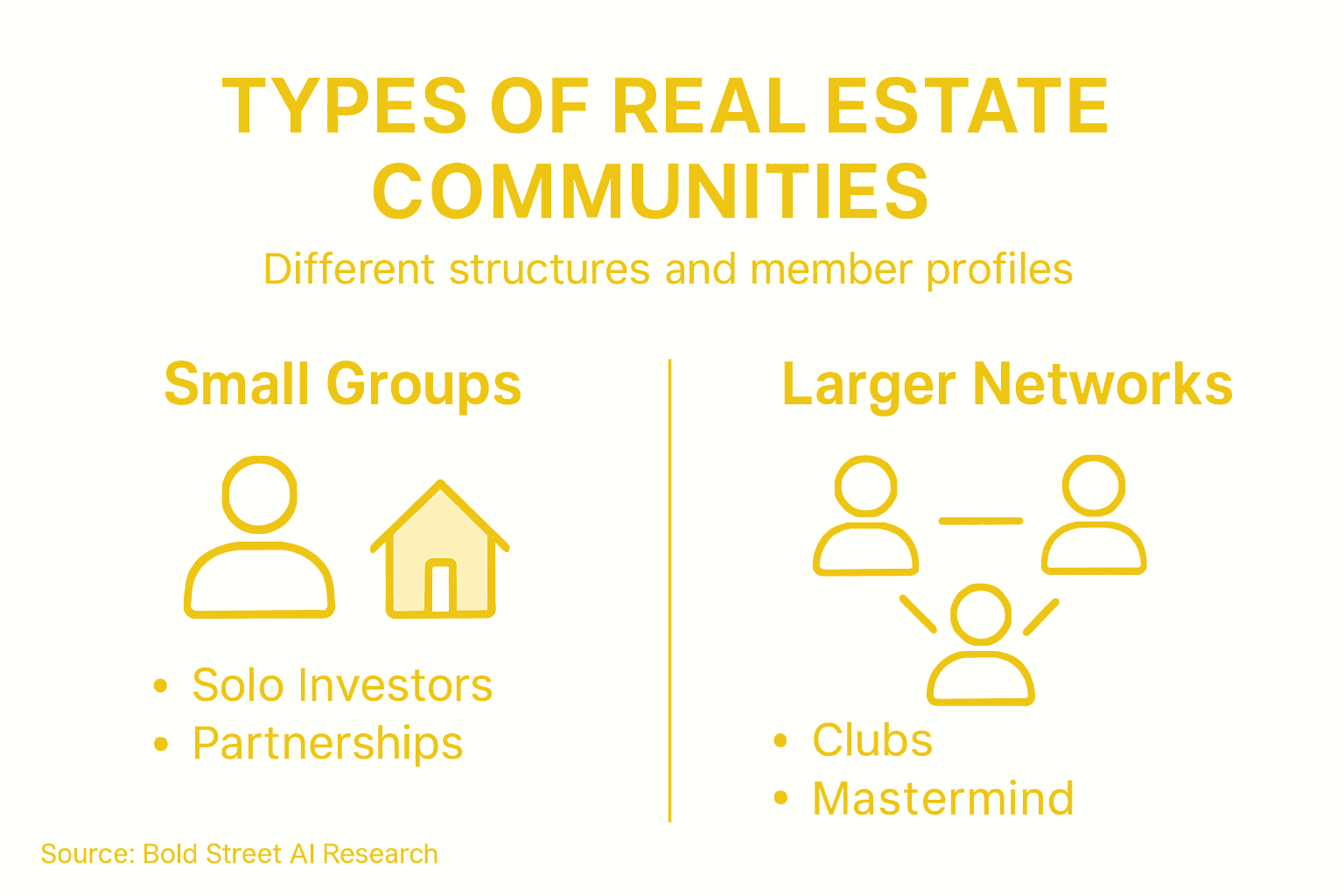
Solo Investors and Small Partnerships
At the smallest end are independent investors and informal partnerships. These are individuals or pairs buying one to five properties, often in their local market. They’re flexible, make decisions quickly, and avoid the complexity of formal agreements.
Small groups typically:
- Keep overhead low: No fancy office, no paid coordinators, minimal administrative costs.
- Move fast: One person decides; deals close quickly without committee meetings.
- Focus locally: Deep knowledge of neighborhoods, contractors, and local market trends.
- Share informally: Deals, resources, and advice flow through personal relationships.
This model works well for beginners who want autonomy but occasional mentorship from one trusted partner.
Here is a quick comparison of key real estate investor community types:
| Community Type | Typical Member Profile | Deal Access Style | Investment Focus |
|---|---|---|---|
| Local Meetup Group | Small-scale, local investors | In-person networking | Regional opportunities |
| Online Platform | All experience levels | Digital deal sharing | Nationwide or targeted |
| Formal Partnership | Serious, committed partners | Pooled decision-making | Joint property ownership |
| Investment Club | Dues-paying, learning-oriented | Group-vetted opportunities | Education + networking |
| Mastermind Group | Experienced, invite-only | Peer-to-peer advisement | Advanced strategies |
Real Estate Investment Clubs and Mastermind Groups
These are formal communities with membership dues, regular meetings, and structured education. Members pay $50 to $500 monthly for access to deal flow, speaker events, and networking.
Investment clubs provide:
- Vetted deal access: Members screen and present investment opportunities to the group.
- Educational content: Guest speakers covering financing, property management, and tax strategy.
- Accountability: Regular meetings keep members focused on their investing goals.
- Network density: You meet dozens of active investors monthly.
Mastermind groups are smaller, usually five to twelve members meeting weekly or monthly to solve specific challenges facing their portfolios.
Institutional and Larger Investor Networks
Institutional communities include Real Estate Investment Trusts (REITs), large property management companies, and corporate investment entities. These organizations manage hundreds or thousands of properties, often concentrated in major metropolitan areas.
Large-scale operations differ significantly from smaller communities because they:
- Leverage economies of scale: Bulk purchasing power on materials, labor, and financing.
- Employ specialists: Dedicated teams for acquisitions, property management, and legal compliance.
- Span multiple markets: Geographic diversification reduces local economic risk.
- Access institutional capital: Direct relationships with lenders offering better terms.
Online Platforms and Digital Communities
Internet-based investor networks connect thousands of members across states without geographic limitations. These range from free forums to premium platforms charging thousands annually.
Online communities excel at providing:
- 24/7 access: Ask questions and get responses anytime, not just at monthly meetings.
- Specialized subgroups: Find communities focused on house flipping, buy-and-hold, wholesaling, or specific states.
- Resource libraries: Contracts, calculators, market analysis tools, and recorded webinars.
- Global reach: Learn strategies from investors in different markets and economic conditions.
Choosing the Right Community Type
Different investor community types have distinct investment approaches, risk profiles, and management complexities. Your choice depends on your capital, experience, time availability, and investment style.
Beginners with limited capital benefit from local investment clubs where you learn before deploying serious money. Those with experience and capital might form formal partnerships or join online platforms offering curated deal flow.
Your ideal community matches your investment timeline, capital level, and geographic focus—not the biggest or most prestigious option available.
Pro tip: Visit three different community types before committing—sit in on a local meetup, attend an investment club meeting, and explore an online platform to see which environment actually engages you.
Key Benefits: Networking, Mentorship, Support
Joining a real estate investor community delivers three fundamental advantages that transform your investing journey: access to other investors, experienced guidance, and emotional support through challenging deals. These benefits compound over time, turning first-time investors into confident portfolio builders.
The power of community lies in what you cannot get alone. Real estate investor communities provide networking opportunities, mentorship from experienced investors, and access to pooled resources that would cost thousands to acquire independently.
The Networking Advantage
Your next deal might be sitting in a community member’s inbox right now. Networking in investor communities creates deal flow that never reaches public marketplaces. Off-market properties, wholesale deals, and distressed sales circulate through these networks first.
Beyond deals, networking connects you with critical relationships:
- Lenders and capital sources: Meet hard money lenders, private lenders, and portfolio lenders offering better terms than banks.
- Contractors and service providers: Access vetted professionals who give community members discounts and priority scheduling.
- Property managers: Find managers experienced in your target markets, reducing headaches before they start.
- Co-investment partners: Find capital partners to share deals, spreading risk and amplifying returns.
Each relationship reduces friction. Your third contractor bid becomes unnecessary when you trust someone recommended by five community members.
Mentorship From Investors Who’ve Been There
Mentorship accelerates learning years into months. Experienced investors in your community have already made mistakes you’re about to repeat. They know which neighborhoods appreciate, which don’t, and exactly why.
Real estate communities facilitate mentorship and peer learning, offering new investors support from seasoned professionals. This isn’t generic education—it’s specific guidance on your exact situation. You ask about financing your first property; someone shares what terms they secured last month.
Mentors provide:
- Deal evaluation: Run numbers past experienced investors before committing capital.
- Market wisdom: Learn neighborhood trends, seasonal patterns, and long-term appreciation potential.
- Mistake prevention: Avoid costly errors because mentors share their mishaps.
- Confidence building: Hearing success stories from people who started where you are transforms mindset.
The Psychological Support You Don’t Expect
Real estate investing isolates many people. You’re analyzing spreadsheets alone, making six-figure decisions, watching property values fluctuate. Doubt creeps in. Did I overpay? Will this tenant destroy the place? Is my market crashing?
Community solves isolation. You’re surrounded by people facing identical fears and challenges. That psychological support matters more than you’d think when you’re on your third sleepless night worrying about a property.
Communities provide:
- Accountability: Regular check-ins keep you executing plans instead of procrastinating.
- Shared problem-solving: When issues arise, you have twenty perspectives instead of zero.
- Celebration of wins: Your first rental is celebrated; your portfolio growth is acknowledged.
Real estate communities transform investing from a solitary pursuit into a shared mission where your success becomes everyone’s motivation.
Practical Support Mechanisms
Beyond mentorship and networking, communities provide concrete tools and resources. Access to contracts, property analysis spreadsheets, market reports, and legal templates saves thousands in professional fees during your first deals.
Member benefits typically include:
- Deal analysis tools: Calculators and templates for evaluating profitability quickly.
- Educational content: Webinars covering financing, tax strategy, and property management.
- Market data: Real-time information on comparable sales, rental rates, and investment trends.
- Legal resources: Template contracts and agreements reviewed by real estate attorneys.
Pro tip: Join a community and attend two meetings before your first deal—you’ll avoid at least one expensive mistake just from hearing others’ experiences.
How Communities Help Reduce Investment Risks
Investing in real estate alone means carrying all risk on your shoulders. One bad tenant, one market downturn, one regulatory change can derail your portfolio. Investor communities distribute this risk across multiple minds, experiences, and resources, making your investments safer and more resilient.
Risk reduction happens through collective intelligence. When you analyze deals alone, you miss patterns others spot immediately. When communities collectively manage property portfolios to improve resilience against market fluctuations and regulatory changes, they anticipate problems before individual investors encounter them.
Due Diligence Becomes Thorough
Due diligence transforms when shared across community members. Instead of checking three comparable sales, you access data from fifty recent transactions your network closed. Instead of guessing neighborhood trends, you hear directly from investors currently operating there.
Communities strengthen due diligence through:
- Shared property data: Access transaction histories, rental rates, and cost structures from community deals.
- Neighborhood intelligence: Learn which areas appreciate consistently versus those facing headwinds from members actively investing there.
- Market pattern recognition: Experienced investors spot cyclical trends new investors miss completely.
- Deal flow filtration: Communities pre-screen opportunities, eliminating obvious mistakes before wasting your time.
This collective scrutiny catches problems a solo investor’s spreadsheet misses entirely.
Risk Diversification Through Partnership
Partnering through communities lets you spread capital and risk. Instead of putting $100,000 into one property, you might deploy $25,000 across four properties with different partners. One underperforms; three succeed. Your portfolio remains stable.
Communities practice coordinated approaches to land use, housing, and economic investment, reducing risks from disjointed planning and market volatility. Diversification across properties, neighborhoods, and investor partners protects you from single-point failures.
Partnership models include:
- Joint ventures: Split deals, sharing capital requirements and reducing individual exposure.
- Co-investments: Pool capital for larger properties with lower per-person risk.
- Portfolio sharing: Know investors managing properties in markets you’re entering.
- Syndication access: Participate in larger deals previously unavailable to individual investors.
Learning From Others’ Mistakes
Every experienced investor has failed. They bought in declining neighborhoods, overpaid for properties, trusted unreliable contractors. These mistakes cost them tens of thousands. You learn those lessons for free in community.
When someone shares a costly mistake, you avoid repeating it. This accelerated learning reduces your failure rate dramatically. New investors typically make expensive errors on deals two through five; community members often avoid those mistakes entirely through mentor guidance.
Lessons typically cover:
- Property selection errors: Which neighborhoods declined, which appreciated unexpectedly.
- Financial miscalculations: Underestimating repairs, misforecasting rental rates, underpricing risk.
- Tenant screening failures: Red flags in applications, documentation to require upfront.
- Market timing: When to hold versus sell in different economic cycles.
Market Intelligence and Regulatory Awareness
Markets shift constantly. Zoning changes, rent control policies, tax incentives appear without warning. Staying informed alone requires constant research. Communities solve this through distributed monitoring.
One member discovers a zoning change affecting future development. Another learns about new tax depreciation rules. Someone else hears about changing lending standards. Information flows through the network immediately, protecting everyone’s interests.
Communities transform risk management from individual guesswork into collective vigilance—dozens of experienced investors monitoring threats you’d never spot alone.
Emotional Risk Management
Psychological stress amplifies risk-taking. Worried investors make poor decisions. Communities provide emotional support during challenging periods. Your first tenant stops paying rent; community members share solutions from their experiences. Property values dip; mentors remind you of longer-term appreciation cycles.
This psychological stabilization prevents panic selling or desperate decisions made under stress.
Pro tip: Before joining a community, ask about their risk assessment processes—specifically whether they discuss market cycles, due diligence standards, and how members evaluate deal quality together.
Comparing Communities to Going Solo
Solo investing works. Plenty of successful investors built portfolios entirely alone. But “works” doesn’t mean “optimal.” The real question isn’t whether you can succeed solo—it’s whether you want to fight harder to achieve the same results.
The difference comes down to resources, knowledge, and risk. Investing in real estate communities offers advantages over solo investing such as shared capital requirements, diversified portfolios, and collective market knowledge. Solo investors sacrifice speed, scale, and safety to maintain complete autonomy.
Capital Requirements and Deal Access
Solo investors need substantial capital upfront. Want to buy a $300,000 rental property? You need significant down payment funds plus reserves. Many quality deals remain out of reach without deep pockets.
Community investors deploy smaller amounts across multiple properties. A $50,000 contribution in a joint venture on a $300,000 property beats saving for years to buy alone. This capital multiplication matters enormously for beginners with limited funds.
Capital advantages include:
- Lower entry costs: Participate in deals with $25,000 to $50,000 versus $100,000 plus required solo.
- Faster deal participation: Access properties while solo investors are still saving.
- Portfolio acceleration: Build five properties through partnerships while saving for one alone.
- Larger property access: Participate in multi-million-dollar commercial conversions impossible alone.
Time to your first deal shrinks from years to months in communities.
This table highlights major benefits of joining a real estate investor community compared to solo investing:
| Benefit Category | Community Investing | Solo Investing |
|---|---|---|
| Capital Requirements | Lower per deal, pooled | High, self-funded |
| Learning Curve | Accelerated by mentorship | Slow, self-taught |
| Risk Exposure | Shared among members | Borne entirely alone |
| Network/Resources | Broad and diverse | Limited to self |
| Time to First Deal | Often shorter | Typically much longer |
Decision-Making Speed and Quality
Solo investors analyze deals alone. You review comparable sales, research neighborhoods, run projections. Then you second-guess everything. Did I miss something critical? Am I overpaying? This analysis paralysis delays decisions.
Community investors leverage collective expertise. Run numbers past five experienced members; one spots a market trend you missed. Another knows the contractor pricing for that neighborhood. A third closed a similar deal last month. Decisions happen faster because they’re informed by dozens of data points instead of one person’s research.
Real estate communities provide structured support and collaboration including access to mentorship and shared due diligence. This collaborative approach catches mistakes before you close deals, not after.
Time Investment and Workload
Solo investing demands constant work. You handle property hunting, contractor vetting, tenant screening, lease negotiation, maintenance coordination. Everything lands on your shoulders. Many solo investors work second jobs maintaining their properties.
Communities distribute workload. Partner handles property management; you focus on acquisitions. Someone manages contractor relationships; another handles tenant screening. Specialization means each person does what they do best.
Workload differences include:
- Time to first deal: Solo investors spend hundreds of hours; community members access vetted deals immediately.
- Ongoing management: Handle 10% of operational details through delegation and partnerships.
- Learning curve: Compress years of self-education into months of mentored learning.
- Emergency response: When issues arise, you have expert help—not just your own judgment.
Learning and Market Knowledge
Solo investors learn through expensive mistakes. Your first property teaches you what you should have known beforehand. Overpaid? The market tells you years later. Missed rent control changes? Now you’re navigating policy shifts blindly.
Community investors absorb lessons from others’ experiences. Someone shares their mistake; you avoid it entirely. Thirty years of collective experience becomes your knowledge base immediately. You’re not learning from personal failures—you’re learning from everyone else’s.
The Solo Investing Advantage
Full control. That’s the genuine benefit of solo investing. You make every decision. Properties align perfectly with your vision. No committees. No compromises. No partnership disputes.
For investors who value autonomy above all else, solo investing makes sense. But this control comes at costs: slower growth, higher risk, and dramatically more work.
Communities accelerate success by trading full autonomy for faster growth, lower risk, and genuine partnerships with experienced investors.
Making Your Choice
Beginners almost always benefit from community involvement. You have limited capital, thin experience, and scarce time. Communities solve all three problems. Experienced investors with substantial capital might eventually solo invest because they’ve accumulated knowledge and resources.
The Hybrid Approach
Many investors use both. They join communities for their first three to five deals, building knowledge and capital. Then they cherry-pick community investments while pursuing solo projects. This hybrid strategy combines community advantages early with eventual solo independence.
Pro tip: If you’re considering solo versus community investing, commit to community for your first two deals—experience both approaches with mentorship rather than learning expensive lessons alone.
Unlock the Power of Real Estate Communities with Bold Street AI
Many new investors face uncertainty when stepping into real estate investing alone. The article highlights common challenges such as finding trustworthy deal flow, gaining reliable mentorship, and managing risk through collective knowledge. If you want to avoid feeling isolated while accelerating your learning curve and building your portfolio with confidence then joining a real estate community is essential. Bold Street AI understands these pain points and offers a digital platform designed to connect you with curated investment opportunities, investor-friendly agents, lenders, and property managers all in one place.
Bold Street AI combines the best of community support and expert guidance with tools that simplify your investment process. By joining Bold Street AI you gain immediate access to:
- Curated deals suited for beginners and experienced investors alike
- An educational portal to build your skills through Bold Academy
- A supportive network for sharing insights and strategies
Start building your real estate journey today by exploring how Bold Street AI connects you with local professionals and financing options. Don’t wait until the huge risks of solo investing overwhelm you. Visit https://www.boldstreet.ai/ now and turn challenges into your competitive advantage through community and expert mentorship.
Frequently Asked Questions
What are the main benefits of joining a real estate investor community?
Joining a real estate investor community provides networking opportunities, mentorship from experienced investors, access to pooled resources, and emotional support during challenging deals, greatly enhancing your investing journey.
How do real estate investor communities help reduce investment risks?
Real estate investor communities reduce investment risks by pooling collective knowledge and experience, improving due diligence processes, allowing for risk diversification through partnerships, and enhancing market intelligence to anticipate potential challenges.
What types of real estate investor communities are available?
There are several types, including local meetup groups, online platforms, formal partnerships, investment clubs, and mastermind groups, each catering to different levels of experience and investment strategies.
How do I choose the right real estate investor community for my needs?
To choose the right community, consider your capital, experience level, and investment goals. Attend a few different types of meetings to see which environment aligns best with your approach to investing.
Recommended
- Role of Community in Real Estate Investing Success | Bold Street AI
- Why Build an Investor Network for Real Estate Success | Bold Street AI
- How to Build Investor Network for Real Estate Success | Bold Street AI
- Why Use Investor Networks for Real Estate Success | Bold Street AI
- Collectieve zonnepanelen: Samen investeren in zonnestroom – Holland Electric Duurzaam