
Stepping into residential real estate investing can feel overwhelming if you are not sure where to start. Each decision, from outlining your goals to researching local opportunities, affects your potential for success and risk. If you skip key preparation steps or rely only on instinct, you may lose both money and confidence before you gain momentum.
This guide delivers practical, step-by-step insights backed by professional research and industry experience. You will discover how defining clear investment goals and creating a budget forms the foundation of intelligent investing. These focused strategies will teach you how to research markets, assemble a strong support team, and evaluate properties with precision.
Get ready for actionable steps that can transform confusion into clarity. By following what is ahead, you are set to learn exactly what it takes to make smart moves and avoid the common mistakes that trip up first-time investors.
Table of Contents
- 1. Define Your Investment Goals And Budget
- 2. Research Local Real Estate Markets
- 3. Build A Reliable Investment Team
- 4. Analyze Potential Properties Carefully
- 5. Understand Financing And Loan Options
- 6. Perform Thorough Due Diligence
- 7. Plan For Ongoing Property Management
Quick Overview
| Key Message | Explanation |
|---|---|
| 1. Define Investment Goals Clearly | Establish your financial objectives before searching for properties to ensure strategic alignment in your investments. |
| 2. Conduct Local Market Research | Understand the specific dynamics of your target neighborhoods to make informed, strategic investment decisions. |
| 3. Assemble a Skilled Investment Team | Collaborate with professionals like agents and accountants to maximize your investment success and mitigate risks. |
| 4. Analyze Properties Using Data | Maintain a numbers-driven approach for evaluating properties; prioritize rigorous analysis over emotional attachment to avoid losses. |
| 5. Plan for Ongoing Management | Prepare for property management responsibilities and set aside financial reserves to ensure smooth operations post-purchase. |
1. Define Your Investment Goals and Budget
Before you look at a single property listing, you need to answer a fundamental question: why are you investing in real estate? Your answer shapes everything that comes next.
Are you building long term wealth through rental income? Seeking quick profits through fix and flip projects? Looking for a stable alternative to stock market investments? Each goal requires a different strategy, property type, and financial commitment. Without clarity here, you’ll waste time chasing opportunities that don’t align with your actual objectives.
Defining clear investment goals and a budget forms the foundation for all subsequent decisions. Research shows that understanding your investment goals helps align your finances with realistic market expectations and your personal risk tolerance. When you know exactly what success looks like for you, evaluating properties becomes infinitely easier.
Your budget is equally critical. This isn’t just about how much money you have sitting in a savings account. Calculate your total investable capital including down payment savings, available credit lines, and potential partnerships. Factor in closing costs, which typically run 2-5 percent of the purchase price, plus reserves for repairs and vacancies if you’re buying a rental property. Many first time investors overlook these hidden expenses and find themselves financially stretched before closing day.
Consider your personal circumstances too. How much monthly cash flow do you need from your investment? Can you handle property management responsibilities, or do you need to budget for a property manager’s fees? Are you comfortable with hands on work, or do you prefer passive income? These practical questions directly impact your budget and property selection.
Think about your time horizon as well. Real estate isn’t a get rich quick vehicle. Most successful investors plan to hold properties for at least 5 to 10 years, allowing appreciation and loan paydown to build meaningful wealth. If you need liquidity sooner, real estate might not be your best option.
Pro tip: Create a written investment profile documenting your primary goal, total budget, monthly cash flow needs, and target property type, then review it quarterly as your financial situation evolves.
2. Research Local Real Estate Markets
You can’t succeed in real estate by thinking nationally. Markets are hyper local, and what works in one neighborhood can completely fail just five miles away.
Market research is where smart investors separate themselves from those who get burned. When you understand the specific dynamics of your target area, you identify where prices are climbing, where renters are abundant, and where economic headwinds threaten values. This knowledge transforms you from a random property buyer into a strategic investor.
Start by examining local economic indicators including employment, income trends, and industry concentrations. Is the area’s primary employer stable, or does it face disruption? Are jobs being created or disappearing? Communities with diverse economic bases weather downturns better than those dependent on single industries. If your target market relies on one major factory that’s rumored to be relocating, that’s a red flag worth investigating.
Population trends matter tremendously. Are young families moving into the area or leaving for greener pastures? Is the school system improving or declining? Are there new businesses opening downtown? These patterns reveal whether your market is experiencing growth or stagnation. Growing markets typically appreciate faster and attract more renters.
Historical price data gives you crucial context. The Federal Housing Finance Agency provides detailed house price information across metropolitan areas and states, allowing you to spot trends over months and years. Seeing that prices rose 8 percent annually for the past five years tells you something completely different than watching prices stagnate or decline.
Don’t overlook inventory levels and days on market. How many homes are currently listed? How long does a typical home sit before selling? Low inventory with quick sales suggests a seller’s market where appreciation is likely. High inventory with homes sitting for months suggests prices may soften. Both situations can work for investors, but they require different strategies.
Connect with local real estate professionals who work in the market daily. Investor friendly agents understand cash flow dynamics and recognize emerging opportunities before they become obvious. They provide ground level insight that no data set can replicate.
Pro tip: Track your target market’s data quarterly for at least six months before buying to identify real trends rather than temporary fluctuations.
3. Build a Reliable Investment Team
You cannot succeed in real estate alone. The most successful investors surround themselves with knowledgeable professionals who handle the details while they focus on strategy.
Think of your investment team as your safety net and your accelerator all at once. These professionals protect you from costly mistakes and unlock opportunities you’d never spot yourself. A great team transforms a risky venture into a calculated investment.
Start with a real estate agent who understands investor needs. Not all agents grasp the difference between owner occupant purchases and investment properties. You need someone familiar with how to build investor partnerships and experienced with cash on cash returns, cap rates, and rental income analysis. An investor-friendly agent knows where deals cluster and which neighborhoods attract quality tenants.
A competent accountant or tax professional is non-negotiable. They help structure deals to maximize tax efficiency, track deductions you’d otherwise miss, and ensure compliance with regulations. The difference between a good accountant and an average one often equals thousands of dollars saved annually.
You need a real estate attorney who specializes in residential investing. They review contracts, ensure proper entity structuring, and protect you from legal landmines. Local attorneys understand state and local regulations that amateurs overlook. Their hourly fees seem expensive until they save you from a lawsuit.
Consider adding a property manager early, even before you own multiple properties. Professional managers handle tenant screening, rent collection, maintenance coordination, and evictions. They cost around 8 to 12 percent of monthly rent but free you from daily operational headaches and often improve profitability through professional operations.
A home inspector and contractor complete your core team. Having trusted professionals who evaluate property conditions honestly prevents you from overpaying for problematic properties. Strong relationships with contractors matter tremendously when renovation costs can make or break deal economics.
Assembling a knowledgeable and trustworthy investment team in finance, legal, tax, and property management sectors maximizes returns and mitigates risks through collaborative expertise. Invest time in finding the right people now, and your entire investing journey becomes smoother.
Pro tip: Interview at least three candidates for each key role and check their references specifically from other investors, not just general clients.
4. Analyze Potential Properties Carefully
This is where emotions must take a backseat to numbers. A property might look perfect, but the numbers tell the real story about whether it will actually make you money.
Proper analysis separates profitable deals from money losing disasters. Many first time investors fall in love with a house and convince themselves the numbers work. Then they buy, and reality arrives in the form of negative cash flow and sleepless nights. Rigorous analysis prevents this painful cycle.
Start with the physical condition. Hire a professional home inspector who understands investment properties. Major systems like roofing, HVAC, plumbing, and electrical need honest assessment. Deferred maintenance costs real money. A foundation crack might require a ten thousand dollar repair that kills your deal economics. Don’t skip this step hoping problems don’t exist.
Location matters as much as the structure itself. Evaluate neighborhood trends, school quality, crime rates, and nearby employment centers. Is the area improving or declining? Are new developments happening? Analyze location factors and neighborhood attributes that impact long term value and tenant demand.
Run the numbers ruthlessly. Calculate potential rental income based on comparable properties in the area. Subtract all realistic expenses including mortgage, property taxes, insurance, maintenance, vacancies, and property management fees. What remains is your actual cash flow. If numbers are tight now, they’ll be disastrous later.
Analyze how properties fit your investment strategy through feasibility studies and market research to ensure alignment with your goals. Does this property achieve your return targets? Does it match your investment timeline?
Check legal and title issues carefully. Your attorney should review the title report for liens, easements, or restrictions that could complicate ownership. Zoning should match your intended use. If you plan to rent it out, verify the property complies with local rental regulations.
Compare this deal to other available options in your market. What else is for sale? Are you getting a fair price, or are you overpaying due to emotion? Multiple comparative analysis prevents tunnel vision.
Pro tip: Create a simple spreadsheet template for analyzing properties so you evaluate every deal using identical metrics, making comparison straightforward.
5. Understand Financing and Loan Options
Financing is the engine that powers your real estate investing. Understanding your loan options determines not just whether you can afford a property, but how profitable it will actually be.
Most real estate investors cannot pay cash for every property. Leverage allows you to control assets worth far more than your actual cash investment. A down payment of 25 percent on a 300,000 dollar property means you control a 300,000 dollar asset with only 75,000 dollars of your own money. But leverage cuts both ways, amplifying gains and losses alike.
Conventional mortgages remain the most common financing path. Banks require a minimum down payment, typically 15 to 25 percent for investment properties, plus proof of income and strong credit. Interest rates depend on your credit score, down payment size, and current market conditions. Conventional loans offer stability but require stronger personal finances than some alternatives.
FHA loans are designed for owner occupants and typically require only 3.5 percent down, but you cannot use them for investment properties unless you plan to occupy one unit in a multi-unit property. VA loans offer favorable terms for military veterans. Portfolio lenders, also called bank portfolio lenders, keep loans on their own books rather than selling them, sometimes offering flexibility for investors with less than perfect credit.
Understand essential financing concepts including loan terms, interest rates, and underwriting standards to navigate your options securely. Hard money loans and private money lenders provide faster funding for fix and flip projects but charge higher rates and fees. Cash out refinancing lets you extract equity from properties you already own to fund additional investments.
Calculate your total cost of borrowing, not just the monthly payment. A lower rate saves thousands over a 30 year loan. Even a half percent difference compounds dramatically. Get pre-approval before house hunting so you know your actual buying power. Pre-approval also signals to sellers that you are a serious buyer.
Compare various financing methods and their impact on investment returns to maximize your wealth building strategy. Different loan types work better for different goals. Fix and flips need speed, so hard money might make sense. Buy and hold rentals benefit from long term conventional financing with locked in rates.
Pro tip: Shop rates with at least three different lenders before committing, as rates vary significantly and you could save thousands by comparing offers.
6. Perform Thorough Due Diligence
Due diligence is your final safety check before committing hundreds of thousands of dollars to a property purchase. This is where you verify that everything you believe about the property is actually true.
Think of due diligence as your inspection period insurance policy. You have a limited window to uncover problems that would kill the deal or tank your returns. Once you close, you own those problems. No inspector found the foundation crack? That is now your 15,000 dollar repair. The city discovers the rental use violates zoning? You just became an illegal landlord.
Start with title verification. Your attorney reviews the entire chain of ownership to ensure the seller actually owns the property and can transfer it to you. Title searches reveal liens, judgments, or other claims against the property that you would inherit upon purchase. Title insurance protects you from certain title defects, but you need to identify problems before closing.
Legal and regulatory compliance requires checking zoning laws, local rental ordinances, and building codes. Can you legally rent this property? Are there homeowner association restrictions that limit your use? Does the property meet current building codes? Some jurisdictions restrict the number of unrelated occupants, short term rentals, or have specific landlord licensing requirements.
Physical inspections go beyond the standard home inspection. Environmental testing checks for lead paint, mold, radon, and soil contamination. Septic system inspections matter if the property has one. Survey work confirms boundary lines and identifies encroachments. Comprehensive due diligence covering legal, financial, and physical inspections uncovers risks and validates property value before acquisition.
Financial due diligence means reviewing rent rolls if you are buying a multi-unit property, verifying utility costs, and validating insurance rates. Ask the seller for three years of property tax records and any homeowner association documents. Check whether the property has any code violations or pending assessments that you would inherit.
Environmental factors deserve special attention. Properties near industrial sites, airports, or flood zones carry specific risks. Run a Phase I environmental assessment for older properties or those with potential contamination histories. Flood insurance requirements add ongoing costs you must factor into your analysis.
Pro tip: Use your inspection period strategically by ordering all inspections immediately upon contract signing so you have maximum time to research findings and negotiate repairs or credits.
7. Plan for Ongoing Property Management
Closing day is not the finish line. It is the starting line. The real work of property management begins after you own the property, and how you manage it determines your actual returns.
Many new investors focus exclusively on the purchase and ignore the operational reality of ownership. They dream about appreciation while neglecting the tenant who stops paying rent, the roof that leaks at 2 AM, or the property tax bill that arrives each quarter. Smart investors plan for these realities before closing.
Your first decision is whether to self manage or hire a professional property manager. Self management saves the 8 to 12 percent fee but demands your time and expertise. You handle tenant calls at midnight, coordinate repairs, manage evictions, and handle accounting. For a single family home or duplex you own locally, self management is feasible. For multiple properties or distant investments, professional management becomes invaluable.
A quality property manager handles tenant screening, rent collection, maintenance coordination, and legal compliance. They know local tenant rights laws, required disclosures, and eviction procedures. They conduct regular inspections to catch problems early when repairs cost less. They handle the emotional labor of difficult conversations with problem tenants.
Proactive maintenance is cheaper than reactive repairs. Schedule HVAC maintenance annually, roof inspections every few years, and plumbing evaluations when you notice issues. Keep detailed records of all work performed. This documentation protects you during disputes and helps you justify rent increases when the time comes.
Budget for maintenance reserves. Experts recommend setting aside 10 percent of monthly rental income for unexpected repairs. A water heater fails. The furnace breaks. The roof develops a leak. These events happen, and having reserves prevents them from becoming financial catastrophes.
Understand operational efficiency and tenant relations strategies that optimize property profitability and preserve asset value. Track all expenses, maintain clear financial records, and monitor your actual returns against projections. If numbers fall short, investigate why and adjust your strategy.
Tenant retention matters. A quality tenant who pays on time is worth accommodating when reasonable requests arise. The cost of turnover, including vacancy time, cleaning, repairs, and marketing for new tenants, often exceeds the cost of keeping a good tenant happy.
Pro tip: Establish systems and documentation from day one, using property management software to track expenses, maintenance schedules, and tenant communications, which simplifies accounting and protects you if disputes arise.
Below is a table summarizing the critical stages and actionable strategies for succeeding in real estate investing as outlined in the article.
| Key Area | Strategies and Actions | Benefits and Outcomes |
|---|---|---|
| Define Investment Goals and Budget | Identify your objectives, calculate total funds, and evaluate your financial situation and time horizon. | Ensures alignment with personal goals and prepares for strategically selected investments. |
| Research Local Real Estate Markets | Assess economic indicators, population trends, historical price data, and inventory levels. Engage with local experts. | Enables informed decisions by understanding market dynamics and trends. |
| Build a Reliable Investment Team | Partner with professionals such as real estate agents, accountants, attorneys, and contractors. | Access to expert guidance and reduced risks during investment and operation stages. |
| Analyze Potential Properties Carefully | Evaluate physical condition, location trends, legal compliance, and financial feasibility. | Prevents investments in properties that don’t meet profitability and align with goals. |
| Understand Financing and Loan Options | Explore mortgage types, evaluate total borrowing costs, and shop for competitive rates. | Optimizes financing strategies and affordability. |
| Perform Thorough Due Diligence | Verify title and legal compliance, complete property inspections, and review financial details. | Mitigates risks and confirms accurate investment assessments. |
| Plan for Ongoing Property Management | Decide between self-management or hiring a property manager and budget for maintenance. | Ensures smooth operations, optimal tenant relations, and financial performance. |
This table provides an overview of the key principles, practical steps, and anticipated outcomes associated with developing a structured real estate investing approach.
Simplify Your Residential Investing Journey with Expert Support
Investing in residential real estate can feel overwhelming from defining your goals to analyzing properties and managing finances. This article highlights key challenges such as building a reliable investment team, understanding financing options, and performing thorough due diligence. If you want to avoid costly mistakes and make confident decisions based on clear strategies like cash flow analysis and market research, you need a trusted partner by your side.
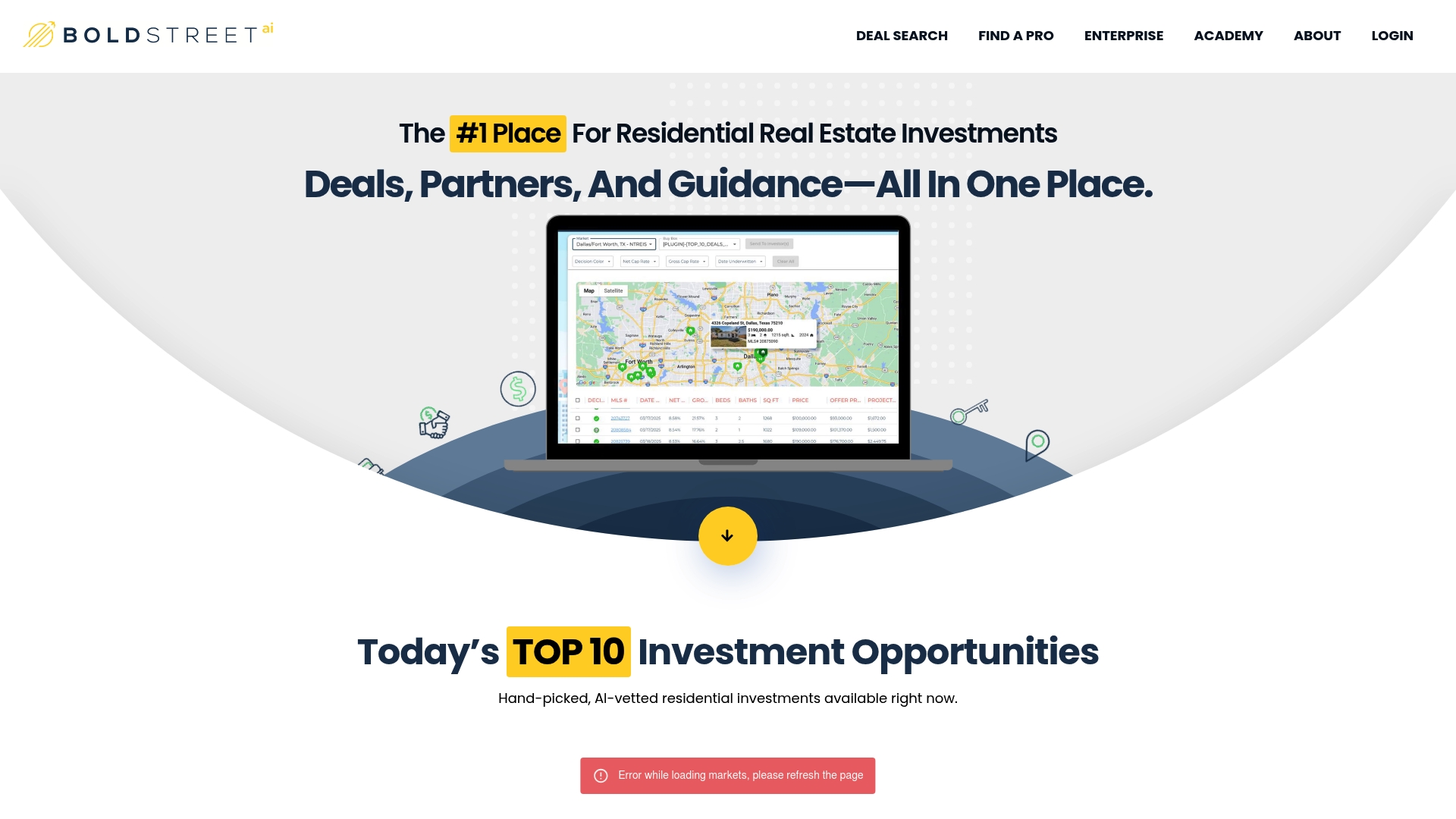
Discover how Bold Street AI empowers you to navigate all seven essential steps with ease. Connect with investor-friendly agents, lenders, and property managers right where you invest. Access expert guidance through our educational portal, Bold Academy, designed to help beginners master real estate terminology and strategies. Join a community that shares success stories and insights to keep you motivated every step of the way. Take control of your real estate portfolio today and turn challenges into opportunities by visiting Bold Street AI.
Frequently Asked Questions
What should I include in my residential investing checklist?
To create a comprehensive residential investing checklist, include key steps like defining your investment goals, researching local markets, building an investment team, analyzing properties, understanding financing options, performing due diligence, and planning for ongoing property management. Start by documenting each step clearly to guide your investment decisions.
How can I determine my investment goals for real estate?
To determine your investment goals, reflect on why you want to invest—whether for long-term wealth, quick profits, or rental income. Write down your primary goal and how it influences your budget and property choices.
What are the signs of a strong local real estate market?
Strong local real estate markets typically show indicators like increasing employment rates, population growth, and short days on market for properties. Research these factors in your target area to spot where prices are likely to appreciate.
How do I analyze potential investment properties?
To analyze potential investment properties, perform a thorough assessment of the physical condition, location dynamics, and financial metrics like rental income versus expenses. Use a structured approach, such as a spreadsheet template, to compare different properties consistently.
What should I consider when deciding between self-managing or hiring a property manager?
Consider your time availability, expertise, and the scale of your property portfolio when deciding. If managing one or two properties, you might handle it yourself; however, for multiple properties, hiring a professional manager could save you significant time and stress.
How do I perform thorough due diligence before buying a property?
Perform thorough due diligence by verifying the title, checking local zoning laws, conducting physical inspections, and reviewing financial records related to the property. Carry out these checks promptly after signing a contract to ensure you have the necessary information to make informed decisions.
Recommended
- 7 Key Examples of Residential Investment Strategies | Bold Street AI
- Why Invest in Residential Property: Building Wealth and Security | Bold Street AI
- Step by Step Real Estate Investing for Beginners | Bold Street AI
- Residential Real Estate Investing: Building Wealth in the U.S. | Bold Street AI
- Estate Agents San Pedro – Luxury Villas and Apartments for Sale | Marbellapads